

By Vincent Howard, CPA | Managing Partner, Howard, Howard and Hodges | SkillAbility for Accounting Firms
Last updated: September 9, 2026 | 44-minute read
- What going concern training should produce
- What is current in ASC 205-40 in 2026
- The look-forward period: issuance date, not year-end
- Where going-concern judgment concentrates
- The CONCERN READY framework
- Going concern vs. liquidation basis
- Conditions and events that can raise substantial doubt
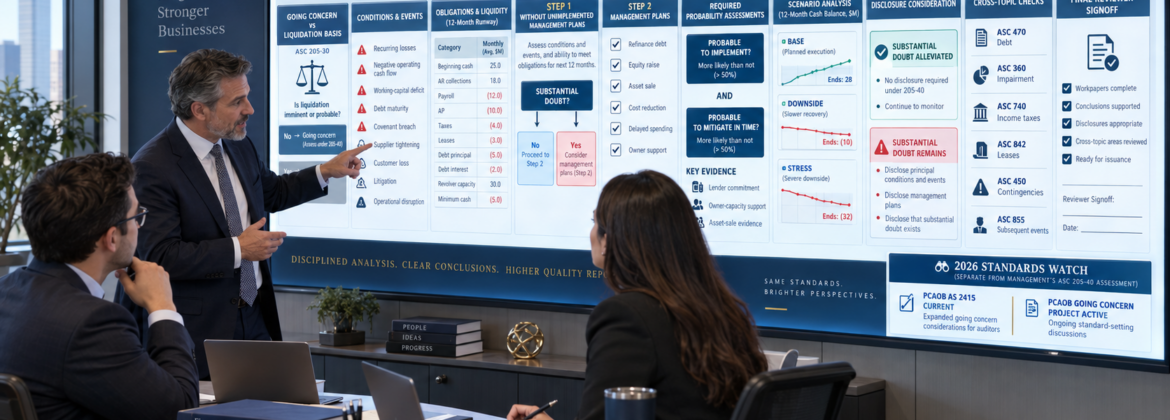
- Step 1: evaluate without unimplemented management plans
- Build the obligations-and-liquidity model
- Step 2: evaluate management’s plans
- Evidence by plan type
- Forecast, scenario, and sensitivity discipline
- Debt maturities, covenants, waivers, and refinancing
- Owner and third-party financial support
- Disclosure decision tree
- Management conclusion vs. auditor conclusion
- Cross-topic accounting consequences
- Worked ASC 205-40 example
- Quarterly going-concern workflow
- Self-review checklist
- 100-point readiness scorecard
- 30/60/90-day development plan
- 15 realistic training scenarios
- What CPA firms should measure
- Frequently asked questions
What Is Going Concern Training for Accountants?
Going concern training develops an accountant’s ability to identify adverse conditions, build a supportable liquidity assessment, evaluate whether substantial doubt exists under ASC 205-40, test management’s mitigating plans, and prepare the resulting financial-statement disclosures.
ASC 205-40 is fundamentally a forward-looking accounting judgment. It requires management to evaluate at each annual and interim reporting date whether conditions and events, considered in the aggregate, raise substantial doubt about the entity’s ability to continue as a going concern within the required look-forward period.
Substantial doubt exists when the conditions and events indicate that it is probable the entity will be unable to meet its obligations as they become due within that period.
The word probable matters. So does the phrase as they become due.
An entity can forecast positive annual EBITDA and still face a going-concern problem if a term loan matures in six months, cash bottoms out before seasonal sales improve, suppliers shorten terms, a revolver is unavailable because of borrowing-base restrictions, a covenant violation makes debt callable, or management’s equity raise is still only an intention.
This guide connects directly to SkillAbility’s Budgeting and Forecasting Training for Accountants, Debt Accounting Training for Staff Accountants, Statement of Cash Flows Training for Staff Accountants, Asset Impairment Training for Staff Accountants, and Workpaper Review Checklist.
Why Going Concern Is a Judgment-Development Topic
I have practiced public accounting since 1990, founded my accounting firm in 1993, and helped grow Howard, Howard and Hodges from three people to approximately 50 staff. Since 2020, I have built SkillAbility around a recurring workforce-development problem: accountants are often trained to produce historical financial statements but not to connect those statements to the obligations and cash demands coming next.
Going concern forces that transition. A staff accountant can prepare a perfect bank reconciliation and still miss that the company has only four months of payroll runway, $2.8 million of debt matures before the forecasted turnaround, the refinancing assumption depends on a lender that has not issued a commitment, sales grow 30% in a model completed after the largest customer left, or a support letter is included without evidence the owner can actually fund it.
What Is Current in ASC 205-40 in 2026?
KPMG’s latest comprehensive U.S. going-concern handbook is dated December 2025 and remains current in 2026. It applies to all entities and focuses specifically on management’s assessment and disclosures.
| 2026 Point | Training Implication |
|---|---|
| ASC 205-40 remains the management accounting model | Assess at every annual and interim reporting date. |
| Assessment horizon extends one year after issuance | Do not stop at the next fiscal year-end or 12 months after the balance-sheet date. |
| Step 1 excludes mitigating plans not fully implemented | Do not let an expected refinancing, cost reduction, equity raise, or asset sale suppress the initial substantial-doubt assessment. |
| Step 2 uses a two-part probability test | A plan must be probable to be effectively implemented and probable to mitigate the conditions/events. |
| Disclosure can be required even when doubt is alleviated | “We solved it” does not automatically eliminate the note. |
| PCAOB AS 2415 remains effective | Keep auditor evaluation/reporting separate from management’s ASC 205-40 conclusion. |
| PCAOB has an active Going Concern project | Monitor possible revisions; do not treat a project objective as adopted guidance. |
The Look-Forward Period: One Year After Issuance, Not One Year After Year-End
For an entity whose financial statements are issued, management evaluates whether substantial doubt exists within one year after the financial statements are issued. For entities whose financial statements are not formally issued, the applicable endpoint can be one year after the statements are available to be issued.
Assume a December 31, 2026 year-end and a March 15, 2027 issuance date.
That means the liquidity model must cover approximately 14½ months after the balance-sheet date, not merely January through December 2027.
| Date | Why It Matters |
|---|---|
| December 31, 2026 | Financial statement date |
| January–March 2027 | Close, forecast, debt, covenant and subsequent-event work |
| March 15, 2027 | Illustrative issuance date |
| March 15, 2028 | ASC 205-40 look-forward endpoint |
Chart: Where Going-Concern Judgment Concentrates
SkillAbility training heat map—not a FASB, AICPA, or PCAOB risk ranking.
The CONCERN READY Framework
| Stage | Staff Question | Review Evidence |
|---|---|---|
| C — Confirm basis, reporting date & horizon | Is going-concern accounting appropriate, and what exact date ends the ASC 205-40 assessment? | Assessment timeline memo |
| O — Observe adverse conditions & events | What financial, financing, internal, external, legal, operational, or market facts exist? | Condition/event register |
| N — Net obligations against existing liquidity | Can obligations be met as due using liquidity available without unimplemented plans? | Obligations/liquidity schedule |
| C — Conclude whether substantial doubt is raised | Considering conditions/events in aggregate, is inability to meet obligations as due probable? | Step-1 conclusion |
| E — Evaluate management’s mitigating plans | Which plans directly address the shortfall or adverse condition? | Plan register |
| R — Require probable implementation & mitigation | Is each critical plan both probable to be implemented and probable to work in time? | Plan evidence matrix |
| N — Navigate debt, covenants, support & asset sales | Are lender rights, refinancing, support letters, sale restrictions and timing supportable? | Financing/support analysis |
| R — Reforecast scenarios & sensitivities | Which assumptions control minimum cash, and what happens when they move? | Base/downside model |
| E — Explain the disclosure outcome | Was substantial doubt raised, alleviated, or not alleviated? | Disclosure decision memo |
| A — Align cross-topic accounting | Do debt, impairment, tax, leases, contingencies and subsequent events reflect the same facts? | Cross-topic checklist |
| D — Document the reviewer trail | Can another accountant reperform the conclusion? | Signed review package |
| Y — Year-round liquidity ownership | Are runway, covenants, maturities, forecasts and emerging risks monitored before quarter-end? | Going-concern control calendar |
C — Going Concern Basis vs. Liquidation Basis
ASC 205-40 addresses uncertainty while the entity is still preparing financial statements on the going-concern basis. ASC 205-30 addresses a different question: whether liquidation is imminent and the liquidation basis of accounting should apply.
Going Concern Uncertainty
Entity continues using going-concern accounting while management evaluates substantial doubt and disclosures.
Liquidation Basis
When liquidation is imminent under the applicable guidance, measurement and presentation move to a separate liquidation-basis model.
A company can have severe liquidity problems and still use going-concern accounting. A company also does not adopt liquidation basis merely because it has recurring losses, current debt, tight cash, or a strategic-alternatives process.
O — Conditions and Events That Can Raise Substantial Doubt
ASC 205-40 does not provide one mechanical ratio. Management considers adverse conditions and events in the aggregate.
Negative financial trends
- recurring operating losses,
- working-capital deficiencies,
- negative operating cash flows,
- deteriorating liquidity ratios,
- shrinking gross margins,
- rapid cash burn.
Other indications of financial difficulty
- loan default or covenant violation,
- dividend arrearage,
- supplier denial of normal trade credit,
- need to restructure debt to avoid default,
- failure to meet statutory capital requirements,
- need to seek new financing or dispose of substantial assets.
Internal matters
- work stoppage or labor disruption,
- dependence on a major project,
- uneconomic long-term commitments,
- need to significantly revise operations,
- loss of key personnel or failure of a critical product initiative.
External matters
- material litigation or regulatory action,
- loss of a franchise, license, patent or permit,
- loss of a principal customer or supplier,
- uninsured or underinsured catastrophe,
- tariff, trade, geopolitical or credit-market disruption.
N + C — Step 1: Evaluate Substantial Doubt Before Unimplemented Management Plans
ASC 205-40’s two-step structure is designed to prevent optimism from hiding the underlying problem.
When answering Step 1, management does not take into account the mitigating effect of plans that have not been fully implemented as of the issuance date. Examples include planned equity raises, refinancing, new borrowing, debt restructuring, asset sales, facility closures, headcount reductions, and delayed capital expenditures.
These plans are not irrelevant. They belong in Step 2 after management has identified honestly whether substantial doubt is raised without them.
Actions fully implemented by issuance are different. Completed financing, completed asset sales, and implemented cost actions become part of the actual facts available at Step 1.
N — Build the Obligations-and-Liquidity Model
The going-concern workpaper should start with when cash is required, not with a generic annual budget.
Obligations to map
- accounts payable, payroll and payroll taxes,
- income and other taxes,
- lease payments,
- term-loan principal, revolver payments and interest,
- vendor and minimum purchase commitments,
- capital expenditure commitments,
- insurance premiums, litigation or settlement payments,
- other contractual and operational cash requirements.
Existing liquidity
- cash and cash equivalents,
- collections from existing receivables supported by realistic DSO,
- operating cash inflows supported by current business facts,
- committed and available borrowing capacity,
- unrestricted liquid investments,
- other liquidity already available under enforceable terms.
Borrowing availability is not the revolver face amount
Then evaluate covenant compliance and lender rights.
Monthly is usually more useful than annual
| Month | Ending Cash Before Plans | Major Event |
|---|---|---|
| Month 1 | $1.4M | Normal operations |
| Month 3 | $900K | Tax payment |
| Month 5 | $350K | Seasonal inventory build |
| Month 6 | ($1.6M) | $2M debt maturity |
| Month 12 | $200K | Year-end forecast positive |
E + R — Step 2: Evaluate Management’s Plans
If Step 1 indicates that substantial doubt is raised, management evaluates plans intended to mitigate those conditions and events.
Both tests must be met. Implementation analysis considers approval, controllability, third-party dependencies, execution history, documentation and timing. Mitigation analysis asks how much cash is produced or preserved, when it becomes available, and whether it actually covers the liquidity gap.
If the company needs $3 million by June 1, a probable $5 million asset sale closing in September does not solve the June shortfall. Timing is part of mitigation.
Management Plan Evidence Matrix
| Management Plan | Evidence of Implementation | Evidence It Mitigates | Common Weak Support |
|---|---|---|---|
| Refinance / new debt | Executed commitment, advanced underwriting, collateral support | Proceeds and closing date cover maturity / gap | “Bank has supported us before” |
| Equity raise | Approved raise, committed investor, funding ability | Net proceeds arrive before cash deficit | Pitch deck or management intent |
| Asset sale | Approval, broker/credible buyers, no blocking restrictions | Net cash after payoff/tax/costs arrives in time | Book value as expected proceeds |
| Cost reductions | Approved actions, notices, vendor/facility actions | Savings net of severance/exit costs arrive before shortfall | Flat percentage savings plug |
| Owner / affiliate support | Specific commitment and evidence of intent/ability | Amount/timing bridge actual need | Support letter with no capacity analysis |
R — Forecast, Scenario, and Sensitivity Discipline
A going-concern forecast is not credible because the spreadsheet calculates correctly. Its assumptions must connect to evidence.
Start from actual, reconciled cash, receivables, inventory, payables, debt, payroll/tax accruals, lease obligations and other significant cash commitments. Then use the disciplines in Budgeting and Forecasting Training for Accountants to connect future cash to operational drivers.
Challenge revenue and working capital
Support revenue with backlog, contracts, pipeline conversion history, pricing, customer retention and capacity. Support working capital with DSO, inventory days, supplier terms, customer deposits and historical conversion.
Challenge historical bias
Compare prior forecasts with actual results. Repeated optimism in revenue, margins, collections, financing timing or cost reductions is evidence relevant to current assumptions.
Build downside scenarios and break points
N — Debt Maturities, Covenants, Waivers, and Refinancing
Going concern and debt accounting intersect constantly. Debt Accounting Training for Staff Accountants covers ASC 470 classification, covenants, waivers, modifications and lender reconciliation. The going-concern file uses those conclusions to assess liquidity.
Build a maturity ladder containing contractual maturity, amortization, balloon payment, interest, covenant test dates, springing maturities, cross-defaults, borrowing-base requirements, waiver expiration and refinancing assumptions.
Refinancing assumptions require third-party evidence such as commitments, approvals, term sheets plus advanced diligence, lender correspondence, collateral support and compliance with conditions precedent.
N — Owner and Third-Party Financial Support
Closely held entities often rely on an owner, parent, affiliate or related party. That can be a valid plan. It still requires evidence.
- Does the supporting party intend or have an enforceable obligation to provide support?
- Does the supporting party have the financial ability to provide the required support when needed?
A support letter can address intent. It does not automatically prove capacity. Capacity evidence can include cash, liquid investments, borrowing availability, financial statements, net worth, other commitments, legal restrictions, amount and duration.
Also avoid double counting the same liquidity or collateral across the entity and supporting party.
E — ASC 205-40 Disclosure Decision Tree
| Outcome | ASC 205-40 Result | Core Disclosure Content |
|---|---|---|
| No substantial doubt raised in Step 1 | No ASC 205-40 going-concern disclosure required solely by this guidance | Other GAAP disclosures may still apply |
| Substantial doubt raised, then alleviated | Going-concern disclosure required | Principal conditions/events; management evaluation; plans that alleviated doubt |
| Substantial doubt raised and not alleviated | Enhanced going-concern disclosure required | Conditions/events; management evaluation; mitigation plans; explicit substantial-doubt statement |
Alleviated does not mean undisclosed. Once Step 2 is required and plans alleviate the doubt, disclosure remains required. When plans do not alleviate the doubt, the note should expressly state that substantial doubt exists.
Management’s ASC 205-40 Conclusion Is Not the Auditor’s Report
Management is responsible for the financial-reporting assessment and disclosures. Auditors have separate responsibilities under the standards applicable to the engagement.
For PCAOB audits, AS 2415 remains the current going-concern auditing standard in 2026. It directs auditors to evaluate conditions/events, management plans, financial-statement effects, reporting, documentation and audit-committee communication. AS 2415 describes the auditor’s reasonable period as not exceeding one year beyond the date of the financial statements being audited.
That differs from management’s ASC 205-40 look-forward period, which extends one year after issuance.
The PCAOB currently has an active Going Concern project considering how AS 2415 should be revised. That project is relevant standards monitoring, not an adopted replacement.
For AICPA audits, AU-C 570 addresses the auditor’s separate responsibilities and recognizes financial-reporting frameworks such as FASB ASC that explicitly require a management evaluation.
A — Cross-Topic Accounting Consequences
A going-concern issue rarely stays inside one footnote.
Debt — ASC 470
Liquidity stress can expose current classification, covenant violations, waivers, grace periods, refinancing, modifications and extinguishments.
Asset impairment — ASC 360 / ASC 350
Operating losses, closures, customer losses or financing stress may also be impairment indicators. See Asset Impairment Training for Staff Accountants.
Statement of cash flows — ASC 230
Historical cash flows reveal cash burn, working-capital conversion, financing dependence and capital spending. See Statement of Cash Flows Training.
Deferred taxes, leases, contingencies and subsequent events
Going-concern facts can affect ASC 740 valuation-allowance evidence, ASC 842 restructuring/impairment, ASC 450 litigation, and ASC 855 information through issuance—including completed or failed financing, customer loss, asset sale, covenant breach or bankruptcy filing.
Worked ASC 205-40 Example: Substantial Doubt Raised, Then Alleviated
Assume Beacon Components, Inc. has a December 31, 2026 year-end and expects to issue financial statements on March 15, 2027. Management’s assessment extends through March 15, 2028.
Conditions and events
- December 31 cash: $1.2 million
- 2026 operating cash outflow: $2.0 million
- $3.0 million term loan matures July 31, 2027
- Customer representing 18% of revenue lost in January 2027
- Supplier terms tighten from net 45 to net 20
- Base forecast before unimplemented plans shows minimum cash of negative $2.4 million in July 2027
Management cannot give credit in Step 1 to a planned refinancing or equity raise that is not fully implemented.
Management plans
Plan A: refinance the $3.0 million term loan with a new $4.5 million facility. Plan B: reduce operating expenses by $900,000 annually through an approved restructuring.
Plan A evidence
- credit committee approval,
- executed lender commitment dated February 20, 2027,
- closing scheduled March 30,
- conditions precedent substantially completed,
- new maturity beyond the assessment period,
- $1.5 million incremental liquidity after payoff.
Plan B evidence
- board-approved restructuring,
- employee notices completed before issuance,
- vendor contracts terminated or renegotiated,
- $250,000 severance/exit cash before savings,
- net savings begin April 2027.
| Scenario | Minimum Cash | Result |
|---|---|---|
| Before management plans | ($2.4M) | Substantial doubt raised |
| Base case with probable plans | $1.0M | Obligations met |
| Downside: revenue 8% below base | $350K | Obligations still met, limited cushion |
| Stress: refinance delayed beyond July maturity | ($2.8M) | Timing is critical |
Assume management concludes the financing and restructuring are probable to be implemented and probable to mitigate the liquidity conditions in time.
Beacon still discloses the principal conditions/events, management’s evaluation and the plans that alleviated substantial doubt. If the lender had provided only a nonbinding indication of interest with material underwriting incomplete, management might be unable to support probable implementation; substantial doubt could remain.
Quarterly Going-Concern Workflow
| Timing | Primary Activities |
|---|---|
| Month-end / weekly treasury | Monitor cash, revolver availability, collections, AP, payroll, debt, covenants and minimum cash. |
| Quarter close | Refresh conditions/events, maturity ladder, forecast, support, customer/vendor concentration and legal/regulatory matters. |
| Step 1 | Assess conditions/events and obligations without unimplemented plans. |
| Step 2 if required | Evaluate plan approval, dependencies, probability, magnitude, timing and forecast impact. |
| Scenario review | Run downside sensitivities, minimum-cash analysis, covenant projections and break-point tests. |
| Issuance-date refresh | Update new financing, failed plans, actual results, litigation, customer changes, covenant status and other information through issuance. |
| Reviewer signoff | Conclude substantial doubt status, disclosure outcome and consistency with the financial statements. |
Build one controlled going-concern register
Suggested fields include reporting period; expected issuance date; assessment end date; going-concern versus liquidation-basis conclusion; condition/event; date identified; source; cash impact; timing; debt maturity; covenant test date/status; supplier/customer changes; existing liquidity source and restrictions; minimum cash before plans; Step-1 conclusion; management plan; approval date; third-party dependency; implementation evidence; probability conclusion; mitigation amount/timing; downside scenario; minimum cash after plans; Step-2 conclusion; disclosure category; cross-topic flags; reviewer.
ASC 205-40 Self-Review Checklist Before Manager Review
- Did I identify whether going-concern accounting is appropriate and flag possible ASC 205-30 liquidation-basis issues?
- Did I identify the financial statement date and expected issuance/available-to-be-issued date?
- Did I calculate the assessment endpoint one year after that date and make the forecast reach it?
- Did I refresh the assessment for the current annual or interim period using information through issuance?
- Did I identify recurring losses, negative operating cash flow, working-capital deficits and deteriorating liquidity?
- Did I identify defaults, covenant violations, future test dates and debt maturities?
- Did I identify supplier-credit changes, statutory capital issues, financing needs and substantial asset-sale needs?
- Did I identify labor, project dependence, uneconomic commitments and major operational restructuring needs?
- Did I identify litigation, regulatory issues, lost licenses, major customer/supplier losses and catastrophes?
- Did I evaluate conditions/events in the aggregate?
- Did I reconcile starting cash, debt, payables and accrued obligations to source records?
- Did I identify payroll, taxes, leases, debt principal/interest, capex, purchase commitments and other cash requirements?
- Did I calculate actual revolver availability after outstanding draws, letters of credit, borrowing base and restrictions?
- Did I use a forecast interval fine enough to identify liquidity troughs?
- Did I identify minimum cash rather than only ending cash?
- Did I avoid treating annual EBITDA as proof of liquidity?
- Did I perform Step 1 before giving credit to unimplemented plans?
- Did I exclude unimplemented refinancing, equity raises, asset sales and cost reductions from Step 1?
- Did I conclude whether inability to meet obligations as due is probable?
- If substantial doubt was raised, did I identify management’s specific mitigating plans?
- Did I identify who approved each plan and third-party dependencies?
- Did I evaluate probability of implementation separately from probability of mitigation?
- Did I compare plan amount and timing with the actual liquidity gap?
- For asset sales, did I use expected net proceeds after restrictions, payoff, tax and costs rather than book value?
- For refinancing, did I retain lender evidence and identify conditions precedent?
- For new debt, did I model new interest and covenant requirements?
- For equity financing, did I evaluate investor commitment and funding ability?
- For cost reductions, did I model severance/exit costs and actual savings timing?
- For owner support, did I evaluate both intent and capacity?
- Did I avoid double counting support or collateral?
- Did I reconcile forecast revenue, margin, payroll and working capital to operating drivers?
- Did I compare prior forecasts with actual results and identify historical bias?
- Did I prepare a meaningful downside scenario and identify the break point?
- Did I project covenant compliance through the assessment period?
- Did I update the forecast with actual results through issuance?
- Did I determine whether plans alleviate substantial doubt?
- If doubt is alleviated, did I still prepare the required disclosure?
- If doubt remains, did I include the explicit substantial-doubt statement?
- Did I describe principal conditions/events, management’s evaluation and relevant plans clearly?
- Did I coordinate debt, impairment, deferred taxes, leases, contingencies, subsequent events and cash flows?
- Did I distinguish management’s ASC 205-40 conclusion from the auditor’s reporting conclusion?
- Did I avoid using the PCAOB auditor horizon as management’s GAAP horizon?
- Can another accountant reperform the assessment from source evidence through the full one-year-after-issuance period?
100-Point Going Concern Readiness Scorecard
| Capability | Points | Observable Evidence |
|---|---|---|
| Basis / issuance date / horizon | 9 | Correct one-year-after-issuance endpoint and liquidation-basis escalation |
| Condition & event completeness | 12 | Financial, financing, operational, legal and external risks captured |
| Obligations / liquidity / timing | 16 | Runway ties obligations to available liquidity and minimum cash |
| Step-1 substantial-doubt judgment | 10 | Unimplemented plans excluded and aggregate conclusion supported |
| Management-plan probability | 15 | Implementation and mitigation assessed separately |
| Forecast / scenario / sensitivity quality | 14 | Driver support, forecast accuracy, downside cases and break points |
| Debt / support / third-party evidence | 9 | Maturities, covenants, lender evidence and owner capacity |
| Disclosure / cross-topic accounting | 10 | Correct alleviated/not-alleviated note and consistent accounting |
| Documentation / reviewer trail | 5 | Conclusion is reproducible through issuance |
Suggested readiness bands
- 90–100: Ready to own recurring going-concern workstreams with normal manager/technical review.
- 82–89: Generally review-ready; targeted coaching remains in plan probability, financing evidence or downside modeling.
- 72–81: Controlled ownership with checkpoints before substantial-doubt and disclosure conclusions.
- Below 72: Continue structured ASC 205-40 practice.
Override the numerical score for knowingly omitting a debt maturity, hiding a forecasted cash deficit, counting uncommitted financing as existing liquidity in Step 1, fabricating plan evidence, manipulating forecast assumptions solely to avoid substantial doubt, unsupported owner support, or intentionally weakening required disclosure.
A 30/60/90-Day Going Concern Training Plan
| Period | Development Goal | Practice | Evidence |
|---|---|---|---|
| Days 1–30 | Own horizon, triggers and liquidity | Issuance-date horizon, conditions/events, maturities, minimum cash | Five clean Step-1 packages |
| Days 31–60 | Own management-plan evaluation | Refinancing, asset sales, cost cuts, equity raises, support, probability evidence | Review-ready plan-evidence matrix and reforecast |
| Days 61–90 | Own disclosure and cross-topic judgment | Alleviated vs remains, debt/impairment/subsequent events, auditor distinction | Observed reviewer-ready judgment |
15 Realistic Going Concern Training Scenarios
1. Positive annual cash, negative Month 6
Staff identifies the intra-year liquidity shortfall and does not accept positive year-end cash as proof obligations can be met as due.
2. Twelve-month forecast ends at next year-end
Staff extends it through one year after the expected issuance date.
3. Management plans a refinancing but has no lender term sheet
Staff excludes it from Step 1 and challenges whether Step-2 probable implementation is supportable.
4. Refinancing commitment signed before issuance
Staff evaluates conditions precedent, closing risk, timing and sufficiency.
5. Owner signs a support letter
Staff separately tests the owner’s ability to fund the commitment.
6. Company plans to sell a building
Staff checks approval, restrictions, marketability, net proceeds and timing rather than using book value.
7. Cost reduction plan saves $1.5M annually
Staff models severance, implementation timing and monthly savings.
8. Year-end covenant is waived
Staff evaluates future compliance, maturity and liquidity rather than concluding the waiver solved going concern.
9. Largest customer terminates after year-end
Staff updates the issuance-date assessment and forecast.
10. Recurring losses but $25M cash and no material maturities
Staff evaluates aggregate facts rather than assuming losses automatically equal substantial doubt.
11. Positive earnings but $15M debt due in six months
Staff recognizes that profitability does not resolve maturity liquidity.
12. Plans alleviate substantial doubt
Staff still prepares the required ASC 205-40 disclosure.
13. Plans do not alleviate substantial doubt
Staff includes the explicit substantial-doubt statement.
14. Owners vote to liquidate the company
Staff escalates ASC 205-30 liquidation-basis applicability.
15. Auditor’s AS 2415 horizon is copied into management’s workpaper
Staff corrects the management assessment to the ASC 205-40 issuance-date horizon.
What CPA Firms Should Measure
| Metric | What It Reveals |
|---|---|
| Assessment periods truncated by reviewer | ASC 205-40 horizon competence |
| Debt maturities first identified at review | Obligation-population completeness |
| Uncommitted financing included in Step 1 | Two-step model discipline |
| Plans rejected for weak evidence | Probability-analysis quality |
| Forecast assumptions reset by reviewer | Forecast bias/evidence quality |
| Minimum-cash deficits found late | Liquidity-timing competence |
| Owner support not capacity-tested | Third-party evidence quality |
| Disclosure outcome changed by reviewer | ASC 205-40 conclusion quality |
| Manager reconstruction hours | Whether staff own the assessment architecture |
Connect these measures to the Staff Accountant Competency Checklist, Workpaper Review Checklist, and Accounting Employee Development Plan.
Common Going Concern Training Mistakes
Mistake 1: Use 12 months after year-end
The model ends too early.
Mistake 2: Start with refinancing
Step 1 is contaminated by a Step-2 plan.
Mistake 3: Analyze triggers one at a time
Aggregate risk is missed.
Mistake 4: Use full-year EBITDA as liquidity proof
Obligations may mature before profit turns into cash.
Mistake 5: Use revolver face amount as liquidity
Draws, LCs, borrowing bases and covenants are ignored.
Mistake 6: Test only whether a plan can happen
ASC 205-40 also requires probable mitigation.
Mistake 7: Count owner support from a letter alone
Intent is confused with capacity.
Mistake 8: Skip disclosure because plans alleviate doubt
Disclosure remains required once substantial doubt was raised.
Mistake 9: Treat substantial doubt as automatic liquidation basis
ASC 205-30 is separate.
Mistake 10: Let the auditor build management’s assessment
Management’s GAAP responsibility is displaced.
How SkillAbility Builds Going Concern Capability
BASE — Horizon, conditions, and liquidity
- ASC 205-40 scope
- issuance-date horizon
- condition/event identification
- obligation mapping
- cash runway
- minimum-cash analysis
- Step-1 conclusion
MAPS — Management plans and forecast judgment
- refinancing evidence
- asset sales
- cost reductions
- equity raises
- owner support
- driver-based forecast challenge
- downside scenarios
- covenant projections
SUMMIT — Reviewer and reporting readiness
- probable implementation
- probable mitigation
- complex debt/liquidity structures
- liquidation-basis escalation
- cross-topic impairment/tax/lease issues
- ASC 205-40 disclosure review
- auditor-standard distinction
- coaching staff without rebuilding the model
Frequently Asked Questions About Going Concern Training
What is ASC 205-40?
ASC 205-40 is the U.S. GAAP guidance requiring management to evaluate an entity’s ability to continue as a going concern and provide disclosures when conditions and events raise substantial doubt.
How often must management perform a going-concern assessment?
Management performs the assessment in connection with each annual and interim reporting period.
How long is the ASC 205-40 look-forward period?
Management evaluates conditions and events within one year after the financial statements are issued, or one year after they are available to be issued when that concept applies.
Is the going-concern period 12 months from the balance-sheet date?
No. Under ASC 205-40, the period generally extends one year beyond issuance.
What does substantial doubt mean?
Substantial doubt exists when conditions and events, considered in aggregate, indicate it is probable the entity will be unable to meet obligations as they become due during the required assessment period.
Does management consider refinancing plans in Step 1?
Not if the mitigating plan has not been fully implemented by issuance. Unimplemented plans are evaluated in Step 2.
What are the two tests for management plans?
It must be probable the plan will be effectively implemented and probable that the implemented plan will mitigate the conditions/events within the assessment period.
Can a signed lender term sheet alleviate substantial doubt?
Possibly, but not automatically. Management evaluates implementation probability, conditions precedent, proceeds, timing and whether the plan actually cures the liquidity problem.
Can owner support alleviate substantial doubt?
It can when the support plan satisfies the probability requirements. The work should address both intent and financial ability.
Does recurring loss automatically create substantial doubt?
No. Recurring losses are an adverse condition, but conditions, obligations and liquidity are considered in aggregate.
Can a profitable company have substantial doubt?
Yes. Profitability does not guarantee liquidity when major obligations mature before cash is available.
Does a covenant waiver automatically solve going concern?
No. Management still evaluates future tests, maturities, borrowing availability and liquidity through the full period.
What disclosure is required when plans alleviate substantial doubt?
Disclose the principal conditions/events, management’s evaluation of their significance and the plans that alleviated the doubt.
Must the note say “substantial doubt” if plans alleviate it?
Not necessarily. The disclosure objective may be met without explicitly saying substantial doubt was raised when qualifying plans alleviate it.
What disclosure is required when substantial doubt remains?
The note includes the principal conditions/events, management’s evaluation, mitigation plans and an explicit substantial-doubt statement.
Does substantial doubt mean liquidation-basis accounting is required?
No. ASC 205-40 and ASC 205-30 are separate models.
What is the difference between ASC 205-40 and PCAOB AS 2415?
ASC 205-40 establishes management’s accounting assessment/disclosures. AS 2415 establishes auditor responsibilities for PCAOB audits.
Is PCAOB AS 2415 still current in 2026?
Yes. The PCAOB also has an active project considering revisions, but the project has not replaced AS 2415.
What forecast is best for going concern?
The model should be detailed enough to reveal when obligations are due and when liquidity bottoms out; monthly is often useful, and more frequent modeling may be needed for highly stressed entities.
How do you know when an accountant is review-ready for ASC 205-40?
Review-ready accountants can establish the horizon, identify conditions, build the obligation/liquidity model, separate Steps 1 and 2, test management plans, challenge forecasts, determine disclosure and document a conclusion another accountant can reperform.
Current Research and Authority Resources
- KPMG — Going Concern Handbook, December 2025
- Deloitte DART — Going Concern Assessment
- Deloitte — 2026 Financial Reporting Alert
- PCAOB — AS 2415
- PCAOB — Going Concern Project
- AICPA — Currently Effective SASs
- AICPA — AU-C 570
- Google Search Central — AI Features and Your Website
- Google Search Central — Optimizing for Generative AI Features
Going concern can intersect with ASC 205-30 liquidation basis, ASC 470 debt, ASC 360/350 impairment, ASC 740 taxes, ASC 842 leases, ASC 450 contingencies, ASC 855 subsequent events, ASC 230 cash flows, financing agreements, legal rights, audit standards, SEC reporting, lender requirements, restructuring plans and insolvency law. Verify current authoritative guidance and entity-specific facts for live work.
The Bottom Line
Going concern training should not produce accountants who know only how to add a footnote after the auditor raises the issue. It should produce professionals who can build and defend the assessment before the disclosure is written.
Start with the issuance-date horizon.
Separate going concern from liquidation basis.
Identify conditions broadly and evaluate them in aggregate.
Map obligations by due date and use actual available liquidity.
Keep Step 1 free of unimplemented management plans.
Require both probable implementation and probable mitigation in Step 2.
Challenge management plans with evidence.
Model minimum cash, not merely annual profit.
Use downside cases to expose fragile assumptions.
Disclose when substantial doubt was raised even if plans alleviate it.
Use the explicit substantial-doubt statement when plans do not alleviate the doubt.
Keep management’s ASC 205-40 conclusion separate from auditor reporting.
Make debt, impairment, tax, lease, contingency and subsequent-event accounting tell the same story.
That is CONCERN READY.
Protect Knowledge. Develop People. Scale the Firm.
Can Your Accountants Defend the Cash Runway—or Does the Going-Concern Issue Appear at Audit Review?
SkillAbility helps accounting firms develop accountants who can move from conditions and obligations through liquidity, substantial doubt, management plans, scenarios, disclosure, and reviewer-ready ASC 205-40 documentation.
Book Your Free 10-Minute Structural Alignment Review →
Includes our 45-Day Out-of-Pocket Performance Guarantee.
To accountants who can prove the runway before review has to reconstruct it,
Vincent Howard, CPA
Managing Partner, Howard, Howard and Hodges
SkillAbility for Accounting Firms
About the Author
Vincent Howard, CPA has practiced public accounting since 1990. He earned a Bachelor of Science in Accounting and a Master’s in Taxation from the University of Central Florida, founded his accounting firm in 1993, and serves as Managing Partner of Howard, Howard and Hodges. He helped grow the organization from three people to approximately 50 staff across multiple Florida locations and states. He has participated in PASBA since 1997, and the firm was named PASBA Firm of the Year in 2015. Through SkillAbility, he helps accounting firms convert technical accounting knowledge into structured staff development and review-ready work.
How This Guide Was Developed
This guide combines Vincent Howard’s public-accounting and workforce-development experience with KPMG’s December 2025 Going Concern Handbook, current ASC 205-40 application guidance, Deloitte’s going-concern assessment guidance and 2026 financial-reporting updates, PCAOB AS 2415 and the PCAOB’s active Going Concern project, current AICPA AU-C 570 resources, and SkillAbility’s debt, cash-flow, budgeting/forecasting, impairment, workpaper-review and reviewer-development frameworks. CONCERN READY and the 100-point readiness scorecard are original SkillAbility teaching frameworks designed to make going-concern judgment observable, evidence-based and reviewable.
© 2026 SkillAbility for Accounting Firms. This article provides general educational information and does not replace client-specific U.S. GAAP, audit, legal, tax, financing, restructuring, valuation, SEC, lender, insolvency, or financial-reporting advice.