

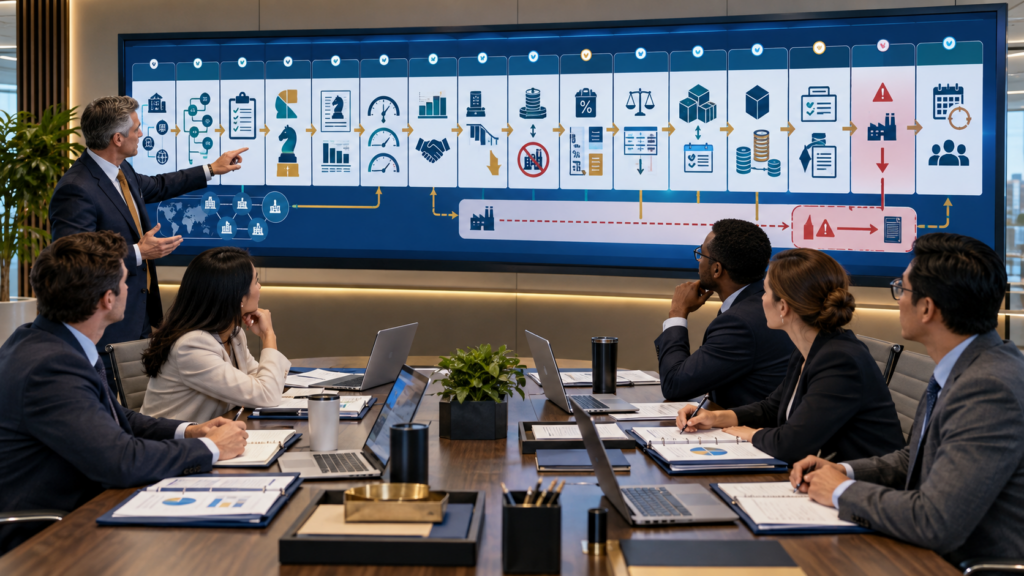
By Vincent Howard, CPA | Managing Partner, Howard, Howard and Hodges | SkillAbility for Accounting Firms
Last updated: September 10, 2026 | 44-minute read
- What discontinued-operations training should produce
- What is current in 2026
- Where ASC 205-20 judgment concentrates
- The STRATEGIC READY framework
- What is a component of an entity?
- Held for sale, sold, or otherwise disposed of
- Strategic shift and major-effect test
- Why the percentages are examples—not bright lines
- Newly acquired business held for sale
- Continuing involvement after disposal
- Income-statement presentation
- Direct costs, overhead, interest, and taxes
- Balance-sheet presentation
- Statement of cash flows
- Prior-period recasting and later adjustments
- Significant disposals that do not qualify
- Worked classification and presentation example
- Quarter-end disposal close workflow
- Self-review checklist
- 100-point readiness scorecard
- 30/60/90-day development plan
- 15 realistic staff scenarios
- What CPA firms should measure
- Frequently asked questions
What Is Discontinued Operations Training?
Discontinued operations training develops an accountant’s ability to determine when a disposal belongs below continuing operations as a separately presented discontinued operation, build the related presentation and disclosures, and preserve comparability across all periods presented.
The key mistake is treating the conclusion as synonymous with selling a business.
A component can meet ASC 360’s held-for-sale criteria and still remain in continuing operations if its disposal does not represent a strategic shift that has or will have a major effect on the entity’s operations and financial results.
Conversely, a qualifying discontinued operation can arise through:
- sale,
- abandonment,
- distribution to owners in a spin-off,
- other qualifying disposal methods,
- certain newly acquired businesses or nonprofit activities classified as held for sale upon acquisition.
That is why the accounting decision has multiple layers:
- Do the operations and cash flows constitute a component of the entity?
- Has that component been classified as held for sale, sold, or otherwise disposed of?
- Does the disposal represent a strategic shift?
- Will that strategic shift have a major effect on operations and financial results?
- What results, assets, liabilities, cash flows, taxes, and disposal gains/losses belong in discontinued operations?
- How are prior periods recast?
- What continuing involvement and retained exposure must be disclosed?
This guide builds directly on SkillAbility’s Asset Impairment Training for Staff Accountants, Business Combination Accounting Training for Staff Accountants, Equity Method Accounting Training for Staff Accountants, Goodwill Impairment Training for Accountants, Statement of Cash Flows Training for Staff Accountants, and Workpaper Review Checklist.
Why ASC 205-20 Is a Staff-Development Topic
I have practiced public accounting since 1990, founded my accounting firm in 1993, and helped grow Howard, Howard and Hodges from three people to approximately 50 staff. Since 2020, I have built SkillAbility around a recurring workforce-development problem: staff are often asked to “reclass the divested business to discontinued ops” after management and the reviewer have already made the actual accounting judgments.
That produces technicians who can move rows in Excel but cannot answer:
- Why is this unit a component?
- What makes the sale strategic?
- What makes the effect major?
- Why did a 12% revenue disposal qualify while another 18% revenue disposal did not?
- Why are allocated corporate costs staying in continuing operations?
- Why was some interest reclassified and other interest left behind?
- Why does continuing involvement not automatically kill discontinued-operations reporting?
- Why are comparative periods recast?
- Why is the held-for-sale loss inside discontinued operations but not allocated to individual major classes of assets and liabilities for presentation?
- Why does a significant nonqualifying disposal still require separate disclosure?
A staff accountant who cannot answer those questions does not yet own the conclusion.
What Is Current in ASC 205-20 in 2026?
The current model remains rooted in the narrowed discontinued-operations framework introduced by ASU 2014-08.
KPMG’s May 2026 handbook is the latest in-depth 2026 reference located for ASC 205-20 and held-for-sale disposal groups under ASC 360-10. KPMG emphasizes that the current definition intentionally excludes routine disposal transactions that do not change the entity’s strategy while retaining extensive disclosures for significant disposals.
Deloitte’s November 2025 Roadmap remains a current comprehensive source covering ASC 360-10 impairments/disposals and ASC 205-20 discontinued operations.
| Current 2026 Point | Training Implication |
|---|---|
| Latest KPMG handbook: May 2026 | Current implementation focus remains component identification, held-for-sale/disposal status, strategic-shift testing, presentation, disclosure, and disposal-group measurement. |
| Current ASC 205-20 model remains intentionally narrow | Routine disposals should not be pushed below continuing operations merely because they are large or separately managed. |
| Held-for-sale accounting and discontinued-operations presentation remain separate | ASC 360 drives disposal-group measurement; ASC 205-20 decides whether results are separately presented as discontinued operations. |
| No numeric bright line defines “major” | Use ASC examples as evidence, not mechanical thresholds. |
| Continuing involvement does not automatically preclude classification | Evaluate whether continued supply, distribution, guarantees, options, or retained equity interests undermine the strategic-shift conclusion and disclose significant involvement. |
| Google’s 2026 AI-search guidance reinforces normal SEO fundamentals | Use unique expert-led analysis, structured visible content, internal links, helpful images, and accurate schema rather than artificial AEO/GEO tactics. |
Chart: Where Discontinued-Operations Judgment Concentrates
SkillAbility training heat map—not a FASB, SEC, or audit risk ranking. Actual complexity depends on disposal method, asset mix, legal structure, segment reporting, retained interests, intercompany activity, financing, taxes, transition services, shared assets, and public-company reporting.
The STRATEGIC READY Framework
| Stage | Staff Question | Review Evidence |
|---|---|---|
| S — Scope the disposal population | What business, geography, subsidiary, investment, product line, or asset group is being exited? | Disposal intake memo |
| T — Trace the component | Are operations and cash flows clearly distinguishable operationally and for reporting? | Component map |
| R — Route held-for-sale, sold, or other disposal status | Has the component reached the ASC 205-20 gateway? | Status/date analysis |
| A — Assess the strategic shift | Does this disposal change how management intends to run the business? | Strategy evidence |
| T — Test the major effect | How significant is the disposal to revenue, assets, income, cash flows, geography, products, customers, and strategy? | Quant/qual matrix |
| E — Evaluate continuing involvement | What supply, service, financing, guarantee, repurchase, or retained-investment relationships survive disposal? | Continuing-involvement memo |
| G — Gather direct results & disposal effects | Which revenues, direct costs, gains, losses, and measurement effects belong to the component? | Pretax P&L bridge |
| I — Isolate interest, shared costs & overhead | What interest must or may be allocated, and which indirect costs stay in continuing operations? | Cost-allocation memo |
| C — Calculate tax & discontinued-operations line | What tax expense/benefit and disposal gain/loss produce the net-of-tax result? | Tax bridge / face presentation |
| R — Recast comparative periods | Have all prior income-statement periods been reclassified consistently? | Comparative recast |
| E — Expose assets, liabilities & cash flows | Are major balance-sheet classes and cash-flow information presented or disclosed correctly? | Balance sheet / cash-flow bridge |
| A — Add required disclosures | Do facts, timing, segment, major line items, continuing involvement, and adjustments tell the full story? | ASC 205-20 checklist |
| D — Document nonqualifying significant disposals | If the disposal fails ASC 205-20, does ASC 360 still require prominent disclosure? | Continuing-ops disclosure memo |
| Y — Year-round disposal ownership | Are strategy decisions, board approvals, broker activity, buyer negotiations, closures, spin-offs, and retained relationships monitored before quarter-end? | Disposal control calendar |
T — What Is a Component of an Entity?
ASC 205-20 defines a component by the ability to distinguish its operations and cash flows from the rest of the entity, both operationally and for financial reporting purposes.
A component can be:
- a reportable segment,
- an operating segment,
- a reporting unit,
- a subsidiary,
- an asset group,
- a group of components.
Legal form is not decisive.
A separately incorporated subsidiary might be a component.
A product line that is not a separate legal entity might also be a component.
Financial information must be available or obtainable
Staff should be able to identify:
- revenue,
- direct cost of sales,
- direct payroll,
- direct depreciation/amortization,
- direct operating expenses,
- associated assets and liabilities,
- cash flows,
- disposal effects.
The presence of some shared systems or retained working capital does not automatically mean no component exists.
But if the proposed “component” can only be created through arbitrary allocations that do not reflect distinguishable operations and cash flows, the conclusion becomes weaker.
Component vs. disposal group
A component is an operational/financial-reporting concept.
A disposal group is the collection of assets and liabilities expected to be disposed of together in one transaction.
One component can include multiple disposal groups.
A disposal group can also include assets or liabilities that are not part of the discontinued component, which becomes important when preparing balance-sheet reconciliations.
Disposal Group = Assets & Liabilities Disposed of Together
R — Held for Sale, Sold, or Otherwise Disposed Of
A component cannot be presented as a discontinued operation merely because management is discussing a sale.
For the general component model, the ASC 205-20 presentation gateway is reached when the component:
- meets the held-for-sale criteria,
- has been disposed of by sale, or
- has been disposed of other than by sale, such as abandonment or distribution to owners.
Held-for-sale criteria
For disposal groups within ASC 360, the core held-for-sale criteria include:
- management with authority commits to a plan to sell,
- the disposal group is available for immediate sale in its present condition,
- an active buyer-search program has begun,
- sale is probable,
- completion generally is expected within one year, subject to limited exceptions,
- the group is actively marketed at a reasonable price relative to fair value,
- actions indicate significant plan changes or withdrawal are unlikely.
See Asset Impairment Training for Staff Accountants for the complete ASC 360 held-for-sale measurement model.
Measurement is an ASC 360 question
Once a qualifying long-lived disposal group is held for sale:
Long-lived assets in that model generally stop being depreciated or amortized.
But that does not answer the ASC 205-20 question.
A + T — Strategic Shift With a Major Effect
The central ASC 205-20 test is whether the disposal represents a strategic shift that has or will have a major effect on the entity’s operations and financial results.
ASC 205-20 gives examples of potentially qualifying strategic shifts:
- disposal of a major geographical area,
- disposal of a major line of business,
- disposal of a major equity method investment,
- disposal of other major parts of the entity.
Strategic shift is not the same as “large transaction”
A strategic shift asks whether management is changing the way it intends to run the business.
Evidence can include:
- board materials,
- investor communications,
- budget and capital-allocation changes,
- exit from a geography,
- exit from a customer class,
- exit from a distribution model,
- exit from a product family,
- shift from owned operations to licensing/franchising,
- shift from physical retail to e-commerce,
- sale of a major investee that represented a strategic platform.
Routine closures can be large but not strategic
If management routinely closes underperforming locations as part of normal operations, closing a group of stores may have a material earnings effect without representing a strategic shift.
That is an important distinction.
“Major effect” and “strategic shift” both need support.
Test the effect using multiple lenses
| Lens | Questions |
|---|---|
| Revenue | What percentage of consolidated revenue disappears? Is the revenue strategically distinct? |
| Assets | What share of total assets, productive capacity, or invested capital is disposed of? |
| Income | What share of pretax profit, net income, or operating income is affected? Is the component unusually profitable or loss-making? |
| Cash flows | How much operating/investing cash generation or consumption disappears? |
| Geography | Is the entity exiting a country, region, or market that changed its footprint? |
| Business model | Does the entity cease a major product, distribution channel, customer category, technology, or operating model? |
| Management strategy | Do board and strategic plans show a deliberate redirection of the company? |
Why 15% Revenue, 20% Assets, and 15% Net Income Are Not Bright Lines
Deloitte highlights examples embedded in ASC 205-20 implementation guidance where qualifying strategic shifts include:
- a product line representing 15% of total revenue,
- a geographic area representing 20% of total assets,
- all mall stores that historically generated 30–40% of total net income and 15% of current-period net income,
- a major equity-method investment representing 20% of total assets,
- an 80% interest in one of two product lines where that product line represented 40% of total revenue.
Those examples indicate that the threshold is quantitatively high.
They do not create automatic tests.
Example: 18% revenue but not strategic
A national retailer closes 120 chronically unprofitable stores.
The stores represent 18% of annual revenue.
Management has closed 50–100 stores each year as part of ordinary portfolio optimization and continues the same:
- brands,
- geographies,
- distribution model,
- customer base,
- product categories.
Even if the financial effect is large, the strategic-shift criterion may not be met.
Example: 12% revenue but strategic facts are stronger
A manufacturer exits its only medical-device business, sells its FDA-regulated operating platform, withdraws from all healthcare markets, and reallocates all future R&D spending to industrial automation.
The component is 12% of revenue but a substantially larger share of specialized assets, R&D spending, and strategic management attention.
The percentage alone does not answer the question.
The entity should analyze whether the total facts demonstrate a major strategic shift.
Special Rule: Newly Acquired Business Classified as Held for Sale Upon Acquisition
ASC 205-20 includes a special path for a newly acquired business or nonprofit activity that meets the held-for-sale criteria upon acquisition.
That newly acquired business can qualify for discontinued-operations reporting without separately satisfying the same strategic-shift test applied to an existing component.
Why this matters
Staff can miss this when an acquirer buys a larger business but intends from the acquisition date to dispose of one acquired operation immediately.
The analysis should coordinate:
- ASC 805 acquisition accounting,
- held-for-sale classification,
- fair-value measurement,
- discontinued-operations presentation,
- goodwill and disposal-group allocation,
- tax effects,
- financial-statement disclosures.
See Business Combination Accounting Training for Staff Accountants.
Do not generalize the exception
The special treatment is tied to a newly acquired business or nonprofit activity that meets the held-for-sale criteria upon acquisition.
It should not be used to bypass the strategic-shift test for a legacy operation that management later decides to sell.
E — Continuing Involvement Does Not Automatically Prevent Discontinued-Operations Reporting
Current ASC 205-20 does not automatically prohibit discontinued-operations presentation merely because the seller will continue to interact with the disposed business.
But significant continuing involvement is still relevant in two ways:
- It can affect whether the disposal really represents a strategic shift.
- It can trigger significant disclosure requirements after disposal.
Examples of continuing involvement
- supply agreement,
- distribution agreement,
- transition services agreement,
- financial guarantee,
- option to repurchase the disposed business or assets,
- retained equity-method investment,
- continued manufacturing for the buyer,
- continued licensing of intellectual property,
- shared systems or facilities for a transition period.
Example: supply agreement after sale
A paper manufacturer sells its distribution subsidiary.
After sale, the former subsidiary will continue buying paper from the seller.
The seller therefore has continuing revenue with the disposed business.
That relationship does not automatically eliminate discontinued-operations treatment.
But staff must evaluate:
- whether the disposal still changes the seller’s strategy in a major way,
- how historical intercompany sales should be recast,
- what continuing revenue/expense will appear in continuing operations after sale,
- what cash flows and continuing-involvement disclosures are required.
Required continuing-involvement disclosures
For significant continuing involvement after disposal, ASC 205-20 requires disclosure of information such as:
- nature of the continuing activities,
- how long the involvement is expected to continue,
- cash inflows and outflows with the discontinued operation after disposal,
- revenues and expenses included in continuing operations after disposal that were previously eliminated as intra-entity transactions,
- additional information when an equity-method interest is retained.
For a retained equity-method investment, coordinate with Equity Method Accounting Training for Staff Accountants.
G + C — Income-Statement Presentation of Discontinued Operations
Once the criteria are met, the discontinued operation’s results are reported separately from continuing operations.
Separate component of income
The results of all discontinued operations, net of applicable income taxes, are presented as a separate component of income.
A simplified presentation might be:
| Income Statement | Amount |
|---|---|
| Income from continuing operations before tax | $18,000,000 |
| Income tax expense — continuing operations | (4,500,000) |
| Income from continuing operations | $13,500,000 |
| Loss from discontinued operations, net of $600,000 tax benefit | (1,800,000) |
| Net income | $11,700,000 |
Disposal gain or loss
A gain or loss on the disposal—or a loss recognized when the component is classified as held for sale—is included in discontinued operations when the component qualifies.
The gain/loss can be:
- presented separately on the face of the income statement, or
- disclosed in the notes.
Results include operations through disposal
Do not report only the sale gain or loss below continuing operations.
The discontinued operation includes the component’s operating results for the periods presented, subject to ASC 205-20’s cost-allocation rules.
Future operating losses are not accrued simply because the component is discontinued
Classification as discontinued operations does not create a reserve for expected future operating losses.
Future operating losses are recognized when incurred under the applicable guidance.
Earnings per share
Public entities should coordinate discontinued-operations presentation with ASC 260 earnings-per-share requirements.
The discontinued-operations classification affects the way continuing and discontinued results are presented in per-share information and should be included in the public-company close checklist.
G + I — What Goes Into the Discontinued-Operations Result?
This is where many staff workpapers become unreliable.
A component’s historical management P&L often contains allocated costs that cannot simply be copied into discontinued operations.
Direct operating expenses belong
Examples can include:
- payroll for employees dedicated to the disposed component,
- facility costs directly associated with disposed locations,
- depreciation and amortization of assets belonging to the component,
- direct marketing, distribution, logistics, or service costs,
- specific insurance directly attributable to disposed facilities,
- other expenses that are clearly identifiable with the discontinued component.
General corporate overhead does not get allocated
ASC 205-20 prohibits allocating general corporate overhead to discontinued operations.
Examples:
- CEO salary allocated by revenue,
- corporate accounting department allocation,
- general corporate legal costs,
- enterprise cybersecurity insurance,
- headquarters rent retained after disposal,
- central ERP costs retained after disposal.
If the cost continues after the sale because the parent retains the related corporate resource, keeping it in continuing operations better reflects the future cost structure users need to understand.
General Corporate Overhead → Continuing Operations
Shared assets retained by the seller
If the seller retains a shared system or shared asset, the historical allocated depreciation or amortization of that retained asset generally should not be moved into discontinued operations merely because the component used it historically.
Interest that must be allocated
ASC 205-20 requires interest associated with:
- debt the buyer will assume, and
- debt that must be repaid because of the disposal
to be allocated to discontinued operations.
Other consolidated interest
Allocation of other consolidated interest that is not directly attributable to continuing operations is permitted but not required.
If an entity elects that allocation, it should use the prescribed allocation approach and apply its policy consistently to all discontinued operations.
For SEC registrants, disclosure of the allocation policy and amount allocated is particularly important.
Debt extinguishment effects
If debt directly related to the disposed component must be extinguished as part of the disposal, related prepayment penalties or other debt-extinguishment effects can require discontinued-operations classification depending on the facts.
Income taxes
Discontinued operations are presented net of applicable income taxes.
The tax provision should not simply use a blended statutory rate multiplied by pretax discontinued income.
Staff should coordinate:
- jurisdictional income/loss,
- tax basis of disposed assets,
- deductibility of transaction costs,
- capital vs ordinary treatment,
- valuation allowances,
- outside-basis differences,
- intraperiod tax allocation.
Transition Services and Intercompany Activity
Transition service agreements
A seller can continue providing accounting, IT, HR, manufacturing, distribution, or other services to the buyer after disposal.
Those arrangements can affect:
- continuing-involvement assessment,
- historical cost presentation,
- post-disposal continuing revenue and expense,
- cash-flow disclosure,
- segment information.
Historical intercompany sales
Suppose a manufacturing parent historically sold products to the distribution subsidiary being disposed of.
Those sales were eliminated in consolidation.
If the parent will continue selling the same products to the former subsidiary after disposal, the historical presentation may need to be recast so continuing operations reflects the parent manufacturing margin that will remain after the disposal, while discontinued operations reflects the distribution component’s historical margin.
This is not permission to manufacture revenue.
Intercompany profit on inventory that had not yet been sold to third-party customers remains subject to elimination.
E — Balance-Sheet Presentation
For a discontinued operation classified as held for sale, the major classes of assets and liabilities must be presented or disclosed for the current period and comparative periods as required by ASC 205-20.
Assets and liabilities are not netted
The held-for-sale assets and liabilities should be presented separately in the asset and liability sections rather than as one net “disposal group” number.
Major classes
Depending on the component, major classes can include:
- cash,
- accounts receivable,
- inventory,
- property, plant and equipment,
- goodwill,
- intangible assets,
- right-of-use assets,
- other assets,
- accounts payable,
- debt,
- lease liabilities,
- accrued liabilities,
- other liabilities.
If major classes are disclosed in the notes rather than on the face, they should be reconciled to the amounts shown on the balance sheet.
Disposal group can contain items outside the discontinued component
If the disposal transaction includes assets or liabilities that are not part of the discontinued operation, the note reconciliation should identify those amounts separately.
Do not allocate the held-for-sale loss to the major classes for presentation
ASC 205-20 requires the held-for-sale loss associated with the discontinued operation to be presented appropriately without mechanically allocating it across the disclosed major asset/liability classes.
E — Statement of Cash Flows for Discontinued Operations
ASC 205-20 requires cash-flow information that helps users understand how the discontinued operation affected liquidity.
If not presented separately on the face, an entity can disclose either:
- the discontinued operation’s total operating and investing cash flows, or
- depreciation, amortization, capital expenditures, and significant operating and investing noncash items.
The entity should apply the selected presentation consistently across periods affected.
See Statement of Cash Flows Training for Staff Accountants.
Illustrative cash-flow disclosure
| Discontinued Operation Cash Flow | 2026 | 2025 |
|---|---|---|
| Operating cash flow | $3.2M | $4.0M |
| Investing cash flow | ($0.8M) | ($1.2M) |
Continuing involvement after disposal
When significant continuing involvement exists, post-disposal cash inflows and outflows with the discontinued operation may also need separate disclosure.
R — Recast Comparative Periods and Track Later Adjustments
One of ASC 205-20’s most visible effects is retrospective presentation.
Income statement
When the discontinued-operations criteria are first met in the current period, the component’s results are reclassified to discontinued operations for all prior periods presented in the comparative income statements.
This is a reclassification, not an error correction.
The underlying transactions were not wrong when initially reported.
The comparative presentation changes because the disposal now qualifies for discontinued-operations reporting.
Balance sheet
For a qualifying discontinued operation held for sale in the current period, ASC 205-20 requires presentation or disclosure of the major classes of assets and liabilities for comparative balance-sheet periods as applicable.
Later adjustments to previously reported discontinued operations
Amounts can change after the disposal because of:
- final transaction-price adjustments,
- settlement of retained liabilities,
- tax examinations,
- working-capital true-ups,
- indemnification settlements,
- other items directly related to the prior disposal.
Adjustments to amounts previously reported in discontinued operations are generally presented separately in the current-period discontinued-operations section when the applicable ASC 205-20 criteria are met.
Staff should disclose the nature and amount of those adjustments.
Do not send unrelated later investment results back to discontinued operations
If the seller receives securities as consideration and later chooses to hold or sell those securities, later gains/losses, interest, dividends, or portfolio-management expenses generally belong in continuing operations unless another specific rule applies.
SEC registrants
When discontinued-operations presentation changes prior-period financial statements, public-company teams should evaluate:
- retrospective financial-statement reclassification,
- MD&A recasting,
- selected financial information where applicable,
- earnings-per-share presentation,
- segment disclosures,
- pro forma and filing implications.
For classification changes generally, see Accounting Changes and Error Corrections Training, while remembering that discontinued-operations recasting is not automatically an ASC 250 error correction.
D — Significant Disposals That Do Not Qualify as Discontinued Operations
A failed ASC 205-20 strategic-shift test does not mean “no special presentation or disclosure.”
ASC 360 contains separate requirements for held-for-sale or disposed components that remain in continuing operations.
Income statement
A gain or loss on a long-lived asset or disposal group that does not qualify as discontinued operations remains in continuing operations before income taxes.
If the entity presents an operating-income subtotal, the applicable disposal gain/loss is generally included in that subtotal under ASC 360-10.
Balance sheet
A disposal group classified as held for sale but not as a discontinued operation is separately presented on the balance sheet in the current period when initially classified as held for sale.
Unlike a discontinued operation, prior-period balance sheets generally are not retrospectively reclassified for this held-for-sale presentation.
Individually significant component
When a disposal is an individually significant component but does not meet the strategic-shift threshold, ASC 360-10 requires additional pretax profit/loss information.
For public business entities and certain public-market NFPs, that information extends to comparative periods.
For other entities, the requirement is more limited.
The term individually significant is not defined, so judgment remains necessary.
Why this improves financial reporting
The current model intentionally narrows discontinued operations so the below-the-line presentation signals a major strategic change.
But it does not let a company hide significant disposals inside continuing operations without useful disclosure.
| Disposal Outcome | Income Statement | Balance Sheet | Disclosure |
|---|---|---|---|
| Qualifies as discontinued operation | Separate net-of-tax discontinued-operations component; recast prior periods | Major asset/liability classes presented/disclosed for comparative periods as required | Comprehensive ASC 205-20 disclosures |
| Held for sale, individually significant, not discontinued | Continuing operations | Separate HFS presentation in initial classification period; no retrospective prior-BS recast | ASC 360 disposal disclosures + pretax profit/loss information |
| Held for sale, not individually significant, not discontinued | Continuing operations | Separate HFS presentation in initial classification period | ASC 360 disposal disclosures without the additional individually-significant component P&L requirement |
Worked ASC 205-20 Example: From Board Decision to Discontinued-Operations Line
Assume Apex Industrial Group operates three major platforms:
- Industrial Automation
- Energy Systems
- Medical Devices
On September 15, 2026, Apex’s board approves a plan to exit the healthcare market entirely and sell the Medical Devices business.
By October 1, 2026:
- management with authority has committed to the sale,
- the business is available for immediate sale,
- an investment bank is actively marketing it,
- qualified buyers are in diligence,
- sale is probable within nine months,
- the asking price is reasonable relative to fair value,
- withdrawal from the plan is unlikely.
Step 1: component conclusion
Medical Devices has:
- separate management,
- distinct customers and regulatory environment,
- separate product-development teams,
- separately identifiable revenue and direct expenses,
- distinct assets and liabilities,
- separately tracked operating cash flows.
Its operations and cash flows are clearly distinguishable.
Step 2: held-for-sale gateway
Assume the ASC 360 held-for-sale criteria are met on October 1.
The disposal group therefore enters the held-for-sale model.
Carrying amount of the long-lived disposal group before held-for-sale measurement: $48.0 million.
Fair value less cost to sell: $44.0 million.
Long-lived assets subject to the held-for-sale model cease depreciation/amortization after classification.
Step 3: strategic shift
The board’s strategy materials show that Apex will:
- exit all healthcare markets,
- eliminate FDA-regulated product development,
- reallocate capital to industrial automation and energy systems,
- close the healthcare commercial organization after transition,
- remove medical devices from its five-year strategic plan.
This is more than ordinary portfolio pruning.
Step 4: major effect
Medical Devices represents approximately:
- 17% of consolidated revenue,
- 22% of consolidated assets,
- 26% of consolidated pretax operating profit,
- a distinct regulated market the company will no longer serve.
No single percentage is a bright line.
Together with the qualitative strategy evidence, the facts strongly support that the disposal represents a strategic shift with a major effect.
Step 5: continuing involvement
Apex agrees to provide six months of transition IT and accounting services at market-based rates after sale.
The buyer will otherwise operate Medical Devices independently.
Staff evaluates the arrangement and concludes that the limited transition support does not overturn the strategic-shift conclusion.
The nature, term, cash flows, and post-disposal revenues/expenses from the transition arrangement are included in the continuing-involvement disclosure as applicable.
Step 6: build the discontinued operation’s pretax result
For the nine months before held-for-sale classification, assume Medical Devices generated:
| 2026 Medical Devices Result | Amount | ASC 205-20 Treatment |
|---|---|---|
| Revenue | $35.0M | Discontinued operations |
| Cost of sales | (24.0M) | Direct component cost |
| Dedicated payroll / SG&A | (6.0M) | Direct component cost |
| Depreciation / amortization before HFS date | (2.0M) | Direct component cost |
| Allocated corporate overhead | (1.2M) | Exclude; remains in continuing operations |
| Held-for-sale write-down | (4.0M) | Discontinued operations |
| Interest on debt buyer will assume | (0.8M) | Required allocation to discontinued operations |
Pretax discontinued result:
Assume the applicable intraperiod tax allocation produces a $450,000 tax benefit.
Step 7: recast prior periods
Apex presents comparative 2026, 2025, and 2024 income statements.
The Medical Devices component’s historical results are reclassified to discontinued operations for all periods presented.
General corporate overhead that had historically been allocated to Medical Devices is removed from the component’s recast results and remains in continuing operations.
Step 8: balance-sheet and cash-flow disclosure
Apex separately presents or discloses the major classes of Medical Devices assets and liabilities for the required comparative balance-sheet periods and provides the required cash-flow information.
Step 9: disclosures
The note explains:
- the board’s decision to exit healthcare,
- the expected sale method and timing,
- the segment in which Medical Devices had been reported,
- the $4.0 million held-for-sale write-down,
- pretax operating results and major income-statement line items,
- major classes of assets and liabilities,
- cash-flow information,
- six-month transition services,
- post-disposal cash flows and continuing revenues/expenses as applicable.
What makes this example review-ready?
The accounting conclusion does not rely on “17% is above 15%.”
It documents:
Quarter-End Discontinued-Operations Close Workflow
| Timing | Primary Activities |
|---|---|
| Strategy / board monitoring | Track business exits, geography changes, product-line sales, spin-offs, equity-method investment disposals, major closures, and acquisition plans. |
| Disposal intake | Identify component, disposal group, management approval, buyer process, expected timing, continuing involvement, and relevant segments. |
| Classification date | Determine whether held-for-sale criteria are met or whether sale/abandonment/other disposal occurred; document exact reporting date. |
| Strategic-shift analysis | Prepare quantitative and qualitative major-effect matrix; compare strategy before/after disposal and current ASC examples. |
| Measurement | Complete ASC 360 held-for-sale measurement, impairment sequencing, goodwill allocation, and transaction-cost accounting. |
| P&L separation | Extract direct results; remove corporate overhead; allocate required debt interest; evaluate optional other interest; compute disposal gain/loss and tax. |
| Comparative recast | Reclassify all prior income-statement periods and required balance-sheet information; reconcile to previously issued totals. |
| Disclosure close | Prepare facts/timing, segment, major line items, assets/liabilities, cash flows, continuing involvement, adjustments, and significant nonqualifying-disposal disclosures. |
Build one controlled disposal register
Suggested fields include:
- Disposal ID
- Business / geography / product line / subsidiary / investment
- Legal entities involved
- Operating segment / reportable segment
- Reporting unit
- Asset group / disposal group
- Component conclusion
- Distinguishable operations evidence
- Distinguishable cash-flow evidence
- Board approval date
- Plan-of-sale commitment date
- Buyer-search launch date
- Held-for-sale criteria date
- Sale date
- Abandonment / spin-off / other disposal date
- Expected completion date
- Carrying amount
- Fair value less cost to sell
- Held-for-sale loss
- Strategic-shift conclusion
- Revenue percentage
- Asset percentage
- Pretax profit percentage
- Net-income percentage
- Operating cash-flow percentage
- Qualitative strategy evidence
- Major geography / line-of-business evidence
- Continuing involvement type
- Continuing involvement term
- Retained equity interest
- Guarantees / repurchase options
- Transition services
- Direct revenue
- Direct expenses
- Corporate overhead removed
- Required interest allocation
- Optional consolidated-interest policy
- Income tax allocation
- Disposal gain/loss
- Net discontinued-operation result
- Prior-period recast status
- Major asset/liability classes
- Cash-flow disclosure
- ASC 360 individually-significant nonqualifying-disposal flag
- SEC reporting flag
- Preparer
- Reviewer
ASC 205-20 Self-Review Checklist Before Manager Review
- Did I identify the exact operation, geography, product line, subsidiary, investment, or asset group being disposed of?
- Did I identify whether one component or a group of components is involved?
- Did I distinguish the component from the disposal group?
- Did I determine whether operations can be clearly distinguished from the rest of the entity?
- Did I determine whether cash flows can be clearly distinguished?
- Did I avoid using legal-entity boundaries as the only evidence of a component?
- Did I identify whether the financial information is available or can reasonably be obtained?
- Did I evaluate whether allocations needed to create the component P&L are too arbitrary to support distinguishability?
- Did I identify the component’s operating segment and reportable segment?
- Did I identify relevant reporting units and asset groups?
- Did I determine whether the component is held for sale?
- Did I identify the exact date management with authority committed to the sale?
- Did I verify the disposal group is available for immediate sale in its present condition?
- Did I verify that an active buyer-search program has begun?
- Did I assess whether sale is probable?
- Did I verify expected completion generally within one year unless an exception applies?
- Did I verify active marketing at a reasonable price relative to fair value?
- Did I evaluate whether significant changes or withdrawal from the plan are unlikely?
- If not held for sale, did I identify whether the component was sold?
- Did I identify whether it was disposed of through abandonment, spin-off, or another method?
- Did I identify the reporting period in which the discontinued-operation criteria were first met?
- Did I separate ASC 360 measurement from ASC 205-20 presentation?
- Did I complete the held-for-sale measurement before presenting discontinued operations?
- Did I stop depreciation/amortization only when the applicable held-for-sale model requires it?
- Did I test assets governed by other impairment guidance in the proper sequence?
- Did I evaluate goodwill associated with the disposal?
- Did I assess whether the disposal changes how management intends to run the business?
- Did I obtain board, strategy, budget, capital-allocation, investor, or management evidence?
- Did I distinguish a strategic exit from normal portfolio optimization?
- Did I evaluate whether routine store/site closures are part of normal operations?
- Did I assess whether the disposal is a major geographical exit?
- Did I assess whether it is a major line-of-business exit?
- Did I assess whether it is a major equity-method investment disposal?
- Did I assess whether other major parts of the entity are being disposed of?
- Did I quantify revenue affected?
- Did I quantify total assets affected?
- Did I quantify pretax operating profit/loss affected?
- Did I quantify net income affected?
- Did I quantify operating and investing cash flows affected?
- Did I evaluate customer, channel, product, geography, regulatory, and technology implications?
- Did I avoid applying 15% revenue as a bright-line rule?
- Did I avoid applying 20% assets as a bright-line rule?
- Did I avoid applying 15% net income as a bright-line rule?
- Did I use the percentages as examples within a broader facts-and-circumstances analysis?
- Did I consider both qualitative and quantitative factors?
- Did I document why the effect is or is not “major”?
- Did I document why the change is or is not “strategic”?
- If a newly acquired business is held for sale upon acquisition, did I evaluate the special ASC 205-20 rule?
- Did I avoid applying that acquisition-date exception to a legacy component?
- Did I identify all significant continuing involvement?
- Did I identify supply agreements?
- Did I identify distribution agreements?
- Did I identify transition service arrangements?
- Did I identify guarantees?
- Did I identify repurchase options?
- Did I identify retained equity-method investments?
- Did I consider whether continuing involvement weakens the strategic-shift conclusion?
- Did I avoid treating any continuing involvement as an automatic disqualifier?
- Did I identify the expected duration of continuing involvement?
- Did I identify post-disposal cash inflows/outflows with the discontinued operation?
- Did I identify post-disposal revenue/expense that was eliminated historically as intercompany activity?
- Did I capture direct revenue of the discontinued component?
- Did I capture direct cost of sales?
- Did I capture dedicated payroll and benefits?
- Did I capture direct facility and operating costs?
- Did I capture depreciation/amortization through the proper classification date?
- Did I include the held-for-sale write-down or disposal gain/loss appropriately?
- Did I exclude general corporate overhead?
- Did I exclude retained shared-asset costs that remain with continuing operations?
- Did I identify debt the buyer will assume?
- Did I identify debt that must be repaid because of the disposal?
- Did I allocate the related required interest expense?
- If other consolidated interest is allocated, did I follow the required allocation methodology?
- Did I apply the interest-allocation policy consistently?
- Did I identify debt-extinguishment gains, losses, premiums, and issuance-cost effects directly related to the disposal?
- Did I evaluate transaction and employee-related costs under their applicable guidance?
- Did I compute applicable income tax expense/benefit using intraperiod tax allocation?
- Did I evaluate jurisdictional tax effects?
- Did I evaluate tax basis and outside-basis differences?
- Did I identify deductible/nondeductible transaction costs?
- Did I calculate discontinued operations net of tax?
- Did I determine whether disposal gain/loss is separately presented or disclosed?
- Did I avoid accruing future operating losses simply because the component is discontinued?
- Did I reclassify the component’s results for all comparative income-statement periods?
- Did I remove historical corporate-overhead allocations from those recast results?
- Did I apply interest-allocation policy consistently to prior periods?
- Did I recompute tax effects for all recast periods?
- Did I reconcile recast net income to previously reported total net income?
- Did I coordinate earnings-per-share presentation where applicable?
- Did I identify major classes of discontinued-operation assets?
- Did I identify major classes of discontinued-operation liabilities?
- Did I present or disclose them for required comparative periods?
- Did I avoid netting assets and liabilities into one number?
- If the disposal group contains items not part of the discontinued component, did I identify them separately in the reconciliation?
- Did I avoid allocating the held-for-sale loss across the major asset/liability classes for presentation when prohibited?
- Did I prepare required operating and investing cash-flow information?
- If using the alternative cash-flow disclosure, did I provide depreciation, amortization, capex, and significant noncash operating/investing items?
- Did I apply the cash-flow disclosure approach consistently across periods?
- Did I disclose facts and circumstances leading to disposal?
- Did I disclose expected manner and timing?
- Did I disclose the gain/loss if not separately presented?
- Did I disclose applicable segment information?
- Did I disclose pretax profit/loss?
- Did I disclose major income-statement line items?
- Did I reconcile note amounts to the income statement?
- Did I reconcile major asset/liability classes to the balance sheet?
- Did I disclose significant continuing involvement?
- Did I disclose retained equity-method information when applicable?
- Did I disclose changes in the plan of sale?
- Did I identify and separately present later adjustments to prior discontinued-operation amounts?
- Did I disclose the nature and amount of those later adjustments?
- Did I keep unrelated later gains/losses on securities received as consideration in continuing operations?
- If the disposal does not qualify as discontinued operations, did I keep its operating results in continuing operations?
- Did I keep the nonqualifying disposal gain/loss in continuing operations before tax?
- If held for sale but not discontinued, did I separately present the disposal group in the initial current-period balance sheet?
- Did I avoid retrospectively reclassifying prior balance sheets for a non-discontinued held-for-sale disposal?
- Did I determine whether a nonqualifying disposal is an individually significant component?
- Did I prepare ASC 360-10-50-3A pretax profit/loss disclosure when required?
- Did I apply the correct public/private comparative disclosure requirements?
- Did I evaluate SEC recast requirements for MD&A and other affected information?
- Can another accountant reproduce the classification from component through strategic shift, major effect, presentation, recast, and disclosure?
100-Point Discontinued-Operations Readiness Scorecard
| Capability | Points | Observable Evidence |
|---|---|---|
| Component identification | 10 | Operations and cash flows are demonstrably distinguishable |
| Held-for-sale / disposal status | 10 | Exact classification/disposal date and ASC 360 gateway are supportable |
| Strategic-shift judgment | 15 | Board and strategy evidence proves how management’s operating intent changes |
| Major-effect analysis | 15 | Quantitative and qualitative effects are documented without bright-line shortcuts |
| Continuing involvement | 7 | Retained supply, services, guarantees, options and equity interests are analyzed |
| P&L / direct cost / interest / tax | 14 | Direct results, overhead exclusions, interest allocations, disposal effects and tax reconcile |
| Comparative recast | 10 | All prior periods are reclassified consistently and tie to previously reported totals |
| Balance sheet / cash flow | 8 | Major classes and required cash-flow information reconcile |
| Disclosures / nonqualifying disposal | 8 | ASC 205-20 or ASC 360 disclosure package is complete |
| Documentation / reviewer trail | 3 | Reviewer can reconstruct the conclusion without oral history |
Suggested readiness bands
- 90–100: Ready to own defined discontinued-operation workstreams with normal manager/technical review.
- 82–89: Generally review-ready; targeted coaching remains in strategic-shift, cost allocation, or complex presentation.
- 72–81: Controlled ownership with checkpoints before classification and external reporting.
- Below 72: Continue structured ASC 205-20 practice before independent preparation.
Override the numerical score for manipulated “major effect” metrics, classification timed to manage earnings, hidden continuing involvement, intentional corporate-overhead shifting, unsupported interest allocation, omitted held-for-sale losses, premature depreciation cessation, selective prior-period recasting, or disclosures designed to obscure continuing risk.
30/60/90-Day Discontinued Operations Training Plan
| Period | Development Goal | Practice | Evidence |
|---|---|---|---|
| Days 1–30 | Own component and disposal-status basics | Component vs disposal group, HFS gateway, ASC 360 vs ASC 205-20, basic presentation | Five clean classification memos |
| Days 31–60 | Own strategic-shift and presentation judgment | Major-effect matrix, direct costs, overhead, interest, tax, recast, continuing involvement | Review-ready discontinued-operations bridge |
| Days 61–90 | Recognize complex / escalation issues | Equity-method disposals, acquired HFS businesses, spin-offs, transition services, SEC recasts, significant nonqualifying disposals | Observed technical judgment and escalation quality |
15 Realistic Discontinued-Operations Training Scenarios
1. Sale of one ordinary store
A national retailer routinely opens and closes stores. One store qualifies as held for sale. Staff keeps the store in continuing operations because the disposal is not a major strategic shift.
2. Closure of 100 loss-making stores
The stores represent 18% of revenue, but closures are part of ordinary annual portfolio optimization and the retailer remains in the same geographies and format. Staff does not convert 18% into an automatic ASC 205-20 conclusion.
3. Exit from all European operations
Europe represents 16% of revenue and is a distinct geography. Management is withdrawing entirely. Staff documents both the strategic change and major effect.
4. Sale of a 20%-of-assets equity-method investment
The investee was a major strategic platform. Staff evaluates discontinued operations even though the disposed item is a financial investment rather than a long-lived asset under ASC 360.
5. Sale of equipment but not the business
The company sells a factory and moves production to another retained factory while continuing the same product line. Staff distinguishes an asset disposal from disposal of a component.
6. Business held for sale but not strategic
A small noncore subsidiary meets all held-for-sale criteria. Staff applies ASC 360 held-for-sale measurement but keeps operations in continuing operations because the major-strategic-shift threshold is not met.
7. Acquired business intended for immediate resale
A buyer acquires a group and one acquired business meets held-for-sale criteria upon acquisition. Staff evaluates the special ASC 205-20 acquired-business rule rather than applying the ordinary legacy-component path mechanically.
8. Spin-off of a major business line
The business is distributed to shareholders rather than sold for cash. Staff recognizes that a qualifying disposal other than by sale can still be a discontinued operation.
9. Six-month transition services
The seller provides temporary accounting and IT support. Staff evaluates continuing involvement and disclosure instead of automatically disqualifying discontinued-operations treatment.
10. Seller keeps a 25% equity-method interest
The disposal can still qualify depending on the full strategic-shift analysis, but retained-investment and continuing-involvement disclosures become especially important.
11. Corporate overhead allocation
The component’s management P&L includes $2 million of headquarters allocation. Staff removes the general corporate overhead from discontinued operations rather than mechanically copying the management P&L.
12. Debt assumed by buyer
The buyer assumes debt associated with the disposed component. Staff allocates the related interest to discontinued operations as required.
13. Shared ERP retained by seller
The seller historically allocated ERP depreciation to the disposed component. The ERP remains with the seller. Staff does not shift that retained shared-asset cost into discontinued operations.
14. Prior-year statements already issued
The component first qualifies in 2026. Staff reclassifies the component’s 2025 and 2024 results in the comparative 2026 financial statements without calling the prior reporting an accounting error.
15. Individually significant disposal fails strategic-shift test
The component stays in continuing operations, but staff applies ASC 360’s significant-disposal disclosure requirements rather than concluding “nothing special is required.”
What CPA Firms Should Measure
| Metric | What It Reveals |
|---|---|
| Component conclusions changed by reviewer | Unit-of-account competence |
| Held-for-sale dates corrected | ASC 360 classification discipline |
| Strategic-shift conclusions reversed | ASC 205-20 judgment quality |
| Bright-line percentage shortcuts found | Major-effect reasoning |
| Corporate overhead removed at review | P&L separation competence |
| Interest/tax recast adjustments | Cross-topic presentation skill |
| Prior-period reclassifications corrected | Comparative-reporting controls |
| Continuing involvement omitted | Post-disposal risk ownership |
| Significant nonqualifying disposals missed | ASC 360 disclosure competence |
| Manager reconstruction hours | Whether staff own the classification-to-disclosure evidence chain |
Connect these measures to the Staff Accountant Competency Checklist and Workpaper Review Checklist.
Common Discontinued-Operations Training Mistakes
Mistake 1: “It is held for sale, therefore it is discontinued.”
Held-for-sale measurement and discontinued-operations presentation are separate conclusions.
Mistake 2: Use legal entity as the component test
The test is distinguishable operations and cash flows, not incorporation.
Mistake 3: Use 15% revenue as a bright line
The ASC examples inform judgment; they do not create automatic percentage thresholds.
Mistake 4: Test “major” but ignore “strategic”
A routine disposal can be financially large without changing management’s strategy.
Mistake 5: Treat continuing involvement as an automatic disqualifier
Current ASC 205-20 requires judgment and significant-involvement disclosure rather than a blanket prohibition.
Mistake 6: Copy the management P&L
General corporate overhead cannot simply be allocated into discontinued operations.
Mistake 7: Leave all interest in continuing operations
Interest on buyer-assumed debt or debt required to be repaid because of the disposal must be allocated.
Mistake 8: Use an average tax rate
Intraperiod tax allocation can produce a different tax result.
Mistake 9: Reclassify only the current year
Qualifying discontinued-operation results are retrospectively reclassified for all comparative income-statement periods presented.
Mistake 10: Recast prior balance sheets for every held-for-sale disposal
Non-discontinued held-for-sale disposal groups have different balance-sheet presentation rules.
Mistake 11: Ignore an individually significant failed disposal
ASC 360 can require meaningful disclosure even when ASC 205-20 classification is not achieved.
How SkillAbility Builds ASC 205-20 Capability
BASE — Classification and recurring execution
- Component vs disposal group
- Held-for-sale gateway
- ASC 360 vs ASC 205-20
- Basic strategic-shift framework
- Net-of-tax presentation
- Basic comparative recast
MAPS — Presentation judgment
- Major-effect matrix
- Routine disposal vs strategic exit
- Direct vs indirect costs
- Interest allocation
- Income taxes
- Cash-flow disclosure
- Continuing involvement
- Significant nonqualifying disposals
SUMMIT — Reviewer and transaction readiness
- Major line-of-business/geography exits
- Equity-method investment disposals
- Acquired businesses held for sale
- Spin-offs and deconsolidations
- Transition services / retained interests
- Intercompany recasting
- SEC comparative recasts and MD&A
- Complex tax and disposal-gain presentation
- Coaching staff without rebuilding the classification memo
Frequently Asked Questions About ASC 205-20 Discontinued Operations
What qualifies as a discontinued operation under ASC 205-20?
A component or group of components generally qualifies when it is held for sale, sold, or otherwise disposed of and the disposal represents a strategic shift that has or will have a major effect on the entity’s operations and financial results. Certain newly acquired businesses held for sale upon acquisition follow a special rule.
What is a component of an entity?
A component comprises operations and cash flows that can be clearly distinguished, operationally and for financial reporting purposes, from the rest of the entity. It may be a reportable segment, operating segment, reporting unit, subsidiary, asset group, or group of components.
Is a legal subsidiary automatically a component?
No. Legal form alone is not decisive. The operations and cash flows must be clearly distinguishable.
Is an asset group always a component?
An asset group can be a component if its operations and cash flows are clearly distinguishable. Deloitte’s current guidance does not generally view a component as being below the asset-group level.
What is the difference between a component and a disposal group?
A component is an operational and financial-reporting concept. A disposal group is the assets and liabilities expected to be disposed of together in one transaction. A component can include multiple disposal groups.
Does held-for-sale classification automatically create discontinued operations?
No. Held-for-sale classification is one gateway, but an existing component also must satisfy the strategic-shift and major-effect test to qualify for discontinued-operations presentation.
What is the ASC 360 held-for-sale measurement?
Qualifying long-lived assets or disposal groups are measured at the lower of carrying amount or fair value less cost to sell, and depreciation or amortization of qualifying long-lived assets generally stops once held-for-sale classification is achieved.
Can an abandoned business qualify as discontinued operations?
Yes. A component disposed of other than by sale, such as through abandonment or a distribution to owners, can qualify if the applicable ASC 205-20 criteria are met.
What is a strategic shift under ASC 205-20?
ASC 205-20 does not define the term with a mechanical formula. The assessment asks whether the disposal changes how management intends to run the business, such as exiting a major geography, line of business, equity-method investment, or other major part of the entity.
What does “major effect” mean?
ASC 205-20 does not establish a bright-line definition. The conclusion is based on quantitative and qualitative evidence regarding the effect on operations and financial results.
Is 15% of revenue a bright-line threshold for discontinued operations?
No. ASC 205-20 implementation examples include a disposal representing 15% of total revenue, but the guidance does not establish 15% as an automatic threshold.
Is 20% of assets a bright-line threshold?
No. Examples involving 20% of total assets help illustrate a quantitatively major effect but do not create a universal rule.
Is 15% of net income a bright line?
No. Current implementation guidance treats the examples as evidence, not as mandatory quantitative thresholds.
Can a disposal be large but not qualify as discontinued operations?
Yes. A routine portfolio disposal can have a large financial effect but fail the strategic-shift criterion if it does not change how management intends to run the business.
Can a disposal below 15% of revenue still qualify?
Potentially. The full facts and circumstances matter, including assets, income, cash flows, geography, business model, customers, strategic importance, and management’s future operating plan.
Can continuing involvement prevent discontinued-operations reporting?
Continuing involvement does not automatically preclude classification under the current model. However, its nature, duration, and extent should be considered in the strategic-shift analysis, and significant continuing involvement must be disclosed.
What are examples of continuing involvement?
Examples include supply or distribution agreements, transition services, financial guarantees, repurchase options, continued licensing, and retained equity-method investments.
How are discontinued operations presented on the income statement?
The results of all discontinued operations, less applicable income taxes or benefits, are presented as a separate component of income below continuing operations.
Does the disposal gain or loss go in discontinued operations?
For a qualifying discontinued operation, the gain or loss on disposal or the applicable loss recognized on held-for-sale classification is included in discontinued operations and is either presented separately on the face or disclosed in the notes.
Do future expected operating losses get accrued when a business is classified as discontinued?
No. Discontinued-operations classification does not create a reserve for future operating losses. Those losses are recognized when incurred under the applicable accounting guidance.
Can general corporate overhead be allocated to discontinued operations?
No. ASC 205-20 prohibits allocation of general corporate overhead to discontinued operations. Direct operating expenses of the component can be included.
How is interest expense allocated to discontinued operations?
Interest on debt the buyer will assume and debt required to be repaid because of the disposal is allocated to discontinued operations. Allocation of certain other consolidated interest is permitted but not required and must follow the applicable methodology and consistency requirements.
How are income taxes presented?
Discontinued operations are presented net of applicable tax expense or benefit. The tax calculation should follow the intraperiod allocation rules rather than simply applying one average tax rate.
Are prior periods reclassified?
Yes. In the period a component first meets the discontinued-operations criteria, its results are retrospectively reclassified to discontinued operations for all comparative income-statement periods presented.
Is that retrospective reclassification an error correction?
No. The prior accounting was not necessarily wrong. The comparative presentation changes because the component now qualifies as a discontinued operation.
Are prior-period balance sheets also recast?
For qualifying discontinued operations, ASC 205-20 requires major classes of assets and liabilities to be presented or disclosed for comparative periods as applicable. The requirements differ from a held-for-sale disposal group that does not qualify as a discontinued operation.
What cash-flow information is required?
If not presented separately on the face, an entity generally discloses either total operating and investing cash flows of the discontinued operation or depreciation, amortization, capital expenditures, and significant operating and investing noncash items.
What happens if a disposal is significant but fails the strategic-shift test?
The disposal remains in continuing operations, but ASC 360 can require separate held-for-sale balance-sheet presentation and additional disclosures, including pretax profit or loss information for an individually significant component.
How is an equity-method investment handled?
A major equity-method investment can qualify as a discontinued operation even though it is not a long-lived asset under ASC 360. The component, disposal, and strategic-shift criteria still require analysis, and ASC 323 disclosure considerations remain relevant.
What is the special rule for a business acquired and held for sale?
A newly acquired business or nonprofit activity that meets held-for-sale criteria upon acquisition can qualify for discontinued-operations reporting under the specific ASC 205-20 acquisition-date rule without separately satisfying the ordinary strategic-shift test for legacy components.
What should be disclosed about a discontinued operation?
Required information can include facts and circumstances leading to the disposal, expected manner and timing, gain or loss, relevant segment, pretax profit or loss, major income-statement line items, major asset and liability classes, cash-flow information, significant continuing involvement, plan changes, and later adjustments.
Did discontinued-operations accounting materially change in 2026?
The current framework continues to apply the established ASC 205-20 strategic-shift model. KPMG’s May 2026 handbook is effective immediately and adds current clarifications and application guidance rather than replacing the underlying model.
How do you know when an accountant is review-ready for ASC 205-20?
Review-ready accountants can identify the component, establish the exact disposal gateway date, defend the strategic-shift and major-effect conclusion without bright-line shortcuts, build the direct-result and allocation bridge, recast comparative periods, identify continuing involvement, and prepare the correct ASC 205-20 or ASC 360 disclosure package without the reviewer reconstructing the analysis.
Current Research and Authority Resources
- KPMG — Discontinued Operations & Held-for-Sale Disposal Groups Handbook, May 2026
- Deloitte — Impairments and Disposals of Long-Lived Assets and Discontinued Operations Roadmap, November 2025
- Deloitte DART — ASC 205-20 Criteria for Reporting a Discontinued Operation
- Deloitte DART — Continuing Involvement
- Deloitte DART — Income Statement Presentation
- Deloitte DART — Direct Costs, Interest, Intercompany Activity and Other Presentation Issues
- Deloitte DART — Detailed Discontinued-Operation Disclosures
- Deloitte DART — Individually Significant Disposals That Are Not Discontinued Operations
- Google Search Central — Optimizing for Generative AI Features
- Google Search Central — Generative AI Performance Reports in Search Console
Discontinued-operations accounting can intersect with ASC 360, ASC 805, ASC 350, ASC 323, ASC 280, ASC 230, ASC 260, ASC 740, ASC 842, ASC 420, ASC 450, ASC 460, ASC 610-20, debt extinguishment guidance, tax law, transaction agreements, and SEC reporting. Verify current authoritative literature and transaction-specific facts for live work.
The Bottom Line
Discontinued operations training should not produce accountants who only know how to move a business below continuing operations after somebody else makes the judgment.
It should produce accountants who can defend why the classification is warranted.
Start with the component—not the sale announcement.
Separate the component from the disposal group.
Establish the held-for-sale, sale, abandonment, or other disposal gateway date.
Keep ASC 360 measurement separate from ASC 205-20 presentation.
Prove the strategic shift.
Prove the major effect with qualitative and quantitative evidence.
Use 15% revenue, 20% assets, and 15% net income as examples—not bright lines.
Evaluate continuing involvement rather than automatically disqualifying it.
Include direct component results and keep general corporate overhead in continuing operations.
Allocate required interest and compute tax under the applicable rules.
Reclassify all comparative income-statement periods.
Present or disclose major asset and liability classes and required cash-flow information.
Do not ignore significant disposals that fail ASC 205-20; ASC 360 may still require substantial disclosure.
Document enough evidence that another accountant can reproduce the conclusion.
That is STRATEGIC READY.
Protect Knowledge. Develop People. Scale the Firm.
Can Your Staff Defend the Strategic Shift—or Only Reclassify the P&L?
SkillAbility helps accounting firms develop accountants who can move from component identification and disposal status through strategic-shift judgment, major-effect analysis, net-of-tax presentation, retrospective recasting, and review-ready disclosure.
Book Your Free 10-Minute Structural Alignment Review →
Includes our 45-Day Out-of-Pocket Performance Guarantee.
To accountants who can explain why a business belongs below continuing operations before review has to rebuild the classification,
Vincent Howard, CPA
Managing Partner, Howard, Howard and Hodges
SkillAbility for Accounting Firms
About the Author
Vincent Howard, CPA has practiced public accounting since 1990. He earned a Bachelor of Science in Accounting and a Master’s in Taxation from the University of Central Florida, founded his accounting firm in 1993, and serves as Managing Partner of Howard, Howard and Hodges. He helped grow the organization from three people to approximately 50 staff across multiple Florida locations and states. He has participated in PASBA since 1997, and the firm was named PASBA Firm of the Year in 2015. Through SkillAbility, he helps accounting firms convert technical accounting knowledge into structured staff development and review-ready work.
How This Guide Was Developed
This guide combines Vincent Howard’s public-accounting and workforce-development experience with KPMG’s May 2026 Discontinued Operations & Held-for-Sale Disposal Groups Handbook, Deloitte’s November 2025 Impairments and Disposals of Long-Lived Assets and Discontinued Operations Roadmap, current ASC 360 held-for-sale guidance, ASC 230 cash-flow presentation, ASC 323 equity-method considerations, ASC 805 acquisition accounting, ASC 280 segment reporting, current SEC reporting considerations, and SkillAbility’s impairment, business-combination, equity-method, goodwill, cash-flow, accounting-change, workpaper-review, and staff-readiness frameworks. STRATEGIC READY and the 100-point readiness scorecard are original SkillAbility teaching frameworks designed to turn discontinued-operations classification and presentation into observable staff judgment rather than a late-stage financial-statement reclassification.
© 2026 SkillAbility for Accounting Firms. This article provides general educational information and does not replace client-specific U.S. GAAP, audit, legal, tax, valuation, SEC, restructuring, transaction-advisory, or financial-reporting advice.