
By Vincent Howard, CPA | Managing Partner, Howard, Howard and Hodges | Skillability for Accounting Firms
Last updated: 2026 | 12-minute read
The Short Answer (TL;DR)
The standard bookkeeper hiring process — resume screen, interview, reference check, offer — verifies presentation skills, not bookkeeping skills. That’s why firms keep hiring candidates who “know QuickBooks” on paper and can’t reconcile a bank account at a desk. The fix is sequencing: put a timed, execution-based skills assessment BEFORE the offer letter, weight demonstrated aptitude over claimed experience, and treat the first two weeks of structured onboarding as the final interview stage — with objective data, not gut feel, making the call. A mis-hire identified at day 90 costs you a quarter’s salary plus $9,500 in onboarding drag; the same mis-hire identified before the offer costs you nothing.
Here’s the full hiring system, the red flags, and the mistakes I made for years so you don’t have to.
Who I Am and Why You Should Listen
I’ve been in public accounting since 1990. I founded my own firm in 1993, merged it in 2001 to form Howard, Howard and Hodges, and grew it from three people to 50 staff across four locations and multiple states. I have personally hired bookkeepers, staff accountants, and tax professionals for over three decades — which means I have also personally mis-hired them, carried the wrong ones too long, and paid every version of the cost.
For the better part of a decade, I hired almost exclusively on credentials and prior firm experience, because the logic felt airtight: if someone did this work somewhere else, they can do it here. That assumption cost me more money than any other single management belief I’ve held. One hire — a credentialed, experienced CPA by every measure I was using — consumed nearly four months of salary and senior staff time before I accepted that the fit was never going to materialize. The right assessment would have flagged it in the first week. Before the offer, even.
Since 2020, I’ve also had a vantage point most firm owners never get: data from more than a thousand learners moving through a measured training environment across dozens of PASBA member firms. That data rewrote what I believe about hiring — including some things the profession still gets backwards.
Why the Standard Hiring Process Fails for Bookkeepers
Walk through what a typical bookkeeper hire actually verifies at each stage:
The resume verifies that the candidate (or their AI assistant) can describe experience persuasively. “Proficient in QuickBooks Online” costs nothing to type. I call the gap between claimed and actual proficiency the resume embellishment tax, and every firm I’ve ever worked with has paid it — usually more than once.
The interview verifies confidence, communication, and likability. All genuinely useful traits. None of them are bookkeeping. The accounting profession is full of people who interview beautifully and process slowly, and people who interview awkwardly and produce flawless reconciliations at speed. The interview systematically favors the first group.
The reference check verifies that the candidate once worked somewhere and didn’t burn it down. Past employers are legally cautious and personally conflict-averse; you will learn dates of employment and pleasant generalities.
The offer then commits you — salary, benefits, onboarding investment, senior staff time — based on three signals, none of which measured whether this person can do the job.
The result is a discovery process that happens after the hire, on your payroll, at your clients’ expense. By the time the standard process reveals a mis-hire — usually 60 to 90 days in — you’ve absorbed a quarter’s salary plus roughly $9,500 in onboarding drag: lost senior billable hours and compliance write-offs. And in this labor market, where replacing skilled accounting staff costs 50% to 400% of annual salary and the candidate pipeline keeps shrinking, every one of those cycles hurts more than it used to.
The entire fix is sequencing. Move the discovery before the commitment.
The Contrarian Position: Stop Hiring for Experience
Here’s the belief that 35 years of hiring — and five years of training data — forced me to abandon: prior bookkeeping experience is one of the weakest predictors of success at your firm.
Three reasons, each of which surprised me at the time:
First, accounting work is firm-specific to a degree nobody admits. The way your firm sets up clients, structures monthly deliverables, sequences its workflow — none of that transfers automatically from a prior employer. An eight-year veteran of another firm sits down in your environment needing weeks of orientation anyway. Experience bought you less of a head start than the salary premium suggested.
Second, experience can encode bad habits as confidently as good ones. Manager A’s workarounds, Firm B’s outdated processes — a blank-slate hire with strong aptitude and a structured pathway frequently outruns a veteran who has to unlearn before they can learn.
Third — and this is the data point that genuinely changed my hiring philosophy — domain experience doesn’t transfer across accounting functions the way résumés imply. When we ran experienced tax managers through our foundational bookkeeping modules, they took up to 20 hours on material that experienced bookkeepers finished in three to four. Not because they lacked intelligence — because tax preparers think backward from a return and bookkeepers think forward through transactions. They are different cognitive workflows. “Ten years in accounting” on a resume tells you almost nothing about which workflow lives in that person’s hands.
What actually predicts success, in order: demonstrated aptitude on realistic work, processing speed and accuracy under mild time pressure, and trainability — how fast they absorb a workflow they haven’t seen before. All three are measurable before you ever extend an offer. None of them appear on a resume.
Hire for aptitude. Train for skill. Pay for neither until you’ve measured both.
The Five-Stage Bookkeeper Hiring System
Here is the sequence we use and recommend — built so that every expensive commitment is preceded by an objective checkpoint.
Stage 1: Write the job posting around tasks, not traits
Skip “detail-oriented team player.” List the actual work: process monthly financials for 25–40 small business clients, complete bank reconciliations, prepare sales tax returns, handle quarterly payroll filings, year-end 1099 and W-2 processing. Name your software stack explicitly. Two effects: candidates self-select against work they can’t do, and you’ve established the exact criteria your assessment will measure. The posting is the first filter and the test blueprint at the same time.
Stage 2: Timed skills assessment — BEFORE any interview
This is the stage that changes everything, and the order matters: assessment before interview, not after. Interviewing first anchors you emotionally to candidates you like, and then you’ll rationalize their weak test (“they were probably nervous”). Test first, and you only spend interview time on people who can demonstrably do the work.
What the assessment must include:
- Core accounting logic — debits and credits, the accounting equation, classification judgment. Not trivia; reasoning.
- Realistic data entry under time pressure — speed and accuracy together, because a bookkeeper who is accurate but glacial is a capacity problem wearing a quality halo
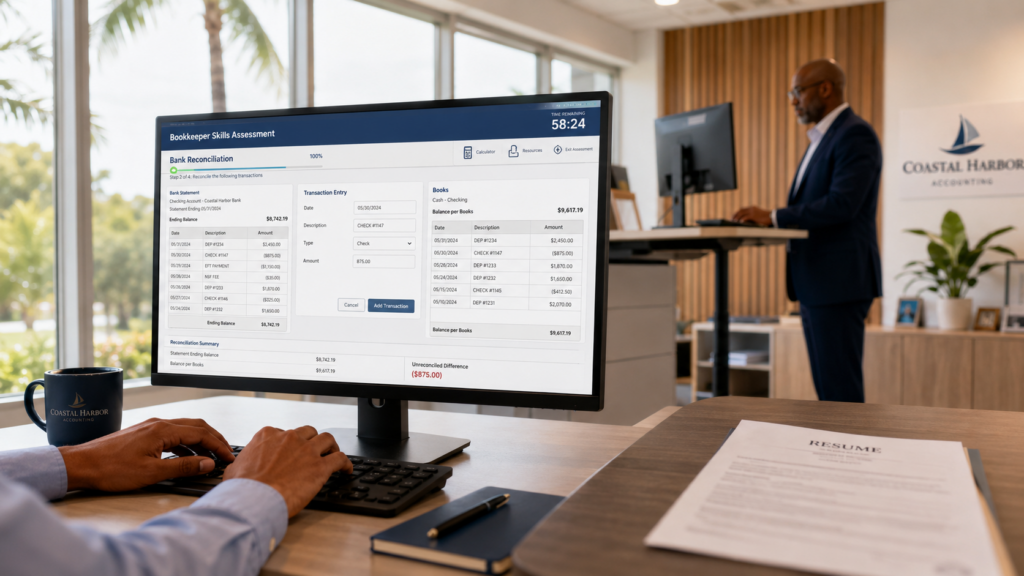
- Error-spotting — hand them a deliberately flawed reconciliation or transaction set; finding what’s wrong is the single most job-realistic skill a bookkeeper exercises daily
- Software navigation fundamentals in your actual stack
Two design notes from hard experience. One: timed matters — the job has deadlines, and the assessment should too. Two: design for the AI era. Candidates take at-home tests with a chatbot open in the next tab; assume it. That means favoring screen-recorded or proctored execution tasks (single login, single monitor) over multiple-choice questions a language model answers instantly, and weighting doing over describing. A candidate who pastes your questions into an AI tells you nothing; a candidate who has to actually drive the software tells you everything.
The economics of this stage are absurd in your favor: one avoided mis-hire covers years of assessment infrastructure. It is the highest-ROI hour in your entire hiring process.
Stage 3: The interview — now repurposed
With competence established, the interview finally measures what interviews are actually good at: communication, coachability, and fit. My three highest-signal questions:
- “Walk me through how you’d figure out why a bank rec is off by $312.48.” You’re listening for a systematic process, not a right answer. Process-thinkers make bookkeepers; guessers make corrections work.
- “Tell me about a mistake you made in a prior role and what happened next.” Anyone who claims they don’t make errors either doesn’t notice them or won’t admit them — both disqualifying in a profession built on self-review.
- “What do you want to be doing in three years?” Not for the ambition theater — for the development conversation. People stay where they’re becoming something, and you should be hiring people who want to become something, because data-entry-only bookkeeping has a three-to-five-year shelf life and your hire should be someone worth upskilling past it.
Stage 4: Reference checks that ask narrow questions
Generic reference calls produce generic warmth. Ask narrow, factual questions instead: “What volume of clients did they handle monthly?” “Who reviewed their work, and how much correction did it typically need?” “Would you rehire them for the same role?” The pause before that last answer is the most honest data a reference call produces.
Stage 5: Structured onboarding as the final interview stage
Here’s the reframe that protects you from the residual risk no pre-hire process eliminates: the first two weeks of structured onboarding are the last stage of the hiring process.
A gated training pathway — real software, real sample client data, pass/fail assessments at 80%, time-on-task benchmarks — produces objective performance data within days. You know what normal looks like: experienced bookkeepers clear the foundational module in three to four hours, newer professionals in eight to twelve. When a new hire is at sixteen-plus hours with incomplete work, the data has made the decision before you’ve had to.
One of our member firms lived exactly this: a hire who interviewed well logged 16 hours on a module their colleagues finished in four, still hadn’t completed January’s financials — and resigned on day six, because the objective gap was undeniable to everyone including them. No agonizing 90-day review. No awkward subjective conversation. Six days, minimal sunk cost, and both sides moved on.
Build the early-exit trigger explicitly: if completion time exceeds roughly double your firm’s benchmark and the assessment hasn’t been passed in two attempts, that’s a structured conversation in week one — remediation with a defined timeline, or a clean early separation. It sounds harsh; it is the kindest version of this process for both parties. Nobody is served by three months of slow-motion failure.
Red Flags When Hiring a Bookkeeper
The signals that have cost me or firms I work with real money, roughly in order of how often they get ignored:
- Software claims without specifics. “Proficient in QuickBooks” but can’t tell you the difference between QBO and Desktop workflows, or name what they did in it daily. Proficiency has texture; embellishment doesn’t.
- Vague volume. Can’t answer “how many clients did you process monthly?” or “what was your month-end close routine?” Real bookkeepers know their numbers — it’s the job.
- No relationship with their own errors. Claims of error-free work, blame routed to prior employers, or visible discomfort discussing mistakes. Bookkeeping is a self-review profession; people without error-handling habits create silent client damage.
- Resistance to skills testing. Strong candidates generally like assessments — it’s their chance to outshine a thinner resume. Pushback on a reasonable, paid-or-brief skills test is a signal worth its weight.
- Job hopping specifically out of accounting roles without a coherent story. Movement is normal in this market; repeatedly leaving the function is a pattern.
- Interview polish wildly out of proportion to assessment performance. This is the resume embellishment tax announcing itself in advance. Trust the work sample over the charisma — every time.
And one red flag for you, not the candidate: if you find yourself rationalizing a weak assessment because you liked the person, you’ve inverted the system. The order exists to protect you from exactly that.
What This System Costs vs. What It Saves
The math, since we’re accountants:
A mis-hire surfaced at day 90 the traditional way costs roughly a quarter’s salary (~$13,000 at a $52,000 bookkeeper salary), plus ~$9,500 in onboarding drag, plus the restart of your hiring cycle in a market where replacements take months — call it $25,000+ all-in, per miss.
The system above costs: a more deliberate job posting (one hour), a skills assessment (included in a platform subscription, or modest standalone cost), a restructured interview (free), narrow reference questions (free), and structured onboarding you should be running anyway for the $9,500-per-hire savings it produces on good hires.
One avoided mis-hire pays for the entire infrastructure several times over. Two makes it the best-returning investment in your firm. And the side effect nobody expects: your good hires get better too, because the same gates that catch mis-hires early give strong performers visible milestones from day one — which is the beginning of retention, not just selection.
Frequently Asked Questions
What should I test a bookkeeper on before hiring?
Four areas, all timed: core accounting logic (debits/credits, classification reasoning — not memorized definitions), realistic data entry measuring speed and accuracy together, error-spotting on a deliberately flawed reconciliation or transaction set, and navigation fundamentals in your firm’s actual software. Weight execution tasks over multiple-choice questions, which AI tools answer trivially on at-home tests. The assessment belongs before the interview, not after — interviewing first anchors you emotionally and corrupts your read of the test results.
What are the red flags when hiring a bookkeeper?
The highest-cost signals: software proficiency claims without specific daily-use details; inability to quantify prior workload (client counts, close routines); no honest relationship with their own errors — claims of error-free work or blame-shifting; resistance to a reasonable skills assessment; repeated exits from accounting roles specifically; and interview polish dramatically out of proportion to assessment performance, which is resume embellishment announcing itself. The most dangerous red flag is internal: rationalizing a weak test score because you liked the candidate personally.
Should I hire an experienced bookkeeper or train someone from scratch?
Experience is a weaker predictor than the salary premium implies. Accounting work is heavily firm-specific, prior experience can encode bad habits that must be unlearned, and cross-function experience transfers poorly — experienced tax professionals take three to five times longer than bookkeepers on foundational transactional modules because the cognitive workflows differ. The better predictors are measurable before hire: aptitude on realistic work samples, speed-plus-accuracy under time pressure, and trainability. A high-aptitude hire inside a structured 2–3 week training pathway routinely outperforms an experienced hire inside an unstructured one — at a lower salary.
How much does a bad bookkeeper hire cost?
A mis-hire identified at the typical 60–90 day mark costs roughly a quarter’s salary (about $13,000 on a $52,000 bookkeeper), plus approximately $9,500 in onboarding drag — lost senior billable hours and error write-offs — plus the restarted recruiting cycle, for a realistic all-in of $25,000 or more. Industry-wide, replacing skilled accounting staff runs 50% to 400% of annual salary. The same mis-hire caught by a pre-offer skills assessment costs essentially nothing, which is why testing before the offer letter is the highest-ROI step in the entire hiring process.
How long should it take a new bookkeeper to become productive?
Inside a structured, execution-based onboarding pathway: two to three weeks to independent productivity, during which the hire processes a complete simulated client year — 12 months of financials, sales tax returns, and reconciliations, quarterly payroll filings, and year-end W-2/1099 work — gated by pass/fail assessments at each stage. Under traditional shadowing, 60–90 days is typical. The early data is also diagnostic: experienced bookkeepers clear the foundational module in 3–4 hours and newer professionals in 8–12, so a hire dramatically outside those ranges has surfaced a problem in week one rather than month three.
Should bookkeeper skills tests be done at home or proctored?
At-home testing is convenient but increasingly compromised: assume candidates have an AI chatbot open in another tab, because many do. Mitigations, in increasing order of strength: timed tests that reward fluency over lookup, execution-based tasks inside actual software rather than describable multiple-choice questions, screen recording, and single-login/single-monitor proctoring for final-stage candidates. The principle: measure what the candidate can do with their hands in the software, not what they can describe — descriptions are now free.
The Bottom Line
Hiring a bookkeeper the standard way is an act of faith: you verify presentation three different ways and then pay to discover, over a fiscal quarter, whether any competence sits behind it. In a market where the candidate pipeline is shrinking and every mis-hire costs $25,000 or more, faith is not a process.
The fix doesn’t require better instincts or more interviews. It requires sequencing: test before you talk, weight aptitude over experience claims, make references answer narrow questions, and let two weeks of structured, gated onboarding — real software, real data, objective benchmarks — serve as the final stage of the hire itself. Every expensive commitment preceded by an objective checkpoint.
You are not losing to a bad labor market. You are losing to a hiring process that measures everything except the work. Fix the sequence, and the market gets a lot less scary.
Want the assessment and onboarding infrastructure already built?
Book a 10-minute structural alignment review at calendly.com/skillabilitydemo
In ten minutes we’ll show you the pre-employment testing engine that verifies accounting logic and software capability before you extend an offer, and the structured onboarding pathway that doubles as your final hiring filter — running inside the software your firm already uses.
Put your next hires through our system. If they don’t pass our modules and aren’t autonomously delivering client-ready work within 45 days, we refund 100% of your enrollment fee and pay your monthly subscription out of our own pocket.
To your firm’s capacity,
Vincent Howard, CPA Managing Partner, Howard, Howard and Hodges Skillability for Accounting Firms
Vincent Howard, CPA has practiced public accounting since 1990. He holds a Master’s degree in Taxation, leads a 50-person multi-state firm, and built the Skillability training platform used by accounting firms nationwide through the PASBA network. His firm was named PASBA Firm of the Year.
© 2026 Skillability for Accounting Firms. 45-Day Out-of-Pocket Performance Guarantee applies to qualifying onboarding engagements. Contact us for full terms.