By Vincent Howard, CPA | Managing Partner, Howard, Howard and Hodges | Skillability for Accounting Firms
Last updated: 2026 | 15-minute read
The Short Answer (TL;DR)
Accounting firms shopping for staff development run into four categories that look interchangeable and aren’t: an LMS (a delivery container you fill with your own content), CPE (license-maintenance education), training (one-time courses and seminars that transfer knowledge), and a staff development system (an end-to-end pathway that builds verified, billable capability and tracks it over a career). They solve different problems, and confusing them is why firms overspend on compliance while their staff still can’t work independently. I learned this distinction the hard way: I originally called my own platform “My Task LMS,” and the name actively undersold it — people assumed “LMS” meant an empty box they’d have to load their own training into, when what I’d actually built was a complete development ecosystem with the curriculum, assessments, benchmarks, and advisory pathways already inside. So I renamed it Skillability. Same offering, accurate label. This article explains the four categories, why an LMS, CPE, and training each leave a gap, what a development system adds, and how a firm owner should decide which they actually need. (Short version: you need CPE for licenses and a development system for capability — and they’re not the same purchase.)
Who I Am and Why You Should Listen
I’ve been in public accounting since 1990. I founded my own firm in 1993, merged it in 2001 to form Howard, Howard and Hodges, and grew it from three people to 50 staff across four locations and multiple states. Our firm was named PASBA Firm of the Year.
In 2020 I built a training system for accounting firms from scratch and called it My Task LMS. More than a thousand accounting professionals across dozens of PASBA member firms have moved through it since. And the name was a mistake — not because the product was wrong, but because the label put it in the wrong category in buyers’ minds. “LMS” told firm owners they were looking at an empty container they’d have to fill themselves, when the entire point was that I’d already filled it: the curriculum, the gated assessments, the sample-client data, the benchmark dataset, the advisory pathways — all built, all included.
So I renamed it Skillability. The offering didn’t change at all. The category label finally became accurate. This article is the explanation I wish I’d led with from the start — the real differences between the four things firms confuse, written by someone who built one of them and spent years watching firm owners misclassify it.
The Four Categories Firms Constantly Confuse
If you’re a firm owner evaluating “staff development,” you’ll encounter four product categories that all promise to make your people better. They’re genuinely different. Here’s the clean version:
1. An LMS (Learning Management System) is software for delivering and tracking content. It’s infrastructure — user accounts, course hosting, completion tracking, reporting. Critically, an LMS ships empty. TalentLMS, LearnUpon, Moodle: these are the building, not the curriculum. You supply everything that goes inside.
2. CPE (Continuing Professional Education) is license-maintenance education. Credit hours, NASBA-approved courses, the compliance machinery that keeps a CPA license active. Becker, Surgent, CPAacademy, Kaplan. Its job is the license, and it does that job well. Its job is not operational capability.
3. Training is knowledge transfer — courses, seminars, webinars that teach a topic. Gear Up, AICPA conferences, vendor certifications. Excellent for currency on fast-changing material. Subject to the forgetting curve: most of it fades within months without reinforcement.
4. A staff development system is an end-to-end pathway that builds verified capability and tracks it over a career — pre-built curriculum delivered inside the firm’s actual software, gated on real work product, benchmarked, sequenced from new-hire onboarding through advisory development. This is the category that actually changes what your firm can bill.
The trap: categories 1, 2, and 3 are mature, crowded, well-marketed, and familiar — so firm owners default to thinking in those terms. Category 4 is newer, sparsely populated, and the one most firms actually need. When a firm owner searches “LMS for accountants” or “CPA development courses,” they’re usually reaching for a familiar label to describe an unfamiliar need.
Why I Stopped Calling It an LMS
Let me be specific about the renaming, because it illustrates the whole distinction.
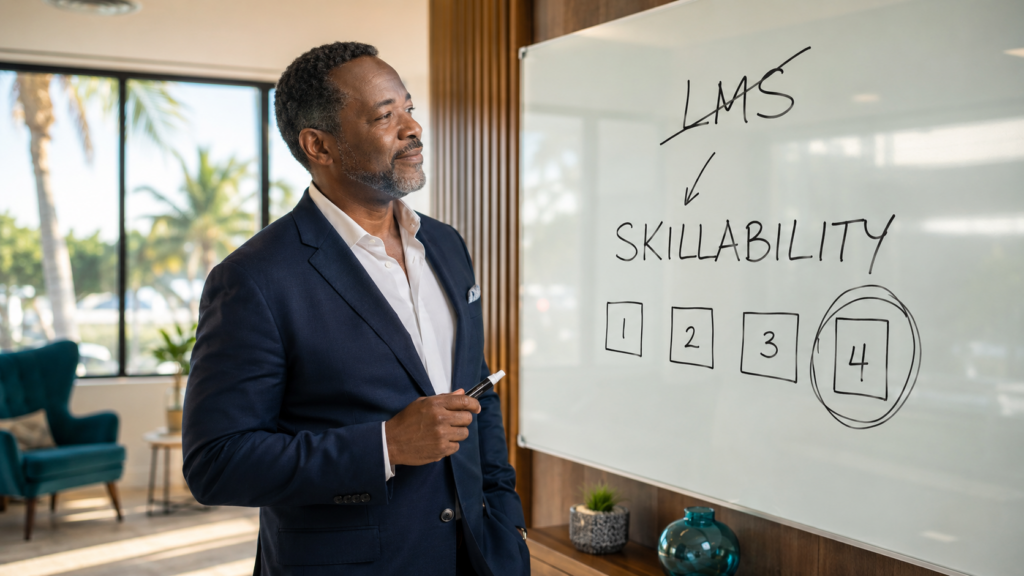
When I called the platform “My Task LMS,” here’s what happened in sales conversations: a firm owner would hear “LMS,” mentally file it next to TalentLMS or Moodle, and ask, “So how much content do we have to build ourselves?” The answer — none, it’s all built — surprised them every time, because the label had already told them the wrong thing. “LMS” is a category that means empty container, and I was selling a full ecosystem. The name was fighting the product.
An LMS, properly defined, is shelving. A genuinely good one — clean interface, solid reporting, reliable hosting — is still just shelving. The value of shelving depends entirely on whether anyone stocks it, and stocking an accounting-firm development curriculum is a multi-year, senior-expertise project most firm owners neither can nor should undertake. (I did undertake it; it took years, and I’m a CPA with 35 years in the work. I do not recommend the build to anyone running a practice.)
What I’d built wasn’t shelving. It was the fully stocked store: the complete bookkeeping pathway from debits-and-credits through year-end W-2 and 1099 processing, the tax preparation tracks, the advanced module library (Section 754, 1202, multi-state apportionment), the gated assessments built on real work product, the benchmark dataset from a thousand-plus trainees, the advisory development catalyst. Calling that an “LMS” was like calling a staffed, stocked, operating restaurant “a commercial kitchen for rent.” Technically the kitchen is in there. But you’ve described the empty version of the thing.
“Skillability” says what it does: it builds skill, and verifies the ability. The offering never changed. The label stopped lying.
The Comparison: What Each Category Actually Does
Here’s the head-to-head, scored on the jobs a firm owner actually needs done:
| Job to be done | LMS | CPE | Training / Seminars | Development System |
|---|---|---|---|---|
| Maintains CPA licenses | No | Yes — its purpose | Sometimes (if CPE-credited) | Partial — pair with CPE |
| Comes with accounting curriculum built | No — you build it | Yes (generic) | Yes (per-course) | Yes — complete & firm-relevant |
| Trains inside your actual software | No | No | Rarely | Yes — definitional |
| Verifies capability on real work product | No | No (attendance/quiz) | No | Yes — gated assessments |
| Onboards a new hire to independence | No | No | No | Yes — 2–3 weeks |
| Builds skill that survives (beats forgetting curve) | Depends on content | No (passive) | No (~10–20% retained) | Yes (~75% via application) |
| Tracks capability over a career | Completion only | Credit hours | No | Yes — pathway + benchmarks |
| Develops advisory capability | No | Conceptually | Conceptually | Yes — structured catalyst |
| Reduces manager re-teaching | No | No | No | Yes — that’s the point |
Read down the “Development System” column and you can see why the other three labels undersold what I built — and why no single older category describes it. It’s not a better LMS (it’s not empty), not a better CPE provider (it’s not about credit hours), not better training (it’s not one-and-done). It’s the category those three each touch one edge of.
Why CPE Isn’t Development (And Why Firms Keep Conflating Them)
This is the most expensive confusion in the profession, so it’s worth isolating.
CPE measures attendance and point-in-time knowledge. Your staff member sat through the hours, maybe answered polling questions, earned the credit. The license stays active. Necessary — genuinely. But here’s the test that exposes the gap: a staff member can hold 40 fresh CPE hours and still be unable to independently process a client’s month-end or execute a Section 754 election in your actual tax software. The credit hour and the capability are different things, and no CPE course is structured to close that gap — because closing it was never CPE’s job.
The reason firms conflate them is understandable: CPE is mandatory, tracked, and visible, so it feels like the firm “has a development program” when it has a compliance program. The line item exists, the certificates accumulate, the box is checked. Meanwhile the actual capability question — can this person do the work without a manager hovering? — goes unmeasured, because nothing in the CPE machinery measures it.
The correct mental model: CPE keeps the license. A development system builds the capability. You need both, as separate purchases, for separate reasons. A firm that audits its “training program” and finds only a CPE budget has found a compliance program wearing a development costume — and that’s the moment to add the layer CPE was never designed to provide.
Why Training and Seminars Aren’t Development Either
Training events — seminars, conferences, webinars, vendor certifications — transfer knowledge well and build capability poorly, for one structural reason: the forgetting curve.
Validated learning research shows people forget roughly 50% of new information within an hour, 70% within a day, and up to 90% within a week without reinforcement — and traditional training sessions leave only 10–20% retained after three months. A two-day advanced tax seminar delivers real knowledge; ninety days later most of it has evaporated, because passive consumption without application is how memory naturally decays.
The same research shows the cure, and it’s exactly what separates training from a development system: when learning is tied to immediate, repeated, hands-on application, retention rises to about 75%. A development system is built around that application — the staffer doesn’t just learn what a technique is, they perform it on real data, gated on getting it right, more than once. Training is the input. A development system is the engine that converts the input into retained, billable skill. (This is why the smartest firms keep their seminar budget and add a development system — the seminar delivers current knowledge, the system makes it stick.)
What a Development System Adds That the Other Three Can’t
Stack the gaps and the missing category defines itself. A staff development system provides:
Pre-built, firm-relevant curriculum — the content an LMS leaves you to build yourself, already constructed by someone who knows both the accounting and the software.
Execution inside your actual tools — QuickBooks Online, Accounting CS, UltraTax, Xero — so capability transfers to real client work instead of dying in a simulation, which neither CPE nor most training provides.
Verification on real work product — gated assessments at an 80% threshold derived from the numbers the trainee actually produced, so “complete” means “capable,” not “attended.”
A career-length pathway — sequenced from new-hire onboarding (independence in 2–3 weeks) through staff and senior development to advisory capability, with the advanced library available at the moment of need. CPE and training are episodic; a development system is continuous.
Benchmarks and capability tracking — knowing that an experienced bookkeeper clears the foundational module in 3–4 hours lets you spot a struggling hire in week one, a diagnostic capability no LMS, CPE provider, or seminar offers.
Reduced manager re-teaching — the entire point. When the system carries the mechanical and procedural load, your $200/hour people stop functioning as the answer desk and the babysitter, and start doing the work only they can do.
That bundle is not a better version of the other three categories. It’s the thing the other three each gesture at and none delivers — which is exactly why it needed its own name.
How a Firm Owner Should Actually Decide
Don’t choose between the categories — sequence them by the job you need done:
If your problem is license compliance: buy CPE. Affordable, abundant, and correct for the job (CPAacademy, Surgent, Kaplan). Don’t overpay, and don’t expect it to build capability.
If your problem is currency on fast-changing law: buy training/seminars (Gear Up for updates, AICPA for depth) — and pair them with application-based reinforcement, or the forgetting curve eats most of the spend.
If your problem is “I have content and infrastructure to host it”: an LMS makes sense — but only if you have the L&D staff and years to build accounting curriculum, which most firms under 50 people don’t.
If your problem is any of these — new hires take 90 days to become useful, my managers spend all day re-teaching, my staff can’t work without supervision, I’m losing people who can’t see a future, my bookkeepers aren’t ready for the AI-era advisory shift — you don’t have a CPE problem, a training problem, or an LMS problem. You have a development-system-shaped hole, and the other three categories will not fill it no matter how much you spend on them.
The one-question diagnostic that cuts through all the category confusion: “After my staff use this, can they do verifiable new work in our actual software without a manager re-teaching it — and can I prove it?” CPE answers with credit hours. Training answers with completion. An LMS answers “depends what you built.” Only a development system answers with work product. Buy according to which answer you actually need.
Frequently Asked Questions
What is the difference between an LMS and a staff development system?
An LMS (Learning Management System) is delivery infrastructure — software that hosts, delivers, and tracks content, but ships empty, requiring you to build or buy everything that goes inside it (TalentLMS, LearnUpon, Moodle). A staff development system is a complete, pre-built pathway that builds and verifies capability — curriculum, execution inside the firm’s actual software, gated assessments on real work product, benchmarks, and career-length progression, all included. The simplest distinction: an LMS is the empty shelving; a development system is the stocked, operating store. For accounting firms, buying an LMS means committing to a multi-year curriculum-building project; a development system arrives with the curriculum already built and is producing trained staff the week you start.
Is CPE the same as staff training or development?
No. CPE (Continuing Professional Education) is license-maintenance education that measures attendance and point-in-time knowledge through credit hours — its job is keeping a CPA license active. Staff training transfers topical knowledge (often subject to rapid forgetting). A development system builds verified, durable capability through structured practice gated on real work product. The exposing test: a staff member can hold 40 fresh CPE hours and still be unable to independently process a client month or execute a complex election in the firm’s software, because no CPE course is designed to verify operational capability. Firms need CPE for compliance and a development system for capability — separate purchases for separate jobs.
Why was Skillability previously called an LMS?
Skillability was originally named “My Task LMS.” The offering was always a complete development ecosystem — pre-built curriculum, gated assessments, software-specific training, a 1,000+ trainee benchmark dataset, and advisory pathways — but the “LMS” label miscategorized it in buyers’ minds. Because an LMS conventionally means an empty container that firms fill with their own content, prospective users assumed they’d have to build the training themselves, when in fact it was all included. The platform was renamed Skillability to accurately reflect that it builds and verifies skill rather than simply hosting content. The offering didn’t change; the name was corrected to match the category it actually occupies — a staff development system, not a learning management system.
Do accounting firms need CPE, training, and a development system, or just one?
Most firms need CPE plus a development system, because they solve different problems. CPE is mandatory for license maintenance and should be bought cheaply and correctly for that purpose. Training and seminars are valuable for currency on fast-changing law (like new tax legislation) but require reinforcement to stick. A development system is what builds the operational capability that lets staff work independently — onboarding new hires to productivity, reducing manager re-teaching, and developing advisory skills. They aren’t competitors; they’re layers. The common, expensive mistake is buying CPE and training generously while leaving the development-system layer — the only one that changes billable capability — entirely empty.
What is an accounting staff development system?
An accounting staff development system is an end-to-end platform that builds and verifies an accountant’s operational capability over their career, as distinct from compliance education or one-time training. Its defining features: pre-built, accounting-specific curriculum; training delivered inside the firm’s actual software (QuickBooks Online, Accounting CS, UltraTax, Xero); progression gated by assessments built on the learner’s real work product; benchmarks that track capability and flag struggling hires early; a sequenced pathway from new-hire onboarding through advisory development; and a structural goal of reducing manager re-teaching. Unlike an LMS, it comes with the curriculum built; unlike CPE, it verifies capability rather than attendance; unlike a seminar, it builds skill that survives the forgetting curve through repeated application.
How do I know if my firm needs a development system versus just CPE?
Apply one diagnostic question: “After my staff complete this, can they do verifiable new work in our actual software without a manager re-teaching it — and can I prove it?” If your pain points are compliance-only (licenses need maintaining), CPE suffices. But if you recognize any of these — new hires take 60–90 days to become productive, managers spend their days re-teaching basics, staff can’t work without supervision, you’re losing people who can’t see a development path, or your compliance staff aren’t ready for the AI-driven shift toward advisory work — those are development-system problems, and CPE, training, and an empty LMS will not solve them regardless of spend. Compliance education and capability building are different categories addressing different needs.
The Bottom Line
The accounting profession has three familiar, mature categories for “making staff better” — LMS, CPE, training — and a firm owner reaching for any of them to solve a capability problem is reaching for the wrong tool with the right intentions. An LMS is an empty container. CPE is a license tool. Training is a knowledge event that fades. Each is correct for its actual job and inadequate for the job most firms are really trying to do: turn the people they have into professionals who can work independently, stay through the AI transition, and eventually advise clients.
That job belongs to a fourth category — a staff development system — and I learned how badly the older labels fit when my own platform’s “LMS” name kept telling buyers it was something it wasn’t. Renaming it Skillability didn’t change a single module. It just stopped miscategorizing a development ecosystem as empty shelving.
So when you evaluate anything sold as CPA development, run it through the one question that ignores the marketing category and tests the actual outcome: after my staff use this, can they do verifiable new work in our software without a manager re-teaching it? CPE keeps your licenses. Training keeps your knowledge current. Only a development system changes what your firm can do.
You are not under-trained on compliance. You are missing the category that builds capability. Name the gap correctly, and you can finally fill it.
Want to see the development system the “LMS” label never captured — complete curriculum, real-software training, gated verification, and advisory pathways, all built?
Book a 10-minute structural alignment review at calendly.com/skillabilitydemo
In ten minutes we’ll show you what separates Skillability from an LMS, a CPE subscription, and a seminar — the pre-built pathways running inside QuickBooks Online, Accounting CS, UltraTax, and Xero, gated on real work product, from new-hire onboarding through the advisory catalyst — and help you identify which category your firm actually needs.
Put your team through our system. If new hires don’t pass our modules and aren’t autonomously delivering client-ready work within 45 days, we refund 100% of your enrollment fee and pay your monthly subscription out of our own pocket.
To your firm’s capacity,
Vincent Howard, CPA Managing Partner, Howard, Howard and Hodges Skillability for Accounting Firms
Vincent Howard, CPA has practiced public accounting since 1990. He holds a Master’s degree in Taxation, leads a 50-person multi-state firm, and built the Skillability staff development platform (formerly My Task LMS) used by accounting firms nationwide through the PASBA network. His firm was named PASBA Firm of the Year.
© 2026 Skillability for Accounting Firms. 45-Day Out-of-Pocket Performance Guarantee applies to qualifying onboarding engagements. Contact us for full terms.