
By Vincent Howard, CPA | Managing Partner, Howard, Howard and Hodges | SkillAbility for Accounting Firms
Last updated: 2026 | 12-minute read
TL;DR — The Short Answer
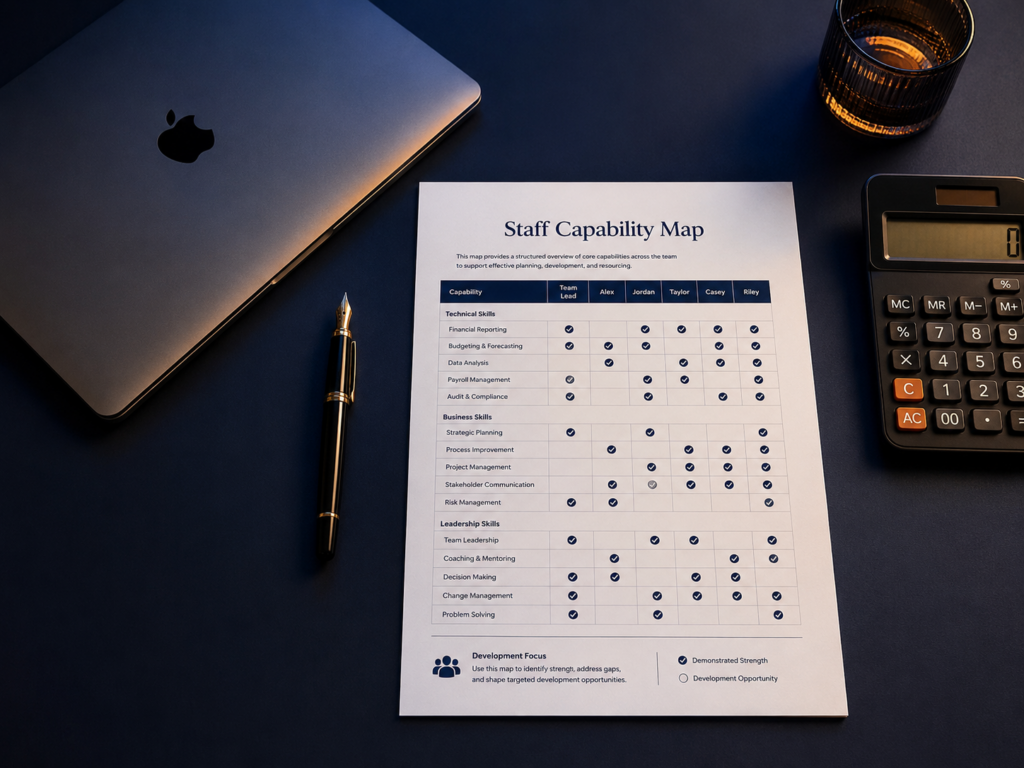
Accounting staff need five layers of capability, not just technical knowledge: (1) technical execution — completing reconciliations, bookkeeping, tax workpapers, and closes accurately; (2) software and workflow fluency — driving the firm’s actual tools without constant hand-holding; (3) documentation and review readiness — leaving a trail another person can review without decoding; (4) judgment and escalation — recognizing when something looks wrong and when a manager needs to be involved; and (5) client communication — asking better questions and explaining work without creating confusion or risk. Most firms define “accounting skills” as layer one and wonder why technically knowledgeable staff still can’t produce independently.
The stakes are documented: only 6% of finance leaders say their teams have the capabilities to accomplish this year’s priority projects, 57% say they need to upskill current staff, and 75% report skills shortages caused project delays — the highest rate of any profession surveyed. And the bar is rising: with AI absorbing routine work, entry-level roles now demand judgment and interpretation earlier, because accountants are expected to explain results, not just produce them. This is the capability map for developing all five layers — deliberately, in order.
Who I Am and Why You Should Listen
I’ve been in public accounting since 1990. I founded my own firm in 1993, merged it in 2001 to form Howard, Howard and Hodges, and grew it from three people to 50 staff across four locations and multiple states. Our firm was named PASBA Firm of the Year.
I’ve hired people who could recite accounting theory beautifully and couldn’t produce a reviewable workpaper. I’ve had staff who executed flawlessly but whose files nobody else could decode, staff who never escalated the thing that mattered, and staff whose client emails created more confusion than they resolved. Every one of them “knew accounting.” What they were missing wasn’t knowledge — it was one of the other four layers no one had ever named, let alone developed. Since 2020 I’ve built a development platform that more than a thousand accounting professionals across dozens of PASBA member firms have moved through, and the pattern is consistent: the staff who become genuinely productive are strong across five distinct layers, and each layer is buildable. This article is the map.
Why “Accounting Skills” Is Too Vague to Develop
Ask a firm owner what skills their staff need and the answer is usually a version of “the accounting” — debits and credits, reconciliations, payroll, bookkeeping, tax prep, maybe the software. All real, all necessary. But if technical knowledge were the whole picture, firms wouldn’t be in the situation the data describes: only 6% of finance and accounting leaders report having the capabilities needed to accomplish this year’s priority projects, and 57% say they need to upskill their current teams. The consequences are concrete: 75% of leaders say skills shortages caused project delays in the past year — the highest rate across all professional fields surveyed — and 62% report projects canceled entirely.
The gap isn’t that staff don’t know accounting. It’s that “knows accounting” and “can independently produce reliable, reviewable, client-ready work” are separated by four more layers of capability most firms never define — and you can’t develop what you haven’t defined. Meanwhile the bar keeps rising: the World Economic Forum projects 39% of workers’ core skills will change by 2030, and as AI absorbs routine execution, entry-level accounting roles increasingly demand stronger judgment, oversight, and interpretation earlier in a career.
The goal is not to train people who can follow steps. The goal is to develop people who can produce reliable work, explain their thinking, and grow into trusted advisors. That takes five layers — and most firms only ever name the first.
The CPA Firm Capability Map: 5 Layers Every Staff Member Needs
Layer 1: Technical Execution
The foundation — can they complete the work accurately? Reconciliations (still the single most requested technical skill in job postings), bookkeeping tasks, tax workpapers, payroll workflows, closing tasks, and basic analysis. This is what CPE, degrees, and most training address — necessary, and genuinely the base of everything above it. But note what execution alone produces: a person who can do the work when someone tells them what to do, checks it, and handles everything around it. That’s a helper, not a producer.
How it’s built: structured practice on full sample files — a complete simulated client year — gated by assessment on the work product itself, so “can execute” is verified rather than assumed.
Layer 2: Software and Workflow Fluency
Can they work inside the firm’s actual tools — QuickBooks Online, Accounting CS, UltraTax, Xero, configured your way — without constant hand-holding? This is the layer where generic CPE and webinars fall shortest: they teach concepts and generic navigation, not your stack, your file structure, your workflow sequence. A staffer who knows the accounting but fumbles the software still consumes manager time on every engagement — and software fluency is now a baseline employer expectation, not a differentiator.
How it’s built: practice inside the real software from day one. Capability built in a demo environment evaporates on contact with the actual stack.
Layer 3: Documentation and Review Readiness
The most underrated layer in the whole map: can another person review their work without decoding their thought process? Strong staff leave a trail — workpapers that explain themselves, tie-outs that are obvious, notes where judgment was applied. Weak documentation converts every review into an archaeology dig, doubling the reviewer’s time and hiding errors inside ambiguity. In a firm, work that can’t be efficiently reviewed is only half-done, no matter how accurate it is — because the firm’s leverage model runs on review.
How it’s built: practice must produce real, reviewable outputs documented to the firm’s standard from the first sample file — so the standard is learned as part of the work, not retrofitted through months of review notes.
Layer 4: Judgment and Escalation
Can they recognize when something looks wrong, when an assumption is weak, and when a manager needs to be involved? This layer is what separates a person who processes from a professional who protects the firm. It matters more now than ever: as Robert Half’s analysis puts it, organizations adopting AI and automation “still need experienced accountants to validate results, apply sound judgment and ensure accuracy” — and the profession-wide shift means less time on manual execution and more on supervising systems, validating outputs, and interpreting results. Escalation judgment is the humble, teachable core of this layer: knowing the edge of your authority is worth more in a first-year staffer than any amount of technical depth.
How it’s built: scenario-based practice with planted errors and ambiguities — find what’s wrong, explain the reasoning, decide whether to fix, question, or escalate — with feedback. Judgment is reps, not lectures. (The AI-supervision version of this layer: training staff to review AI’s work.)
Layer 5: Client Communication
Can they explain what they need, ask better questions, and communicate professionally without creating confusion or risk? The market signal here is unambiguous: communication appears in every 2026 skills analysis as a top employer demand, and the underlying reason is the profession’s shift — accountants are now expected to explain results, not just produce them. For a firm, this layer is also the gateway to everything valuable: a staffer who can communicate with clients can own document requests, handle routine questions, and eventually carry relationships and advisory conversations — each step relieving partners of work only they could previously do.
How it’s built: rehearsed, simulated client interactions before live ones — drafting the request email, practicing the explanation, fielding the pushback — so client-facing confidence is built where mistakes are free. (The full progression: developing advisory skills in accountants.)
The Capability Map at a Glance
| Layer | The question it answers | What’s missing without it |
|---|---|---|
| 1. Technical execution | Can they complete the work accurately? | Nothing works without it |
| 2. Software & workflow fluency | Can they drive our actual tools unaided? | Constant hand-holding |
| 3. Documentation & review readiness | Can someone review it without decoding it? | Review takes twice as long |
| 4. Judgment & escalation | Do they know when something’s wrong — and when to raise it? | Silent errors reach clients |
| 5. Client communication | Can they interact with clients without creating risk? | Partners stay the bottleneck |
Read it as a diagnosis tool: when a staffer is “technically fine but somehow not working out,” the problem is almost always a named gap in layers 2 through 5 — which means it’s fixable, if the firm develops that layer deliberately instead of concluding the person “just doesn’t have it.”
Why Shadowing Doesn’t Build These Five Layers
Run the map against the industry’s default development method and the mismatch is obvious. Shadowing — watching a senior work — can’t verify layer 1 (watching isn’t doing), teaches layer 2 only in fragments (whatever screens happened to be open), never addresses layer 3 (you see the finished file, not the documentation discipline), can’t transmit layer 4 (judgment is invisible — you see the decision, never the reasoning), and gives zero reps at layer 5 (nobody lets the shadow talk to the client).
Watching someone work does not prove the learner can perform, document, question, or communicate. It proves they were in the room. Every layer of the map requires doing with feedback — which is exactly what shadowing structurally cannot provide. (The full case: structured training vs. shadowing.)
How to Develop All Five Layers Intentionally
The method follows from the map — each layer names its own development mechanism:
- Sample files and full simulated client work build technical execution where mistakes are safe (Layer 1).
- Practice inside the firm’s real software, configured your way, builds fluency that actually transfers (Layer 2).
- Reviewable outputs to firm standard from day one make documentation a habit, not a retrofit (Layer 3).
- Scenario-based judgment training — planted errors, weak assumptions, escalate-or-handle decisions, with feedback — builds the instinct that protects the firm (Layer 4).
- Simulated client interactions — request emails, explanations, pushback — build communication confidence before a real relationship is at stake (Layer 5).
- Assessments gate progression at every layer, so “capable” is demonstrated, not assumed — and manager coaching sits on top, refining judgment and standards rather than teaching basics.
This is the practical machinery we detailed in how to develop accounting staff without shadowing, aimed at the five targets this article names. The sequence matters too: execution and fluency first (the foundation), documentation woven through everything, judgment and communication built on top — the same execution → judgment → client-readiness arc that carries a staffer from new hire toward advisor and, eventually, leadership. (And it’s why development needs structure at all — see why the 70-20-10 rule is not enough.)
Technical knowledge gets someone hired. The other four layers are what make them productive, independent, and client-ready — and every one of them is buildable.
Frequently Asked Questions
What skills are needed for accounting staff?
Five layers of capability: technical execution (completing reconciliations, bookkeeping, tax workpapers, payroll, and closes accurately); software and workflow fluency (driving the firm’s actual tools — QuickBooks Online, Accounting CS, UltraTax, Xero — without hand-holding); documentation and review readiness (producing workpapers another person can review without decoding the thought process); judgment and escalation (recognizing when something looks wrong, when assumptions are weak, and when to involve a manager); and client communication (asking clear questions and explaining work professionally without creating confusion or risk). Most firms define accounting skill as the first layer only, which is why technically knowledgeable staff can still fail to produce independently — the gap is almost always in layers two through five, each of which is separately developable.
What are the 5 basic accounting skills?
For a CPA firm evaluating staff capability, the five that matter are: (1) technical execution — accurate reconciliations, bookkeeping, workpapers, and closing tasks, with reconciling remaining the single most-requested technical skill in job postings; (2) software and workflow fluency in the firm’s actual stack; (3) documentation and review readiness — leaving a trail a reviewer can follow; (4) professional judgment and escalation — knowing what looks wrong and when to raise it; and (5) client communication. This framing differs deliberately from student-oriented “top skills” lists because it describes what makes staff productive inside a firm: knowledge gets someone hired, but the ability to execute, document, judge, and communicate is what makes them independent and client-ready.
Why do technically knowledgeable accounting staff still underperform?
Because technical knowledge is one layer of five, and underperformance almost always traces to an unnamed gap in the others: they know the accounting but fumble the firm’s software (fluency gap), their work is accurate but undecipherable to reviewers (documentation gap), they process without noticing anomalies or escalate nothing (judgment gap), or their client interactions create confusion (communication gap). Firms that only define skill as technical knowledge conclude these people “just don’t have it,” when the reality is a specific, developable capability was never built. The practical response is diagnostic: identify which layer is weak, then develop it deliberately through the matching method — real-software practice, documented outputs to standard, scenario-based judgment reps, or simulated client interactions.
How do you assess accounting staff skills?
Assess each layer through work product, not conversation. Technical execution: a work-sample assessment on realistic data — complete the reconciliation, produce the return — evaluated on the output itself. Software fluency: the same test run inside the firm’s actual stack, timed against benchmarks. Documentation: can a reviewer follow the workpapers without asking questions? Judgment: planted-error scenarios — do they catch what’s wrong, and do they escalate the item beyond their authority? Communication: a drafted client request or explanation, evaluated for clarity and professionalism. Across all layers, the strongest signals over time are error trends, review-note repetition, benchmark times, and manager interruption load. Interviews and credentials predict these poorly; demonstrated work predicts them well.
What skills matter most for accounting staff in the AI era?
The upper layers of the capability map matter more, not less. As AI absorbs routine execution — reconciliations, data entry, draft workpapers — the human value concentrates in judgment (validating outputs, applying skepticism, ensuring accuracy), documentation and review discipline (supervising machine-produced work), and client communication (explaining results, not just producing them). The World Economic Forum projects 39% of core skills changing by 2030, and entry-level accounting roles now demand judgment and interpretation earlier in careers because the routine work that used to build those capabilities gradually is being automated. Technical execution remains the necessary foundation — you can’t judge AI’s output without knowing what right looks like — but the differentiating skills are now judgment, review, and communication.
How do you develop accounting staff skills without shadowing?
Match each capability layer to its development method: build technical execution through structured practice on full sample client files, gated by assessments on the work product; build software fluency by practicing inside the firm’s real stack from day one; build documentation habits by requiring reviewable outputs to firm standard on every practice file; build judgment through scenario-based training with planted errors and escalate-or-handle decisions, with feedback; and build client communication through simulated interactions — request emails, explanations, pushback — before live relationships are at stake. Gate progression on demonstrated competence rather than time served, and reserve manager coaching for judgment and standards rather than basic re-teaching. Shadowing can’t build any layer reliably because every one requires doing with feedback, not watching.
The Bottom Line
“We need staff with better accounting skills” is true and useless in equal measure — because until a firm names what capability actually means, it can’t build it, test it, or hire for it. The five-layer map does the naming: execution, fluency, documentation, judgment, communication. Technical knowledge is the foundation, but it’s the four layers above it that turn a person who knows accounting into a professional who produces reliable work, protects the firm, and can eventually sit across from a client.
The encouraging part is that every layer is buildable, each by a known method — sample files, real software, documented outputs, judgment scenarios, simulated client reps. The discouraging part, for your competitors, is that almost nobody builds them deliberately; they hire for layer one and hope the rest accretes. In a market where only 6% of leaders say their teams can execute this year’s priorities, the firm that develops all five layers on purpose isn’t marginally better staffed. It’s playing a different game.
You are not losing to firms that hired more talented people. You are losing to firms that mapped the five capabilities and built them — while everyone else trained layer one and hoped.
Want to build all five layers — deliberately, in the software your firm already uses?
Book Your Free 10-Minute Structural Alignment Review →
In ten minutes we’ll map your team against the five capability layers — execution, software fluency, documentation, judgment, and client communication — and show you how SkillAbility develops each one through structured practice, real workflows, gated assessments, and simulated client scenarios, from new hire to advisor to future leader.
Our 45-Day Out-of-Pocket Performance Guarantee: Put your next hires through our system — if it doesn’t improve your onboarding, we’ll refund your investment.
To your firm’s capacity,
Vincent Howard, CPA
Managing Partner, Howard, Howard and Hodges
SkillAbility for Accounting Firms
About the Author
Vincent Howard, CPA has practiced public accounting since 1990. He holds a Master’s degree in Taxation from the University of Central Florida, leads a 50-person multi-state firm, and built the SkillAbility staff development platform used by accounting firms nationwide through the PASBA network. Howard, Howard and Hodges was named PASBA Firm of the Year and has offices in Lake Mary, Sarasota, and Winter Springs, Florida.
© 2026 SkillAbility for Accounting Firms. 45-Day Out-of-Pocket Performance Guarantee applies to qualifying onboarding engagements. Contact us for full terms.