
By Vincent Howard, CPA | Managing Partner, Howard, Howard and Hodges | SkillAbility for Accounting Firms
Last updated: 2026 | 12-minute read
TL;DR — The Short Answer
AI now does the entry-level accounting work — document collection, data extraction, reconciliations, draft returns — that once trained new accountants. 70% of U.S. firms already use AI at least weekly. That’s great for productivity and dangerous for development: the rote work that built pattern recognition and professional skepticism is being automated away, which risks producing staff who can operate the tools but can’t evaluate the results. AI accounting training must therefore shift its target — from teaching staff to do the work to teaching them to review, question, and overrule it.
Every serious AI framework now insists on a “human in charge” who can review, correct, and overrule the machine at any point — but that human only exists if you train them. The skill is built through scenario-based practice where staff review AI-generated work, find the errors, explain their reasoning, and compare against a standard. The senior’s role changes too: from re-teaching steps to coaching judgment (“Why is this wrong? What would you ask the client? What assumption are you making?”). This guide covers the new risk, the new skill, and how to build it.
Who I Am and Why You Should Listen
I’ve been in public accounting since 1990. I founded my own firm in 1993, merged it in 2001 to form Howard, Howard and Hodges, and grew it from three people to 50 staff across four locations and multiple states. Our firm was named PASBA Firm of the Year.
I’m not anti-AI — far from it. The automation reshaping our profession is genuinely useful, and firms that refuse it will lose. But I’ve spent 35 years watching how accountants actually develop judgment, and since 2020 I’ve built a development platform that more than a thousand professionals across dozens of PASBA member firms have moved through. That vantage point made one risk obvious to me that the AI-hype conversation mostly ignores: when the machine does the work a junior used to learn on, the junior can end up fast and hollow — able to run the tool, unable to catch it when it’s wrong. This article is about closing that specific gap, without slowing down on AI.
The Uncomfortable Truth: AI Is Removing the Work That Trained People
AI adoption in accounting isn’t coming — it’s here. Wolters Kluwer’s Future Ready Accountant research found that 70% of U.S. firms now use AI at least weekly, rising to 76% among high-growth firms, with 34% using it daily. And the work it’s absorbing is specific: autonomous AI agents excel at exactly the tasks that bog down junior staff — document and signature requests, data collection, extraction, ingestion, and classification, and assessing audit risks.
That entry-level work was never glamorous. But it was never only work, either. Reconciling hundreds of accounts, vouching transactions, keying data, prepping documents — that grind quietly taught pattern recognition, review habits, client context, and the professional skepticism that makes an accountant trustworthy. It was the apprenticeship hiding inside the busywork.
Wolters Kluwer frames the upside optimistically: with AI handling the rote tasks, younger staffers will be able to advance to judgment-driven work sooner. That’s the opportunity. But “advancing to judgment-driven work sooner” only happens if the judgment gets built deliberately — because the work that used to build it is exactly what’s being automated. Skip that step and “sooner” just means “before they’re ready.”
AI removing the grunt work is genuinely good news — but only for firms that replace the training that grunt work used to provide. (We cover the broader shift in how AI is changing CPA training; this article zooms in on the specific new skill: reviewing AI’s work.)
Faster Output Does Not Mean Better Staff Development
Here’s the trap firms walk into without noticing. AI makes a new hire’s output faster and cleaner immediately — the reconciliation is done, the workpaper is drafted, the return is populated. The dashboards look great. Productivity is up. So leadership concludes the staff are developing well.
They may not be. Faster output and stronger development are not the same thing, and AI has decoupled them. A junior can now generate a polished, review-ready work product without understanding why it’s right, what assumptions it embeds, or where it might be wrong. The work looks finished; the accountant behind it may be hollow.
This is precisely why every credible AI framework now mandates human oversight. Wolters Kluwer’s “responsible AI” principles are explicit: a human must be able to review, correct, and overrule AI at any point in any workflow, and client-facing content must always be reviewed and approved by a human. The whole model depends on a competent “human in the loop.” But that competent human doesn’t appear by magic — they have to be trained. A firm that automates the work and skips the judgment training hasn’t put a human in charge; it’s put a button-pusher in charge and called it oversight.
The Hidden Danger: Staff Who Can Run Tools But Can’t Evaluate Results
This is the risk that doesn’t show up on any productivity dashboard until it’s expensive: a generation of staff who are fluent with AI tools and weak at judging their output. They can run the reconciliation tool; they can’t tell when the reconciliation is wrong. They can generate a draft return; they can’t spot the missing context that makes it incorrect.
The danger compounds because it’s invisible while it’s forming. The firm sees faster turnaround and assumes competence is rising, while underneath, the judgment layer is quietly hollowing out. The bill comes due later — when an AI error flows through to a client because no one in the chain had the judgment to catch it, or when a “senior” who was developed this way can’t actually review a junior’s work because they never built the reviewing instinct themselves.
Wolters Kluwer’s own adoption research names the root issue: skills gaps are repeatedly found to be one of the biggest obstacles to AI adoption, which is why firms are advised to start training now, not later. The skill gap isn’t operating the AI — that’s easy. It’s supervising it, and that’s the skill firms are under-building at exactly the moment it matters most.
What New Accountants Actually Need to Learn Now
If the job has shifted from doing the work to judging the work, the curriculum has to shift with it. The capabilities that matter in an AI-enabled firm:
| The New Skill | What It Means in Practice |
|---|---|
| Compare outputs against a standard | Knowing what “right” looks like well enough to see when AI’s version isn’t |
| Spot inconsistencies | Catching the number that doesn’t fit, the figure that contradicts another |
| Ask better questions | Critical thinking to interrogate an output rather than accept it |
| Identify missing context | Recognizing what the AI didn’t know about the client or situation |
| Explain conclusions | Defending why the work is right — the test of real understanding |
| Know when to escalate | Recognizing the edge of their competence and the AI’s reliability |
Notice that every one of these is a reviewing skill, not a doing skill — and notice the prerequisite hiding in the first row. You can’t tell when AI’s output is wrong unless you know what right looks like, which means staff still have to learn to do the work themselves first, by hand, even though AI will do it in production. Doing it builds the standard against which they’ll later judge the machine. Skip that, and “review” becomes rubber-stamping.
Why Shadowing Is Even Weaker in an AI-Enabled Firm
Shadowing — learning by watching a senior — was always inconsistent. In an AI-enabled firm it gets worse, for a reason specific to automation:
When the senior is moving faster because AI is handling their grunt work, there’s less visible work for the new person to observe. The junior watches the senior accept an AI output, make a quick adjustment, and move on — but the judgment behind that quick adjustment is invisible. They see the speed, not the reasoning. They learn that the senior trusted the output, not why the senior trusted it or what would have made them distrust it.
So the new hire absorbs the senior’s pace without their discernment — arguably the worst possible lesson, because it teaches confidence without the judgment that should underpin it. Add that different seniors use AI tools differently and trust them differently, and shadowing in an AI firm transmits an inconsistent blend of habits, some of them quietly dangerous. (Full breakdown in structured training vs. shadowing.)
The Better Model: Scenario-Based AI-Review Training
If the skill is reviewing AI’s work, then the training has to be practicing reviewing AI’s work — deliberately, with feedback, against a standard. The model that builds judgment in an AI firm:
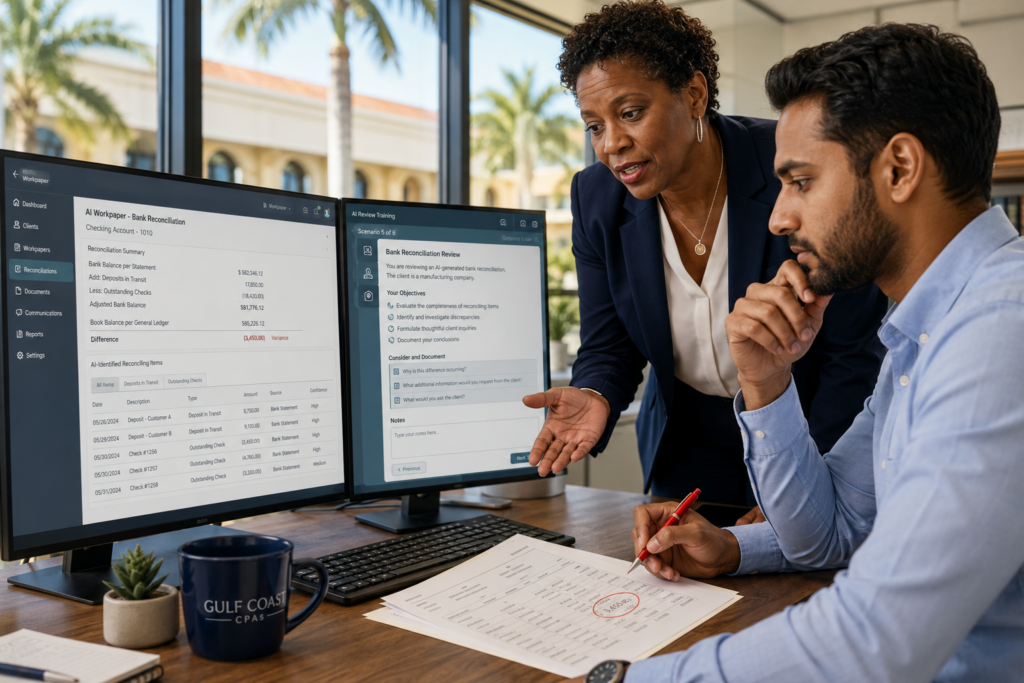
Give staff structured scenarios where they review AI-generated work. Hand them a reconciliation, a workpaper, or a draft return that the “AI” produced — some correct, some with deliberately planted errors and missing context — and have them do four things: find what’s wrong, explain their reasoning, compare it against the correct standard, and decide what to do (fix, question, or escalate). Repeat across many scenarios, with feedback, and you’re building exactly the reviewing instinct the old grunt work used to build — but faster and on purpose.
This is the same simulation-based approach the profession’s own bodies now prescribe for the AI era, applied to the specific skill of AI supervision. It works because judgment is built by making judgment calls and getting feedback on them, not by watching someone else make them. And it directly produces the “human in charge” the responsible-AI frameworks require — a person who has practiced catching the machine’s errors hundreds of times before a real client’s work is on the line.
You build a reviewer the same way you build any skill: reps and feedback. The only difference now is that the thing being reviewed was produced by a machine.
The Senior Accountant’s Role Changes Too
In the old model, a senior trained a junior by re-teaching steps: “here’s how you do this part.” In an AI firm, the steps are largely automated — so the senior’s job shifts from teaching procedure to coaching judgment.
The most valuable thing a senior can now do isn’t show a junior how to produce the work. It’s interrogate the junior’s evaluation of the AI’s work, with questions like:
- “Why is this wrong?” — forcing the junior to articulate the reasoning, not just flag the error
- “What would you ask the client here?” — building the instinct to spot missing context
- “What assumption is this output making?” — training them to see what the AI took for granted
- “How confident are you, and why?” — calibrating professional skepticism and escalation judgment
This is higher-value mentoring than the old step-by-step re-teaching, and it’s a better use of a scarce senior’s time. But it only works on top of a structured foundation — the senior coaches judgment best when the junior has already built baseline reviewing skill through structured practice, so the senior’s time goes to refining judgment rather than covering basics. The structure handles the foundation; the senior handles the nuance. (See developing advisory skills in accountants for the judgment-building progression.)
Frequently Asked Questions
How should CPA firms train staff to work with AI?
By shifting the training target from doing the work to reviewing it. Since AI now produces reconciliations, workpapers, and draft returns, the critical skill is evaluating that output: comparing it against a standard, spotting inconsistencies and missing context, explaining conclusions, and knowing when to escalate. The most effective method is scenario-based practice where staff review AI-generated work (some correct, some with planted errors), find the problems, explain their reasoning, and compare against the correct answer, with feedback. Crucially, staff must still learn to do the work by hand first, because you can’t judge whether AI’s output is right unless you know what right looks like. Firms should start this training now, since skills gaps are a leading obstacle to effective AI adoption.
Will AI replace entry-level accountants?
No, but it is automating much of the entry-level work and changing what those roles require. AI agents now handle the document collection, data extraction, classification, and basic reconciliation that traditionally bogged down junior staff, and 70% of U.S. firms already use AI weekly. But accounting still requires a human who can review, correct, and overrule AI output, which every responsible-AI framework treats as mandatory. The real shift is that entry-level staff must develop judgment and AI-review skills sooner, because the repetitive work that used to build those skills gradually is being automated. Firms that train this judgment deliberately keep their juniors valuable; those that don’t risk creating staff who can operate tools but can’t evaluate their results.
What is the risk of using AI for accounting work?
The operational risk is well-known: AI can produce confident, polished output that is wrong, which is why human review is mandatory. But the deeper, less-discussed risk is developmental: AI lets new staff produce fast, clean output without understanding it, which can create professionals who can run the tools but can’t judge the results. This hollowing-out is invisible on productivity dashboards (output looks great) until an uncaught AI error reaches a client, or until a “senior” developed this way can’t actually review work because they never built the reviewing instinct. The mitigation is deliberately training judgment and AI-review skills rather than assuming competence rises just because output speeds up.
How do you train accountants to review AI-generated work?
Through structured, scenario-based practice. Give staff AI-generated work products (reconciliations, workpapers, draft returns) that include deliberate errors and missing context, and have them find the problems, explain their reasoning, compare against the correct standard, and decide whether to fix, question, or escalate. Repeating this across many scenarios with feedback builds the reviewing instinct that the now-automated grunt work used to build over years. The senior’s role is to coach the judgment with questions like “Why is this wrong?”, “What would you ask the client?”, and “What assumption is this making?” rather than re-teaching procedure. A prerequisite is that staff first learn to do the work themselves, so they know the standard against which they’re judging the AI.
Does AI make staff training more or less important for accounting firms?
More important, not less. It’s tempting to assume that if AI does the work, firms need to train people less, but the opposite is true. AI automates the repetitive work that used to train accountants by accident, so firms must now build judgment deliberately or risk producing staff who can operate tools but can’t evaluate output. Additionally, AI raises the bar: with routine work automated, the human value shifts entirely to judgment, review, interpretation, and advisory skills, all of which require intentional development. Wolters Kluwer’s research identifies skills gaps as a top obstacle to AI adoption itself, meaning under-trained staff actually limit a firm’s ability to benefit from AI. Structured judgment training is what makes AI adoption pay off.
What skills do accountants need in an AI-enabled firm?
On top of foundational technical ability, accountants in an AI firm need reviewing and judgment skills: the ability to compare AI outputs against a standard, spot inconsistencies, ask critical questions, identify missing context, explain conclusions, and know when to escalate. Beyond review, the broader skill set blends data literacy and AI fluency with human capabilities, critical thinking, adaptability, problem framing, and client communication, since the profession is shifting toward advisory-first models. The unifying theme is that value moves from executing tasks (which AI does) to judging outputs and advising clients (which humans do). These judgment-layer skills are built through structured, scenario-based practice with feedback, not through passive courses or shadowing.
The Bottom Line
AI is taking over entry-level accounting work, and that’s genuinely good — it frees your people from the grind and your firm for higher-value work. But it quietly removed something the grind was secretly providing: the training ground where new accountants learned to recognize good work, question bad work, and develop the judgment that makes them trustworthy. Automate the work without replacing that training, and you get faster output wrapped around weaker professionals — button-pushers who can run the tools but can’t catch them when they’re wrong.
The future accountant isn’t a software operator. They’re a reviewer, a questioner, an interpreter, and an advisor — the “human in charge” that every responsible-AI framework demands but none of them trains for you. Building that human takes deliberate, scenario-based judgment training and seniors who coach reasoning instead of re-teaching steps. Firms that build it will have teams that make AI safer and more valuable. Firms that let AI replace the learning curve will discover, too late, that they automated their way to a fragile bench.
AI can produce the work faster than ever. It can’t decide whether the work is right — that’s still your people’s job. Train them to do it, or you’ll have a firm full of fast output and no one who can tell when it’s wrong.
Want to train staff who can review AI’s work, not just run it?
Book Your Free 10-Minute Structural Alignment Review →
In ten minutes we’ll show you how structured, scenario-based development builds the judgment to review, question, and overrule AI output — the “human in charge” every firm now needs — running inside the software your firm already uses.
Our 45-Day Out-of-Pocket Performance Guarantee: Put your next hires through our system — if it doesn’t improve your onboarding, we’ll refund your investment.
To your firm’s capacity,
Vincent Howard, CPA
Managing Partner, Howard, Howard and Hodges
SkillAbility for Accounting Firms
About the Author
Vincent Howard, CPA has practiced public accounting since 1990. He holds a Master’s degree in Taxation from the University of Central Florida, leads a 50-person multi-state firm, and built the Skillability staff development platform used by accounting firms nationwide through the PASBA network. Howard, Howard and Hodges was named PASBA Firm of the Year and has offices in Lake Mary, Sarasota, and Winter Springs, Florida.
© 2026 SkillAbility for Accounting Firms. 45-Day Out-of-Pocket Performance Guarantee applies to qualifying onboarding engagements. Contact us for full terms.