
 By Vincent Howard, CPA | Managing Partner, Howard, Howard and Hodges | SkillAbility for Accounting Firms
Last updated: August 5, 2026 | 41-minute read
- What project management means for accountants
- Why firms need the capability now
- How accounting projects differ
- The CONTROL framework
- Scope and success criteria
- Deliverables and work breakdown
- Dependencies and critical path
- Milestones and status evidence
- Resource and review capacity
- Quality gates and early review
- Risks, assumptions, issues, and decisions
- Client responsibilities and communication
- Scope and change control
- Budget, realization, and lockup
- Workflow software, automation, and AI
- Worked engagement example
- The manager project dashboard
- 90-day implementation plan
- 30-day training curriculum
- 30/60/90-day live-work progression
- 100-point readiness scorecard
- Realistic accounting scenarios
- What the firm should measure
- Common mistakes
- Frequently asked questions
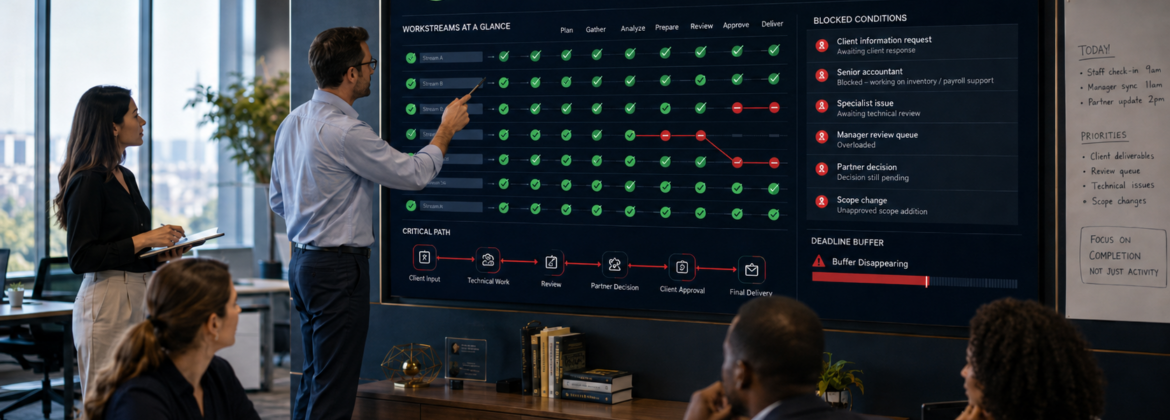
A manager opens the workflow dashboard on Monday morning.
The engagement appears healthy:
- Due date: three weeks away
- Progress: 72 percent
- Assigned staff: three
- Status: green
Then the manager asks what remains.
- The client has not delivered the final inventory detail.
- A specialist has not reviewed a multistate issue.
- The senior has completed most workpapers but not the high-risk revenue section.
- The partner must approve a position before the return can be finalized.
- The reviewer is assigned to four other deadlines that week.
- The scope expanded, but the fee and delivery date were never reset.
The dashboard measured activity.
It did not measure whether the engagement could finish.
The true critical path is:
Until those dependencies are resolved, 72 percent complete is not meaningful.
A task list tells you what people are doing. Project management tells you whether the client outcome can still be delivered—and what must change before it cannot.
Who I Am and Why This Matters
I have practiced public accounting since 1990. I founded my accounting firm in 1993, merged it in 2001 to form Howard, Howard and Hodges, and helped grow the organization from three people to approximately 50 staff across multiple Florida locations and states. Our firm was named PASBA Firm of the Year in 2015.
As firms grow, deadlines stop being controlled by individual effort alone. They depend on client information, staff capability, reviewer availability, manager judgment, partner decisions, specialist input, technology, scope and fee alignment, and communication.
The manager’s job changes. The manager is no longer only the person who knows the technical answer. The manager must make sure the right answer can be produced, reviewed, communicated, delivered, billed, and learned from on time.
Since 2020, I have built and run the SkillAbility accounting workforce development platform, used by more than 1,000 accounting professionals across dozens of PASBA firms.
That work has shown a common development gap: accountants are often promoted because they can perform the work, then expected to manage engagements without ever practicing project ownership.
They may know how to prepare or review a return. They may not yet know how to build a realistic plan, identify the critical dependency, protect review capacity, reset a date when the client is late, control scope before work begins, escalate risk with a recommendation, lead a status meeting that results in decisions, or close the project economically.
Those are trainable capabilities.
What Is Project Management Training for Accountants?
Project management training for accountants develops the ability to define client outcomes and scope; organize deliverables, tasks, owners, dependencies, milestones, capacity, quality gates, risks, decisions, and communications; manage changes and exceptions; and close engagements with evidence that deadlines, quality, economics, and client commitments were controlled.
An accounting engagement is often a project
A project has a defined outcome and temporary delivery cycle. Examples include:
- A tax return
- An audit or review
- A cleanup engagement
- A system conversion
- A forecast or valuation
- A tax notice response
- A CAS implementation
- A transaction or advisory project
Recurring monthly accounting is a repeating service cycle rather than one isolated project, but each period still contains project-management elements: inputs, cutoffs, dependencies, review, deliverables, and client decisions.
Workflow and project management are not the same
Workflow defines the repeatable sequence of work.
Project management applies that sequence to a specific client situation and controls the exceptions.
Workflow may say: “Prepare, review, deliver.”
Project management asks:
- What must be prepared?
- Who is capable of preparing it?
- What information must arrive first?
- When will it be review ready?
- Who has reviewer capacity?
- Which decision controls the date?
- What changes if the client is late?
Accountants do not need unnecessary project bureaucracy
A simple tax return does not need a 40-page charter. A complex conversion, audit, transaction, or advisory engagement may require more structure.
The method should be tailored to risk, complexity, duration, stakeholders, dependencies, quality requirements, and financial exposure.
Why Project Management Capability Matters Now
Workflow and capacity are current firm concerns
The AICPA’s 2026 PCPS Top Issues Survey included 629 respondents. Firms with 11–30 professionals ranked managing workload and capacity third. Firms with 31–100 professionals placed managing firm workflow in a three-way tie for fourth. Larger firms also identified workload and leadership development among their leading concerns.
Official source: AICPA 2026 CPA Firm Top Issues Survey.
Delivery Control Appears Inside Several Leading Firm Concerns
Source: AICPA 2026 PCPS Top Issues Survey. Bar lengths illustrate ranking order only; they do not represent percentages.
The profession is reassessing workforce readiness
In 2026, the AICPA launched the Profession Ready Initiative to identify the skills early-career CPAs need and develop frameworks and learning solutions for employers and professionals.
Official source: AICPA Profession Ready Initiative.
Modern project standards emphasize value and tailoring
PMI published the eighth edition of the PMBOK Guide in November 2025. It emphasizes value delivery, adaptability, accountability, quality, and contextual tailoring across governance, scope, schedule, finance, stakeholders, resources, and risk.
Official source: PMBOK Guide — Eighth Edition.
Late review creates deadline and quality risk
Current accounting guidance on engagement quality reviews emphasizes earlier reviewer involvement for complex or risky engagements instead of waiting until the final stage, when significant issues may force rework or delay issuance.
Source: How to prevent late-stage engagement quality review surprises.
Scope and client responsibilities must be explicit
Current CAS engagement-letter guidance recommends detailed objectives, deliverables, client and accountant responsibilities, timing, fees, and documented scope changes.
Source: Tips for writing CAS engagement letters.
How Accounting Project Management Differs From Generic Project Management
Deadlines may be externally fixed
Tax, regulatory, lender, board, and filing deadlines may not move because the client delivered information late.
Quality and professional obligations override schedule pressure
A project manager cannot solve a deadline by removing required procedures, consultation, review, or documentation.
Client information is often the largest dependency
The firm may be fully staffed but unable to progress because the client has not provided usable records or decisions.
Review capacity is distinct from preparation capacity
More preparers can create a larger queue when qualified reviewers are constrained.
Scope can change through informal conversations
A client email, meeting comment, or “quick question” can add work, risk, and deadlines without updating the engagement terms.
Many projects repeat—but each client differs
Templates help, but facts, systems, risk, client behavior, and judgment differ.
Economics may remain hidden until billing
A project can be on time and still fail because of scope leakage, wrong-level staffing, rework, low realization, or delayed billing.
The CONTROL Framework for Accounting Projects
C-O-N-T-R-O-L
C — Clarify Client Outcome, Scope, and Success
Define exactly what will be delivered, what is excluded, how success is judged, and what the client must do.
O — Organize Deliverables, Owners, and Work Packages
Break the engagement into complete outputs, assign accountable owners, and match work to competence.
N — Name Milestones, Dependencies, and the Critical Path
Identify what must happen first, what can occur in parallel, and which unresolved dependency controls the date.
T — Track Status, Capacity, Risk, and Economics
Use evidence-based status, forecast preparation and review separately, and surface exceptions before the deadline.
R — Review Quality and Decisions Early
Schedule risk-based review gates, consultation, and partner decisions while the team still has options.
O — Obtain Client Inputs and Control Change
Use clear requests, cutoffs, decision dates, and written changes to scope, fees, responsibilities, and delivery.
L — Lead Communication, Escalation, and Learning
Turn status into decisions, escalate with recommendations, close the engagement, and improve the next cycle.
Clarify the Client Outcome, Scope, and Success Criteria
Start with the outcome—not the task list
A project should begin with the result the client and firm must achieve.
Weak objective:
“Complete the engagement.”
Stronger objective:
“Deliver reviewed, supportable federal and multistate returns by March 10, obtain client approval by March 12, file before March 15, and communicate the identified estimated-payment and nexus decisions.”
Define success across multiple dimensions
| Dimension | Example Success Criterion |
|---|---|
| Deliverable | All agreed returns, reports, schedules, and communications delivered |
| Deadline | Internal completion precedes external deadline by the required buffer |
| Quality | Required support, review, judgment, documentation, and approval completed |
| Client | Client understands decisions, responsibilities, and next actions |
| Economics | Scope, fee, staffing, realization, and billing remain controlled |
| Development | Assigned employees demonstrate targeted capabilities |
Define exclusions
State what the project does not include.
Examples:
- Prior-period cleanup
- Bookkeeping corrections
- State registrations
- Tax planning
- Valuation
- Representation before authorities
- Implementation of recommendations
Define client responsibilities
Document:
- Information required
- Format and quality standard
- Responsible client contact
- Delivery dates
- Approvals and decisions
- Consequences of delay
Read CPA Firm Client Acceptance Checklist for screening scope, fit, risk, and capacity before work begins.
Organize Deliverables, Owners, and Work Packages
PMI’s work-breakdown guidance emphasizes organizing the complete project scope into manageable deliverables that support schedule, budget, risk, and performance control.
Official source: PMI Practice Standard for Work Breakdown Structures.
Break the engagement by deliverable
Example tax project:
- Client intake complete
- Book-to-tax reconciliation complete
- Federal return complete
- State returns complete
- Specialist issues resolved
- Manager review complete
- Partner approval complete
- Client package delivered
- E-file authorization received
- Return filed
- Invoice issued
- Post-engagement notes captured
Use the 100-percent principle
The planned work should represent the complete agreed scope.
If work is required but not represented, it will appear later as:
- An undocumented task
- A surprise dependency
- Unbudgeted manager time
- Late scope discovery
Assign one accountable owner
Multiple people may contribute.
One person should own the result.
Ownership includes:
- Knowing the next action
- Knowing the due date
- Following dependencies
- Escalating risks
- Confirming completion evidence
Match work to competence—not only availability
An available employee is not automatically qualified for the assignment.
Evaluate:
- Technical readiness
- Client knowledge
- System knowledge
- Self-review ability
- Judgment and escalation
- Need for supervision
Read Staff Accountant Competency Checklist for evidence-based responsibility expansion.
Name Dependencies and the Critical Path
What is a dependency?
A dependency is a condition that must occur before another activity or decision can proceed.
Six accounting dependency types
| Type | Examples |
|---|---|
| Client | Records, explanations, approvals, representations, e-file authorization |
| Internal work | Reconciliation before return preparation; testing before conclusion |
| Review | First review before manager review; manager review before partner release |
| Decision | Accounting policy, tax election, materiality, scope, pricing, filing position |
| External | Attorney, bank, appraiser, specialist, government agency, third-party confirmation |
| System | Portal access, data conversion, software configuration, integration, automation |
Identify the critical path
The critical path is the chain of dependent activities that determines the earliest possible completion date.
Managers do not need advanced scheduling software to use the concept.
Ask:
- What must happen before final delivery?
- Which item has no schedule flexibility?
- Which delay would move the delivery date?
- Which decision is waiting on one person?
Separate critical from important
Many tasks are important.
Only some control the finish date.
Track dependency dates—not only task dates
For every dependency, record:
- Provider
- Required item
- Requested date
- Needed-by date
- Current status
- Effect if late
- Escalation date
- Fallback plan
Use internal deadlines with buffers
External deadlines are not project plans.
Build:
- Client cutoff
- Preparation-ready date
- Review-ready date
- Manager-review date
- Partner-decision date
- Client-approval date
- Final delivery or filing date
Plan contingency by risk
High-risk dependencies need more buffer.
Examples:
- New client
- First-year audit
- New standard
- Complex multistate work
- Historically late client
- Single specialist
- New technology
PMI’s current scheduling guidance describes the purpose, components, maintenance, and communication of an effective schedule model.
Official source: PMI Practice Standard for Scheduling.
Use Milestones and Evidence-Based Status
A milestone represents a verified state
Examples:
- Client records accepted as complete
- Trial balance reconciled
- High-risk section prepared
- Specialist conclusion documented
- Manager review cleared
- Client approval received
- Invoice issued
Avoid subjective completion percentages
“Eighty percent complete” can mean:
- Eighty percent of tasks checked
- Eighty percent of hours spent
- Eighty percent of sections prepared
- The easy 80 percent is finished
Use milestone evidence instead.
Use four status states
- Not ready: required inputs or capacity are missing.
- Ready: inputs, owner, and capacity are available.
- In progress: work has started and the next milestone is known.
- Complete: acceptance evidence exists.
Add exception status
Use:
- On plan
- At risk
- Blocked
- Decision required
- Scope change pending
Green requires evidence
An engagement should not remain green when:
- A critical client dependency is late
- Reviewer capacity is unavailable
- A technical decision is unresolved
- Scope changed without approval
- The internal buffer is consumed
Plan Preparation, Review, Manager, Partner, and Specialist Capacity Separately
Total hours do not equal usable capacity
A firm may have 200 available staff hours and no qualified reviewer time.
Forecast by layer
| Layer | Typical Responsibilities |
|---|---|
| Preparation | Analysis, workpapers, procedures, documentation, self-review |
| First review | Completeness, standards, consistency, issue identification |
| Manager | Planning, judgment, client leadership, scope, budget, deadline control |
| Partner | Final judgment, risk, pricing, signing, relationship decisions |
| Specialist | Complex tax, valuation, technology, industry, quality, legal coordination |
Forecast review demand before preparation finishes
Review work arrives after preparation.
The manager should see future review-ready dates and reserve capacity before the queue forms.
Protect manager capacity
Managers need time for:
- Review
- Coaching
- Client decisions
- Scope and budget
- Risk escalation
- Future planning
Read Staff Leverage Ratio for Accounting Firms for the six-layer capacity model.
Use Early Quality Gates
One final review is too late for high-risk work
Final review should confirm the engagement—not discover its basic direction.
Possible quality gates
- Acceptance and scope gate
- Planning and risk gate
- Data and opening-balance gate
- Technical-position gate
- High-risk workpaper gate
- Draft deliverable gate
- Final release gate
Match gate timing to risk
Earlier review is appropriate when:
- The service level changed
- The client is new
- A new standard applies
- The transaction is unusual
- The team lacks prior experience
- The deadline is fixed
- The consequence of error is high
Preserve reviewer objectivity
For engagements subject to specific quality-review standards, early involvement must not transfer engagement-team decisions to an objective reviewer.
Define acceptance evidence
A gate is complete when required evidence exists—not when a meeting occurred.
Evidence may include:
- Approved planning memo
- Documented conclusion
- Cleared review notes
- Signed client approval
- Resolved consultation
Manage Risks, Assumptions, Issues, and Decisions
Risk is not the same as issue
- Risk: Something uncertain that may affect the project.
- Issue: A problem already occurring.
- Assumption: A planning belief that must be validated.
- Decision: A choice required to move the project forward.
- Dependency: Something the project needs from another task, person, or party.
Use a simple RAID-D log
| Type | Description | Owner | Due or Review Date | Response |
|---|---|---|---|---|
| Risk | Client may not deliver inventory support | Manager | Feb. 10 | Early request, cutoff, alternate procedure review |
| Assumption | No new state filing requirement | Senior | Feb. 5 | Validate nexus facts |
| Issue | Payroll reconciliation does not agree | Staff | Feb. 7 | Research variance and escalate |
| Decision | Tax treatment of transaction | Partner | Feb. 12 | Review memo and approve position |
| Dependency | Attorney document required | Client CFO | Feb. 8 | Escalate if not received |
Prioritize by impact and time to act
A high-impact risk with three months of lead time may be manageable.
A moderate risk discovered two days before a deadline may be more dangerous.
Escalate with a recommendation
Weak escalation:
“The client is late.”
Strong escalation:
“The inventory detail due Tuesday has not arrived. If received after Friday, manager review moves into the partner’s other deadline week. I recommend notifying the client today that delivery will move five business days unless the file arrives by noon Friday.”
Maintain a decision log
Record:
- Decision required
- Options considered
- Decision maker
- Date needed
- Decision made
- Reason and implications
- Who was informed
Manage Client Responsibilities and Communication
Client work is a joint delivery system
The client may own:
- Records
- Representations
- Management decisions
- Approval of adjustments
- Access to personnel
- Third-party coordination
- Payment and authorization
Use a client responsibility matrix
| Required Item or Decision | Client Owner | Requested Date | Needed-By Date | Effect if Late |
|---|---|---|---|---|
| Final trial balance | Controller | Jan. 20 | Jan. 25 | Preparation start moves |
| Inventory support | Operations CFO | Jan. 22 | Jan. 29 | Revenue and inventory review blocked |
| Tax-election decision | CEO | Feb. 5 | Feb. 10 | Return cannot finalize |
Distinguish requested date from needed-by date
The requested date includes time for:
- Completeness review
- Clarification
- Correction
- Internal processing
Communicate consequences neutrally
Do not threaten.
Explain the operating effect:
“To preserve the March 10 delivery date, we need complete inventory support by February 2. Information received later will be scheduled based on reviewer availability and may require an extension.”
Run decision-oriented status meetings
A useful status meeting answers:
- What was completed?
- What is blocked?
- Which dependency controls the date?
- What decision is required?
- Who owns the next action?
- What changed in scope, fee, risk, or timing?
Send written minutes
Record client commitments, firm commitments, decisions, open issues, and revised dates.
Control Scope and Change Before Added Work Begins
Recognize change signals
- “Can you also…”
- New entity or jurisdiction
- Cleanup beyond the agreed period
- New report or analysis
- Accelerated deadline
- Additional meeting or presentation
- New technology or data conversion
- Change in service level
Use a change decision
Four possible responses
- Include within existing scope and document why.
- Approve a change to scope, fee, staffing, and timing.
- Create a separate engagement.
- Decline or defer the request.
Do not let staff absorb the decision
Junior employees should be trained to identify and elevate change—not negotiate it silently or perform it without approval.
Read Scope Creep in Accounting Firms for the full manager change-control system.
Control Budget, Realization, Billing, and Lockup
Time budget is not the project objective
Hours are an input.
Managers should also track:
- Deliverable progress
- Review demand
- Scope changes
- Client-caused delay
- Rework
- Effective revenue
- Billing milestones
- Cash conversion
Use estimate-at-completion
Do not assume remaining hours equal the original budget minus hours used.
Investigate variance by cause
- Estimate
- Scope
- Client information
- Staffing and capability
- Review and rework
- Technical complexity
- Workflow
- Firm error
- Intentional investment
Connect project milestones to billing
Long projects should not accumulate WIP until final delivery without deliberate approval.
Use:
- Deposits
- Recurring billing
- Progress invoices
- Milestone invoices
- Delivery billing
Read Lockup Days for Accounting Firms for the work-to-cash system.
Interpret realization with project evidence
Low realization may reflect:
- Underpricing
- Uncontrolled scope
- Weak preparation
- Review bottlenecks
- Client delay
- Late billing decisions
Read Accounting Firm Realization Rate.
Workflow Software, Automation, and AI
Software should expose the operating truth
A useful system should show:
- Outcome and scope
- Deliverables
- Owners
- Milestones
- Dependencies
- Review-ready dates
- Capacity
- Risks and decisions
- Client requests
- Scope changes
- Billing status
A task list is not enough
Software can make a weak process look organized.
A dashboard with many checked boxes still fails when:
- The critical dependency is missing
- Status is subjective
- No reviewer is available
- Scope is unclear
- No one owns the decision
Use automation for routine coordination
Automation can support:
- Client reminders
- Recurring task creation
- Due-date calculations
- Status notifications
- Document routing
- Billing triggers
- Exception alerts
AI can support—not own—project decisions
AI may help:
- Draft project plans
- Summarize status
- Identify late dependencies
- Classify risks
- Forecast workload
- Draft client communications
- Compare current and prior projects
Human leaders remain responsible for:
- Data accuracy
- Professional judgment
- Quality requirements
- Scope and fees
- Client commitments
- Resource decisions
- Employment decisions
Validate AI-generated plans
Confirm that the plan includes:
- All deliverables
- Correct sequencing
- Real client dependencies
- Qualified reviewers
- Professional requirements
- Firm-specific authority
Worked Example: A Client Conversion and Advisory Launch
Illustrative example: The following data demonstrate the project-management method. They are not benchmarks or professional recommendations for every engagement.
A CPA firm accepts a client requiring:
- Three months of cleanup
- Conversion to the firm’s accounting platform
- Monthly close
- Management reporting
- Cash-flow forecast
- Quarterly advisory meetings
The weak plan
- Assign conversion to senior
- Assign cleanup to staff
- Start monthly work
- Deliver reports by month-end
The CONTROL plan
| Milestone | Owner | Dependency | Acceptance Evidence |
|---|---|---|---|
| Scope and responsibilities confirmed | Manager | Client process interviews | Signed engagement and responsibility matrix |
| Data access complete | Senior | Client credentials and exports | Access and data validation checklist |
| Cleanup complete | Staff | Complete records | Reconciled balances and open-item log |
| Conversion validated | Senior | Cleanup and mapping decisions | Parallel-balance agreement |
| First monthly close reviewed | Manager | Client approvals and close inputs | Cleared review notes and approved reports |
| Forecast and advisory launch | Manager | Reliable historical data and client goals | Forecast approved and meeting decisions documented |
Critical dependencies
- Client provides usable exports by September 5.
- Controller approves account mapping by September 12.
- Cleanup issues are resolved before conversion validation.
- Manager capacity is reserved for the first close.
- Client leadership defines forecast assumptions.
Early risks
- Source records may be incomplete.
- Payroll mapping may require specialist support.
- Client expects advisory before reliable monthly data exist.
- Cleanup may exceed the scoped period.
Change trigger
If cleanup exceeds the three agreed months or requires source-document reconstruction, work pauses for a scope, fee, staffing, and date decision.
Illustrative status comparison
Late Discovery Compresses the Remaining Options
Conceptual illustration, not empirical percentages. Earlier discovery generally provides more options to change scope, staffing, sequence, client responsibilities, or timing.
The project plan does not guarantee success.
It makes success and failure visible early enough to manage.
The Accounting Project Manager Dashboard
Project definition
Display:
- Client outcome
- Scope and exclusions
- External deadline
- Internal delivery date
- Success criteria
- Engagement owner
Milestone health
For each milestone, show:
- Owner
- Planned date
- Forecast date
- Evidence required
- Status
- Blocking dependency
- Days of buffer remaining
Dependency control
Show:
- Critical-path dependencies
- Client requests outstanding
- Decisions due
- External-party items
- Review and specialist availability
- Escalation dates
Capacity by layer
Display planned and available hours for:
- Preparation
- First review
- Manager
- Partner
- Specialist
- Administrative support
Quality and rework
Include:
- Quality gates completed
- Review-ready first-pass rate
- Repeated review notes
- Files returned for reconstruction
- Late issue discovery
- Manager rescue hours
Risk and change
Include:
- Open risks
- Active issues
- Unvalidated assumptions
- Decisions pending
- Scope changes pending
- Approved changes to fee and date
Economics and cash
Include:
- Original budget
- Hours used
- Estimate at completion
- Expected realization
- Direct contribution
- Billing milestone
- WIP and receivable status
Use a status narrative
A useful manager status statement is:
“The engagement remains on plan for March 10 if inventory support arrives by February 2 and the specialist position is approved by February 6. First-review coverage is available. The scope change for the new state filing is pending client approval and is excluded from the current delivery forecast.”
That statement is more useful than “72 percent complete.”
A 90-Day Project Management Implementation Plan
Days 1–30: Define the firm’s minimum control system
- Select two or three engagement types for the pilot
- Define outcomes, scope, deliverables, and milestone templates
- Define dependency categories
- Define evidence-based status
- Define quality gates
- Define role and decision rights
- Define client responsibility and change templates
- Establish baseline deadline, rework, and economics measures
Deliverable: A minimum viable accounting project standard—not a universal bureaucracy.
Days 31–60: Train and simulate
- Train managers and seniors on CONTROL
- Practice dependency mapping
- Practice client-delay conversations
- Practice scope-change decisions
- Practice risk escalation with recommendations
- Practice capacity forecasting
- Run project-review simulations
- Score performance with observable evidence
Deliverable: Trained pilot leaders and completed simulations.
Days 61–90: Pilot on live work
- Apply CONTROL to selected engagements
- Review milestone and dependency status weekly
- Forecast review capacity
- Measure client-input timeliness
- Track scope changes, rework, and manager rescue
- Compare planned and actual delivery
- Capture lessons and update templates
Deliverable: Measured live-work pilot and rollout recommendation.
Start with meaningful complexity
Choose projects with enough dependencies to test the system but not so much risk that an inexperienced trainee controls the engagement without support.
Do not begin with software selection
Define the management method first.
Then configure technology to support it.
Do not create parallel systems
Integrate the project controls with:
- Workflow
- Time and billing
- Document management
- Client portal
- Capacity planning
- Quality management
The Complete 30-Day Project Management Training Plan
Days 1–5: Outcome, scope, and deliverables
- Distinguish projects, workflows, and recurring cycles
- Define client outcome and success criteria
- Define inclusions and exclusions
- Build a deliverable-oriented work breakdown
- Assign accountable owners
- Define client responsibilities
Evidence: Project charter, deliverable map, responsibility matrix, and engagement-scope summary.
Days 6–10: Dependencies, schedule, and capacity
- Identify dependency types
- Build the critical path
- Create requested and needed-by dates
- Set internal buffers
- Forecast preparation and review capacity separately
- Identify single-person constraints
Evidence: Dependency map, milestone schedule, and layered capacity forecast.
Days 11–15: Quality, risk, and status
- Design risk-based quality gates
- Build a RAID-D log
- Define evidence-based status
- Identify decision deadlines
- Practice early escalation
- Prepare a project-status narrative
Evidence: Quality-gate plan, RAID-D log, and leadership status report.
Days 16–20: Client, scope, and communication
- Build client-request and responsibility schedules
- Conduct a late-information conversation
- Conduct a scope-change conversation
- Lead a decision-oriented status meeting
- Document minutes and commitments
- Reset delivery dates when dependencies change
Evidence: Client communication simulation, change order, and updated project plan.
Days 21–25: Economics, technology, and exceptions
- Estimate remaining effort
- Diagnose budget variance
- Connect milestones to billing
- Review realization and lockup
- Evaluate software and automation support
- Validate an AI-generated project plan
Evidence: Estimate-at-completion analysis, billing plan, and technology-control review.
Days 26–30: Independent capstone
- Analyze an unfamiliar engagement
- Build the complete CONTROL plan
- Identify critical path and capacity risk
- Lead a simulated status meeting
- Respond to a client delay and scope change
- Present the project to firm leadership
- Define closeout and learning measures
Evidence: Complete project-management package, leadership presentation, and 100-point scorecard.
Use Scenario-Based Training for Accountants to practice deadlines, dependencies, scope, and client conversations before live work absorbs the first attempt.
The 30/60/90-Day Live-Work Progression
Days 31–60: Controlled project coordination
The trainee may:
- Maintain milestones and dependencies
- Prepare status reports
- Follow routine client requests
- Forecast review-ready dates
- Identify risks and draft recommendations
- Coordinate approved workflow changes
Leadership retains material scope, pricing, quality, client-risk, staffing, and deadline decisions.
Days 61–90: Scoped project ownership
Expand responsibility when the trainee consistently:
- Defines success clearly
- Builds complete deliverables
- Identifies the critical path
- Uses truthful status
- Protects review capacity
- Escalates early with options
- Controls client inputs and changes
- Connects delivery with economics
After day 90: Authority remains defined
Firm leadership may retain authority for:
- Client acceptance and continuance
- Material scope and fee changes
- Professional-quality decisions
- Extensions, withdrawals, or report release
- Staffing and outsourcing
- Significant credits or write-downs
100-Point Project Management Readiness Scorecard
| Capability | Points | Observable Evidence |
|---|---|---|
| Outcome, scope, and success | 12 | Defines deliverables, exclusions, client value, deadlines, quality, and economics |
| Work breakdown and ownership | 10 | Builds complete work packages and assigns one accountable owner |
| Dependencies and critical path | 14 | Identifies client, internal, review, decision, external, and system dependencies |
| Milestones and status | 10 | Uses acceptance evidence, forecast dates, buffer, and truthful exception status |
| Capacity and assignment | 10 | Forecasts qualified preparation, review, manager, partner, and specialist capacity |
| Quality and risk | 12 | Uses early gates, RAID-D tracking, consultation, and professional safeguards |
| Client and stakeholder leadership | 10 | Controls requests, decisions, responsibilities, meetings, and written commitments |
| Scope and change control | 8 | Identifies changes before work and resets fee, capacity, responsibility, and date |
| Economics and closeout | 8 | Forecasts remaining effort, controls billing, and captures lessons |
| Communication and escalation | 6 | Converts status into decisions and escalates with evidence and recommendations |
Suggested readiness rule: Require at least 84 points overall, no zero category, no deadline represented as green when a critical dependency is late, no material scope change performed without approval, and leadership review for professional-quality, pricing, staffing, and client-risk decisions.
Realistic Project Management Scenarios for Accountants
Scenario 1: The green project with a late client dependency
The workflow shows 80 percent complete, but the client has not provided a critical schedule. The trainee must identify the real finish-date risk and reset communication.
Scenario 2: The review bottleneck
Four staff members finish preparation in the same week, but one qualified manager owns all reviews. The trainee must forecast and rebalance review capacity.
Scenario 3: The informal scope expansion
A client asks the senior to add a state filing and cash-flow analysis. The trainee must stop unauthorized work and prepare the change decision.
Scenario 4: The first-year audit
Opening-balance procedures and specialist consultation are discovered late. The trainee must build early quality gates and critical-path dependencies.
Scenario 5: The recurring CAS close
The client sends records in fragments, forcing repeated starts and stops. The trainee must define data standards, cutoffs, and delivery consequences.
Scenario 6: The partner decision bottleneck
The entire engagement is ready except for a technical position awaiting partner approval. The trainee must set a decision deadline and provide options.
Scenario 7: The capable employee with the wrong assignment
A strong tax preparer is assigned a conversion project without system experience. The trainee must distinguish general performance from project readiness.
Scenario 8: The accelerated deadline
The client asks for delivery two weeks earlier. The trainee must evaluate scope, capacity, quality, client inputs, fee, and displacement of other work.
Scenario 9: The repeated review note
A project remains on schedule only because the manager reconstructs staff work. The trainee must connect project status with capability and manager rescue.
Scenario 10: The external specialist delay
A valuation report controls the completion date. The trainee must manage the external dependency and develop a fallback or client-date decision.
Scenario 11: The optimistic percentage
A senior reports 90 percent complete, but the unresolved 10 percent contains the most complex judgments. The trainee must replace percentage status with milestone evidence.
Scenario 12: The profitable project that will not bill
Work is complete, but pre-bill approval and scope uncertainty trap WIP. The trainee must connect project closeout with billing and lockup.
Scenario 13: AI-generated project plan
The plan is polished but omits client representations, review capacity, and a mandatory consultation. The trainee must validate and correct it.
Scenario 14: The status meeting with no decisions
The team meets weekly but repeats the same updates. The trainee must redesign the meeting around blockers, decisions, owners, and dates.
Scenario 15: The failed deadline postmortem
The trainee must distinguish client, scope, estimate, staffing, review, workflow, quality, and governance causes and convert them into improvements.
Each scenario should require planning evidence, project judgment, communication, and measurable follow-up—not memorized terminology alone.
What the Firm Should Measure
| Metric | What It Reveals |
|---|---|
| On-time internal milestone rate | Whether work progresses before the external deadline |
| Forecast accuracy | Whether expected completion dates and effort are realistic |
| Critical dependency lateness | How client, external, review, and decision delays affect delivery |
| Client-input completeness rate | Whether requests produce usable information the first time |
| Review-ready first-pass rate | Quality and independence of preparation |
| Review queue age | Congestion in first-review, manager, partner, or specialist layers |
| Late issue discovery | Quality risks that escaped planning and early gates |
| Manager rescue hours | Capacity consumed by taking work back or reconstructing it |
| Scope-change capture rate | Whether changes are approved before added work occurs |
| Estimate at completion versus actual | Planning and reforecast quality |
| Billing realization | Whether project effort converts into invoiced value |
| WIP days after milestone | Whether completed project value reaches an invoice promptly |
| Decision turnaround time | Whether managers and partners unblock the project promptly |
| Client commitment reliability | Whether agreed inputs and approvals arrive as promised |
| Post-project improvement adoption | Whether lessons change the next cycle |
Read Accounting Onboarding KPIs for related independence, quality, and manager-dependence measures.
Common Project Management Mistakes in Accounting Firms
Mistake 1: Using the external deadline as the plan
The firm has no internal milestones, review dates, or client cutoffs.
Mistake 2: Tracking tasks without dependencies
The dashboard shows activity but not what controls completion.
Mistake 3: Using percentage complete
Optimistic status hides unresolved high-risk work.
Mistake 4: Assigning by availability alone
The employee lacks the technical, system, client, or self-review capability required.
Mistake 5: Forecasting preparation but not review
Completed work enters a congested manager queue.
Mistake 6: Waiting until final review
Major judgments and deficiencies surface after options disappear.
Mistake 7: Treating client delay as unavoidable
The firm keeps the old date without enforcing cutoffs or rescheduling.
Mistake 8: Allowing scope changes through email
Added work begins before fee, staffing, risk, and date are approved.
Mistake 9: Running status meetings without decisions
Updates repeat while blockers remain ownerless.
Mistake 10: Using software before defining the method
The firm digitizes unclear ownership and subjective status.
Mistake 11: Managers rescue every deadline
Projects finish, but staff capability and manager capacity decline.
Mistake 12: Ignoring project economics
The engagement is delivered on time but suffers low realization and delayed billing.
Mistake 13: Overengineering simple work
Administrative burden exceeds the risk and complexity of the project.
Mistake 14: Letting AI determine professional decisions
A generated plan replaces qualified judgment and firm policy.
Mistake 15: Skipping closeout
The same dependency, review, and client problems recur next cycle.
Frequently Asked Questions About Project Management Training for Accountants
What is project management training for accountants?
It teaches accountants to define scope and outcomes, organize deliverables and owners, manage dependencies, schedule milestones and review, control risks and changes, communicate with clients, and close engagements economically.
Why do accountants need project management skills?
Accounting work depends on client information, technical decisions, review capacity, deadlines, scope, staffing, and communication. Technical ability alone does not control those dependencies.
Is an accounting engagement a project?
Many engagements are projects because they have a temporary delivery cycle and defined result. Recurring services are repeating operating cycles with project-management elements in each period.
What is the difference between workflow and project management?
Workflow defines the repeatable process. Project management applies it to a specific client, controls dependencies and exceptions, and protects the outcome.
Do accountants need PMP certification?
Most accountants do not need PMP certification to manage client engagements effectively. They need a tailored, practical system appropriate to the firm’s services, risk, and complexity.
What is a project dependency in accounting?
It is something required before work or a decision can proceed, such as client records, a reconciliation, reviewer availability, a technical conclusion, partner approval, or third-party information.
What is the critical path in an accounting engagement?
It is the chain of dependent activities and decisions that controls the earliest possible completion date.
How should accountants track project status?
Use verified milestone evidence, forecast dates, open dependencies, available capacity, risks, decisions, and remaining buffer instead of subjective completion percentages.
How should firms manage late client information?
Set requested and needed-by dates, communicate consequences, use cutoffs, escalate before the critical date, and reset delivery based on actual reviewer capacity.
How does project management reduce scope creep?
It identifies change signals, pauses unapproved added work, and documents the effect on deliverables, fee, staffing, risk, client responsibilities, and timing.
How does project management improve quality?
It schedules early risk-based review gates, consultation, and decision points rather than relying on one final review.
How does project management improve realization?
It exposes estimate, scope, staffing, rework, client, and workflow problems early and connects deliverable milestones to billing.
What should be included in an accounting project plan?
Include outcome, scope, exclusions, deliverables, owners, dependencies, milestones, critical path, capacity, quality gates, risks, decisions, client responsibilities, communications, change control, budget, and billing.
Can project management software solve missed deadlines?
Software helps only when the firm has clear scope, ownership, dependency, capacity, status, and escalation rules. It cannot repair an undefined management process by itself.
How can AI help accountants manage projects?
AI can draft plans, summarize status, identify patterns, forecast workloads, and draft communications. Human leaders must validate the plan and retain professional, client, staffing, and quality decisions.
How should firms train accountants in project management?
Combine concise instruction with realistic simulations, controlled live work, observable scorecards, coaching, and progressively broader ownership.
What project management metrics should CPA firms track?
Track milestone reliability, forecast accuracy, dependency lateness, review queue age, first-pass quality, manager rescue, scope-change capture, realization, WIP, decision time, and client commitment reliability.
Can Your Seniors and Managers See the Dependency That Will Break the Deadline—and Act While Options Remain?
SkillAbility helps accounting firms develop review-ready staff, capable reviewers, stronger managers, confident advisors, and future partners through structured practice, feedback, judgment development, and measurable readiness.
Book Your Free 10-Minute Structural Alignment Review →
Includes our 45-Day Out-of-Pocket Performance Guarantee.
To controlling client work prospectively instead of rescuing it retrospectively,
Vincent Howard, CPA
Managing Partner, Howard, Howard and Hodges
SkillAbility for Accounting Firms
About the Author
Vincent Howard, CPA has practiced public accounting since 1990. He earned a Bachelor of Science in Accounting and a Master’s in Taxation from the University of Central Florida, founded his accounting firm in 1993, and serves as Managing Partner of Howard, Howard and Hodges. He helped grow the organization from three people to approximately 50 staff across multiple Florida locations and states. He has participated in PASBA since 1997, and the firm was named PASBA Firm of the Year in 2015. Since 2020, he has built and run the SkillAbility accounting workforce development platform, used by more than 1,000 accounting professionals across dozens of PASBA firms.
© 2026 SkillAbility for Accounting Firms. This article provides general educational information and does not replace accounting, tax, audit, legal, ethics, independence, quality-management, project-management, employment, pricing, data-security, professional-liability, or regulatory advice. Firms should tailor project controls to their services, facts, standards, policies, and applicable law.