
By Vincent Howard, CPA | Managing Partner, Howard, Howard and Hodges | SkillAbility for Accounting Firms
Last updated: July 17, 2026 | 24-minute read
- What scenario-based accounting training means
- Why judgment development matters now
- Scenarios vs. cases, quizzes, shadowing, and live work
- Seven judgment capabilities scenarios should build
- The anatomy of a strong accounting scenario
- A five-level scenario difficulty ladder
- Copy-and-use scenario design template
- How to run feedback and debriefs
- 100-point judgment-readiness scorecard
- Scenario library ideas for CPA firms
- Completed scenario example
- A 90-day implementation plan
- Readiness gates before live client work
- AI-generated work and scenario training
- What CPA firms should measure
Most accounting firms still develop judgment through exposure.
A new hire watches a manager handle an issue. A staff accountant receives a review note after choosing the wrong treatment. A senior hears a partner explain why a client conversation went badly. Over several busy seasons, the employee begins recognizing patterns.
Sometimes.
The problem is that exposure is inconsistent.
One employee receives a strong manager who explains the reasoning. Another receives corrections without context. One person sees several difficult client situations during the first year. Another spends two years completing routine work and is suddenly expected to exercise judgment after a promotion.
AI and automation make this development problem more urgent.
Many of the repetitive tasks that once exposed junior accountants to source documents, unusual transactions, workflow breakdowns, and client inconsistencies are becoming faster or partially automated. That can improve productivity. It can also remove the slow accumulation of experience firms relied on to build pattern recognition.
If the firm does not replace accidental exposure with intentional practice, employees may become faster at producing output without becoming better at evaluating whether the output is reasonable.
Clients should not host an accountant’s first attempt at professional judgment. The first attempt should happen in a controlled scenario where errors create feedback—not client risk.
Scenario-based training gives the firm a structured way to expose employees to the decisions, ambiguity, exceptions, client reactions, and professional boundaries they need before live work carries the consequences.
Who I Am and Why This Matters
I have practiced public accounting since 1990. I founded my accounting firm in 1993, merged it in 2001 to form Howard, Howard and Hodges, and helped grow the organization from three people to approximately 50 staff across multiple locations and states. Our firm was named PASBA Firm of the Year in 2015.
In a growing firm, the most expensive knowledge is rarely a checklist step.
It is the judgment behind questions such as:
- Does this explanation make sense?
- Is the client’s requested treatment appropriate?
- Which issue matters most?
- Can this person resolve the matter independently?
- What evidence is missing?
- What should be communicated to the client?
- When must a manager, partner, specialist, HR, legal, or security professional become involved?
Experienced professionals answer those questions using technical knowledge, pattern recognition, client context, firm standards, professional skepticism, and lessons accumulated through years of work.
The traditional answer was to let junior employees shadow those professionals until enough judgment transferred.
That approach does not scale.
Managers are already overloaded. Live client work does not arrive in a planned developmental sequence. The employee may see the wrong issue at the wrong time or never receive a useful explanation of why the decision was made.
Since 2020, I have built and run the SkillAbility accounting workforce development platform used by more than 1,000 accounting professionals across dozens of PASBA firms. That work has reinforced a principle I believe CPA firms need to adopt:
Judgment should be developed through structured exposure, realistic decisions, immediate feedback, repeated practice, and evidence of readiness—not assumed after enough time has passed.
Why Scenario-Based Judgment Training Matters Now
The AICPA’s Profession Ready Initiative describes a workforce-readiness problem created as entry-level tasks become automated. Its current guidance explicitly points toward judgment, simulation, and continuous upskilling as the focus of future training.
The initiative, launched in 2026, is researching the skills early-career CPAs need in an increasingly AI-driven workplace and is intended to produce a skills framework, learning solutions, and employer resources.
The AICPA PCPS CPA Firm Competency Model, updated in October 2025, identifies productivity, technical knowledge, client service, people development and teamwork, business development, and culture and inclusion across associate through partner roles.
Scenario-based training can integrate those competencies instead of teaching them in isolation.
A realistic client issue may require the learner to:
- Understand the accounting or tax work
- Recognize a risk or inconsistency
- Manage time and workflow
- Communicate with a client
- Coordinate with a reviewer
- Document the conclusion
- Protect confidentiality
Accounting education is also moving toward experiential work
Recent articles in the Journal of Accounting Education have described simulation, business experience, case-based work, and scaffolded workpaper exercises as methods for improving engagement, deeper processing, practical competence, and professional readiness.
That evidence is encouraging, but CPA firms should not overstate what any single study proves. Firm training occurs in a different environment from a university course, and professional judgment includes role authority, client context, firm standards, and consequences that classroom exercises may not reproduce fully.
Other high-stakes professions reinforce the design principles
Research in medicine and nursing has found that simulation paired with deliberate practice can improve specific skills, communication, clinical judgment, and retention. A meta-analysis comparing simulation-based medical education with deliberate practice against traditional clinical education found stronger skill-acquisition outcomes for the simulation approach.
Those studies do not prove that an accounting scenario will produce the same effect.
They do support several instructional design principles that transfer logically to accounting:
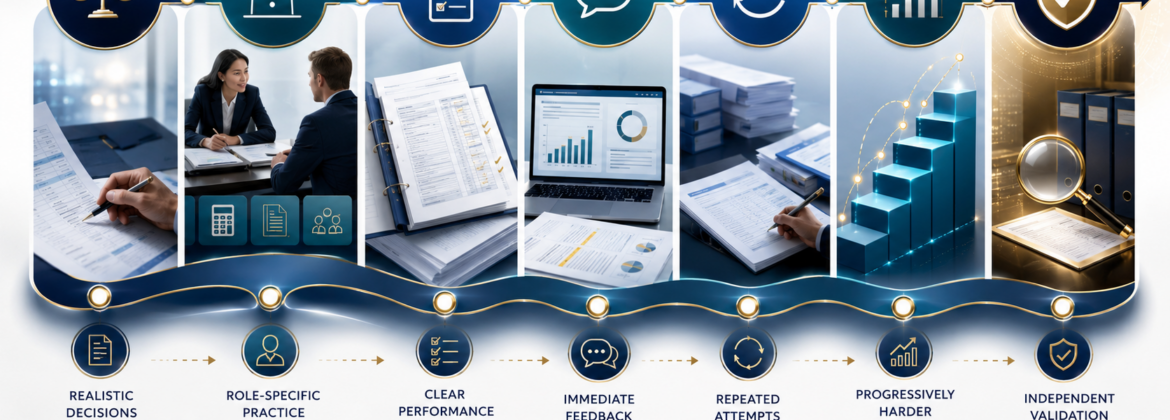
- Practice should be realistic and role-specific
- Learners need clear performance standards
- Feedback should follow observable behavior
- Employees should repeat the task after feedback
- Difficulty should increase progressively
- Competence should be tested, not inferred from attendance
Scenario Design Matters More Than Simply Calling an Exercise a Simulation
The learner must evaluate facts and choose an action—not only recall information.
Feedback identifies the specific behavior, reasoning, communication, or escalation gap.
The employee retries the skill with changing facts until performance becomes reliable.
Accounting-specific research and supporting evidence from other high-stakes professions point toward structured practice, feedback, and progressive complexity. Firms should validate results in their own work environment.
The U.S. Bureau of Labor Statistics projects approximately 124,200 accountant and auditor openings each year from 2024 through 2034 and expects automation to make analytical and advisory responsibilities more prominent.
Firms therefore need a repeatable way to build the reasoning and communication that technology cannot safely replace.
What Is Scenario-Based Training for Accountants?
Scenario-based training for accountants is a structured practice method that places learners inside realistic accounting, tax, review, workflow, client, ethical, or leadership situations and requires them to interpret incomplete information, make decisions, communicate, document, and escalate before similar responsibility is assigned on live client work.
A complete scenario includes:
- A realistic role
- A business or client context
- Relevant documents and systems
- Incomplete, conflicting, or changing information
- A decision or conversation
- Defined authority and escalation boundaries
- Observable evidence of performance
- Feedback and another attempt
The learner should not be rewarded only for arriving at the expected answer.
The firm should evaluate how the employee reached it.
Scenario Training vs. Cases, Quizzes, Shadowing, and Live Client Work
| Method | What It Builds | Main Limitation |
|---|---|---|
| Knowledge quiz | Recall and recognition | Does not prove performance under ambiguity |
| Written case | Analysis and written reasoning | May not test timing, communication, workflow, or changing facts |
| Demonstration | Shows how an expert performs | The learner may remain passive |
| Shadowing | Exposure to real work and relationships | Timing and coaching quality are inconsistent |
| Live client work | Authentic responsibility and consequences | Errors can affect clients, deadlines, quality, and reputation |
| Scenario-based simulation | Integrated execution, judgment, communication, documentation, and escalation | Requires thoughtful design, facilitation, scoring, and maintenance |
These methods should not compete.
A strong development pathway may use a short lesson to establish knowledge, a demonstration to show the process, a scenario to build judgment, and controlled client work to validate readiness.
For the broader alternative to unstructured shadowing, read How to Develop Accounting Staff Without Relying on Shadowing.
Seven Judgment Capabilities Scenarios Should Build
Notice → Investigate → Evaluate → Decide → Explain → Document → Escalate
Recognize that something is unusual, unsupported, inconsistent, or risky.
Identify the additional facts, sources, questions, and context needed.
Compare explanations, authority, evidence, alternatives, and uncertainty.
Choose the next action within the learner’s role and approved authority.
Communicate the issue, reasoning, limitation, and recommendation clearly.
Create evidence another professional can understand and review.
Know when the matter exceeds the person’s authority, expertise, or risk tolerance.
1. Issue recognition
The employee must first notice that the normal process may not apply.
Examples include:
- A balance that changed unexpectedly
- A client explanation that conflicts with the records
- An AI-generated conclusion that does not match the source data
- A recurring adjustment with weak support
- A communication request outside the engagement scope
2. Information gathering
The learner should determine what is missing instead of guessing.
3. Evidence evaluation
Judgment requires comparing sources, credibility, authority, alternatives, and known limitations.
4. Decision-making
The learner should select an action proportional to the evidence and the role.
5. Communication
A technically correct conclusion is incomplete when the employee cannot explain it to a reviewer or client.
6. Documentation
The record should show the issue, evidence, procedures, reasoning, conclusion, unresolved items, and required review.
7. Escalation
Strong judgment includes recognizing when not to decide alone.
For a deeper issue-recognition framework, read Professional Skepticism Training for Junior Accountants.
The Anatomy of a Strong Accounting Scenario
1. Define the role
State whether the learner is acting as a new staff accountant, experienced staff member, senior, reviewer, manager, or client-facing advisor.
The same facts should produce different expectations at different levels.
2. Define the business result
Examples:
- Submit a review-ready workpaper
- Resolve a client information gap
- Identify an unsupported tax position
- Explain a cash-flow issue
- Manage a deadline conflict
- Escalate a suspected security event
3. Provide realistic artifacts
Use sanitized or fictional:
- Source documents
- Workpapers
- Trial balances
- Tax forms
- Client emails
- Workflow notes
- Prior-period files
- AI-generated summaries
4. Include an ambiguity
The learner should not be able to succeed by following a fixed checklist blindly.
5. Include decision points
Decide where the learner must choose whether to continue, request information, research, correct, communicate, or escalate.
6. Include a consequence
The learner should understand what the decision affects: quality, deadline, client confidence, tax exposure, cash flow, security, scope, or reviewer time.
7. Include a variation
Change one fact after the initial decision.
For example:
- The client becomes defensive
- A missing document arrives and contradicts the explanation
- The deadline moves forward
- The manager is unavailable
- The automated result changes after a data correction
8. Define evidence and scoring
Specify what the learner must produce and how the firm will evaluate it.
A Five-Level Scenario Difficulty Ladder
| Level | Scenario Conditions | Primary Development Goal |
|---|---|---|
| 1. Guided routine | Complete information, familiar workflow, visible checkpoints | Correct execution and documentation |
| 2. Routine with one gap | One missing item, discrepancy, or unclear instruction | Issue recognition and information gathering |
| 3. Competing explanations | Conflicting evidence, incomplete client context, multiple possible responses | Evidence evaluation and professional skepticism |
| 4. Pressure and communication | Deadline pressure, client reaction, workload conflict, or unavailable reviewer | Prioritization, communication, and escalation |
| 5. Integrated judgment | Technical, client, ethical, workflow, and leadership issues interact | Role-level readiness and independent judgment |
Do not move directly from a routine exercise to a complex client simulation.
Progressive difficulty allows the firm to identify the exact stage where performance breaks down.
Copy-and-Use Accounting Scenario Design Template
CPA Firm Scenario-Based Training Design
| Scenario title | |
| Target role | |
| Target competency | |
| Difficulty level | |
| Expected time | |
| Coach / evaluator |
1. Business result and risk protected
2. Learner role and authority
3. Scenario background
4. Documents, systems, and available information
☐ Prior-period file
☐ Workpaper or tax form
☐ Client communication
☐ Firm SOP or checklist
☐ Technical guidance
☐ Workflow status
☐ AI-generated output
☐ Other role-specific evidence
5. Hidden issue, ambiguity, or planted error
6. Decision points
| Decision | Evidence to Evaluate | Approved Actions | Escalation Trigger |
|---|---|---|---|
7. Scenario variation
8. Required learner outputs
☐ Written analysis
☐ Client email or meeting response
☐ Reviewer explanation
☐ Technical research summary
☐ Escalation note
☐ Recommendation and next action
☐ Self-assessment
9. Scoring evidence
10. Feedback, retry, and readiness decision
| Observed Strength | Critical Gap | Retry Variation | Readiness Decision |
|---|---|---|---|
How to Run Feedback and Debriefs
The debrief is where experience becomes learning.
Do not begin by telling the learner the correct answer.
1. Ask for the learner’s reasoning
- What did you notice first?
- What did you believe the main issue was?
- Which evidence influenced your decision?
- What were you uncertain about?
- Why did you decide to continue, correct, communicate, or escalate?
2. Separate the result from the process
A learner may reach the expected answer using weak reasoning.
Another may make a defensible decision with incomplete information but communicate it poorly.
Score the components separately.
3. Focus on one or two high-value changes
A long list of comments can make the next attempt less focused.
4. Rewind and retry
Give the employee another opportunity to perform the difficult moment while the feedback is fresh.
5. Add a variation
Change one fact to test whether the employee learned the principle rather than memorized the expected answer.
6. End with a transfer question
Ask:
“Where else in your work could this issue appear?”
This helps the employee connect the scenario to future client work.
100-Point Accounting Judgment Readiness Scorecard
| Judgment Area | Points | Strong Evidence |
|---|---|---|
| Technical and workflow foundation | 10 | Understands the normal process, relevant sources, and role expectations |
| Issue recognition | 15 | Notices the inconsistency, risk, missing evidence, or exception without being told |
| Information gathering | 10 | Identifies and obtains the relevant facts without unnecessary requests |
| Evidence evaluation and skepticism | 15 | Challenges weak assumptions, compares sources, and states uncertainty |
| Decision quality | 15 | Selects a proportionate action supported by the evidence and role |
| Communication | 10 | Explains the issue, impact, limitation, and next step clearly and professionally |
| Documentation | 10 | Leaves a clear record of evidence, reasoning, conclusion, and unresolved items |
| Escalation and authority | 10 | Recognizes when the matter exceeds technical, ethical, security, scope, or role authority |
| Learning agility | 5 | Uses feedback effectively and improves performance on the retry |
Suggested interpretation
- 85–100: Strong evidence for controlled responsibility within the scenario’s defined scope.
- 75–84: Core readiness is present, with targeted supervision or checkpoints still required.
- 60–74: Partial readiness; repeat scenarios and close specific gaps before live responsibility expands.
- Below 60: Foundational technical, workflow, communication, or judgment development is still required.
A high total score should not override a serious integrity, confidentiality, security, technical-authority, or escalation failure.
For broader client-work readiness, use the Staff Accountant Competency Checklist.
Scenario Library Ideas for CPA Firms
Accounting and monthly close
- Profit increased while cash declined
- A bank reconciliation contains a stale item
- A payroll liability does not clear
- A client explanation conflicts with the ledger
- An unusual owner transaction appears
- A close deadline is at risk because information is missing
Tax
- A prior-year treatment was copied without confirming current facts
- Basis information is incomplete
- Related-party activity is poorly documented
- A client requests an aggressive treatment
- A multistate fact appears late in the process
- An AI-generated tax summary cites the wrong authority
Review
- A workpaper is complete but unsupported
- The conclusion is correct but the reasoning is not documented
- The reviewer identifies repeated basic readiness failures
- Two reviewers disagree about materiality or escalation
- The file contains a plausible but planted error
Client communication
- A client becomes defensive about missing information
- The client asks a question outside the engagement scope
- A margin decline requires operational questions
- A difficult finding must be explained without accusation
- The employee must consolidate multiple information requests
Workflow and capacity
- The manager is unavailable during a deadline conflict
- Preparation is complete but the review queue is overloaded
- Two high-priority clients need the same specialist
- A software integration fails during processing
- The employee must decide what to stop, continue, or escalate
Ethics, security, and professional boundaries
- A client sends information through an insecure channel
- An employee notices access that appears broader than necessary
- A request creates a potential conflict or independence issue
- A client asks the employee to hide or alter information
- A generative AI tool is used with confidential data
Build scenarios from real firm patterns after removing confidential information and changing identifying facts.
The Workpaper Review Checklist can provide observable standards for many preparation and review scenarios.
Completed Example: Unsupported Related-Party Transaction
Staff Accountant Preparing a Business Return
| Business result | Prepare a review-ready business return while identifying and documenting unusual related-party activity. |
| Learner role | Staff accountant authorized to prepare, request routine information, document issues, and escalate technical conclusions. |
| Available evidence | General ledger, prior return, shareholder loan schedule, bank activity, client email, and firm preparation checklist. |
| Planted issue | A large transfer to a related entity is coded as a routine operating expense. The client email describes it as temporary funding, but no agreement or repayment evidence is provided. |
| Expected recognition | The transaction may be misclassified and requires more facts before the return can be completed. |
| Required questions | Who owns the related entity? What was the business purpose? Was repayment expected? Is there an agreement? Was any amount repaid? How was it treated on the other entity’s records? |
| Decision | Do not finalize the treatment. Create an open item, request evidence, summarize the facts, and escalate the classification and tax consequences to the reviewer. |
| Communication | Send a concise request explaining that the documentation is needed to determine the proper treatment rather than accusing the client of an error. |
| Variation | The client replies that the prior accountant always deducted similar transfers and asks the employee to “just handle it the same way.” |
| Expected response | Explain that current facts and support must be evaluated, avoid promising the requested treatment, and involve the manager. |
| Validation evidence | The learner identifies the issue, requests relevant facts, documents uncertainty, communicates professionally, and escalates without being prompted. |
The scenario does not require the staff accountant to make the final technical determination.
It tests whether the employee recognizes the issue, gathers the right information, preserves the open question, communicates appropriately, and places the decision with the correct reviewer.
A 90-Day Scenario-Based Training Implementation Plan
| Period | Primary Focus | Required Evidence |
|---|---|---|
| Days 1–30 | Select critical competencies, collect recurring firm issues, define role standards, build three pilot scenarios, and establish scoring | Scenario register, sanitized artifacts, scoring rubrics, facilitator guide, baseline assessments, and pilot schedule |
| Days 31–60 | Run pilots, observe learner behavior, improve realism, calibrate evaluators, add variations, and connect results to development plans | Recorded observations, scorer agreement, learner feedback, revised scenarios, retry evidence, and targeted coaching plans |
| Days 61–90 | Expand the library, establish readiness gates, train managers as coaches, assign recurring practice, and validate transfer into controlled work | Approved scenario pathway, readiness decisions, controlled client assignments, quality results, manager-time measures, and review dates |
Start with three high-value scenarios
Choose issues that:
- Repeat across employees
- Create manager rework
- Carry client or quality risk
- Require more than procedural recall
- Can be sanitized safely
Calibrate evaluators
Two managers may score the same behavior differently unless the firm defines observable standards and reviews example responses together.
Protect practice time
Scenario work should not become an optional task removed whenever production becomes busy.
Connect results to real assignments
The scenario should affect what work the employee receives next, what coaching is assigned, and which responsibilities remain controlled.
Use the Accountant Development Plan to connect scenario evidence to the employee’s longer-term pathway.
Readiness Gates Before Live Client Work
A scenario score should not automatically authorize unrestricted client work.
Use four gates.
Gate 1: Technical and workflow foundation
The employee understands the normal work, source documents, firm systems, and documentation requirements.
Gate 2: Judgment and escalation
The employee recognizes issues, asks for relevant facts, states uncertainty, and escalates appropriately.
Gate 3: Communication and confidentiality
The employee communicates clearly, protects information, and does not overpromise or exceed authority.
Gate 4: Controlled live validation
The employee performs a defined client assignment with appropriate access, checkpoints, review, and manager visibility.
Scenario Success Does Not Mean Unsupervised Practice
It means the firm has evidence to move the learner into the next controlled level of responsibility. Client work remains subject to the firm’s supervision, review, professional standards, access controls, and engagement requirements.
AI-Generated Work and Scenario Training
AI creates new scenario opportunities because it can produce work that appears polished before anyone proves it is correct.
Use scenarios that require the learner to:
- Trace an output to source information
- Identify a fabricated or unsupported citation
- Recognize a conclusion that ignores client context
- Challenge an unreasonable trend explanation
- Correct a confident but incomplete client email
- Decide when AI use requires disclosure, review, or prohibition under firm policy
The AICPA’s Profession Ready Initiative emphasizes judgment and simulation as entry-level tasks become automated. SkillAbility’s article AI Accounting Training: Building Judgment in New Staff provides a deeper framework for this transition.
Use approved tools and sanitized information
Do not place confidential client or employee information into unapproved systems to make a training scenario more realistic.
Teach verification, not distrust of all automation
The goal is not to reject AI output automatically.
The goal is to understand what must be verified, what evidence supports the conclusion, and what remains a human professional responsibility.
Score the learner’s ability to overrule the tool
A person who can operate the system but cannot challenge it is not ready to review its work.
For the broader role shift, read Accountants Are Shifting From Preparers to Reviewers.
What Should CPA Firms Measure?
Learning Evidence
Baseline scores, retry improvement, scenario difficulty passed, and retention over time.
Work Quality
Issue recognition, review notes, unsupported conclusions, documentation quality, and escalation timing.
Firm Capacity
Manager rescue, repeated explanations, reviewer correction time, and readiness for broader assignments.
Risk and Transfer
Client-work errors, confidentiality failures, missed escalations, and performance on controlled live work.
Useful measures include:
- Percentage of critical competencies with at least one scenario
- Baseline-to-retry score improvement
- Percentage of learners who recognize the planted issue without prompting
- Time required to reach a defensible decision
- Quality of questions asked
- Documentation completeness
- Appropriate escalation rate
- Repeated review-note rate after scenario completion
- Manager rescue time
- Controlled client-work pass rate
- Retention when the scenario is repeated later
- Evaluator consistency
Do not measure only scenario completion.
Measure whether the learner’s decisions, explanations, documentation, and live work improve.
Common Scenario-Based Training Mistakes
Making the answer too obvious
Real judgment requires uncertainty and competing evidence.
Testing technical recall only
A multiple-choice answer does not show how the employee will communicate or escalate.
Using unrealistic documents
Generic facts weaken transfer into the firm’s actual workflow.
Scoring only the final answer
The reasoning, evidence, communication, and authority matter.
Giving feedback without another attempt
The learner understands the comment but never demonstrates the corrected behavior.
Building one scenario for every role
A staff accountant and manager should not have the same decision rights or expected output.
Using live client data unnecessarily
Sanitize the scenario and preserve confidentiality.
Failing to update scenarios
Technical guidance, software, client expectations, AI tools, and workflow standards change.
Treating confidence as competence
A polished explanation can still be wrong.
Treating one pass as permanent readiness
Judgment should be reinforced through changing scenarios and real-work evidence.
How SkillAbility Builds Judgment Before Client Work
SkillAbility helps CPA firms replace accidental exposure with structured accounting practice, realistic scenarios, feedback, and measurable readiness.
It is an accounting workforce development and knowledge-transfer platform built around a pathway from new hire to future partner.
The SkillAbility Development Pathway
Develops accounting, tax, payroll, software workflow, documentation, self-review, planted-error recognition, and review-ready execution before live files carry the risk.
Develops financial interpretation, diagnostic questioning, client communication, professional skepticism, business context, recommendations, and client-conversation scenarios.
Develops review leadership, delegation, difficult conversations, client ownership, firm economics, succession decisions, strategic execution, and future-partner thinking.
Courses transfer information.
Scenarios expose decisions.
Feedback improves the decision process.
Validation shows when the person is ready for the next controlled responsibility.
For the complete firmwide system, read Accounting Workforce Development: How CPA Firms Build Capacity From Within.
The goal is not to simulate every possible client problem. It is to build the repeatable habits that allow accountants to recognize unfamiliar problems, gather evidence, make defensible decisions, communicate clearly, and escalate at the right time.
Frequently Asked Questions
What is scenario-based training for accountants?
It is a structured practice method that places accountants inside realistic technical, workflow, review, client, ethical, or leadership situations and requires them to make decisions, communicate, document, and escalate before similar responsibility is assigned on live client work.
Why is scenario-based training useful in CPA firms?
It gives employees controlled exposure to ambiguity, exceptions, client reactions, and professional boundaries while allowing managers to observe reasoning, give feedback, and test readiness without risking a live client relationship or deadline.
How is a scenario different from a case study?
A case study often emphasizes written analysis. A scenario may add role authority, time pressure, changing facts, client interaction, workflow decisions, documentation, and escalation that require the learner to act rather than only analyze.
Does scenario training replace technical courses?
No. Technical instruction builds the knowledge foundation. Scenarios test whether the employee can recognize when the knowledge applies, use it under realistic conditions, explain the reasoning, and escalate uncertainty.
What accounting judgment skills can scenarios develop?
Scenarios can develop issue recognition, professional skepticism, information gathering, evidence evaluation, decision-making, client communication, documentation, prioritization, review judgment, and escalation.
How realistic should an accounting scenario be?
It should use the firm’s actual role expectations, workflows, documents, decisions, and common exceptions while using sanitized or fictional facts that protect client and employee confidentiality.
How should scenario performance be scored?
Score the technical foundation, issue recognition, information gathering, evidence evaluation, decision quality, communication, documentation, escalation, and improvement after feedback. Do not score only the final answer.
How many scenarios should a CPA firm create first?
Start with three high-value scenarios tied to recurring manager rework, client risk, review issues, or readiness gaps. Improve those before building a large library.
How often should employees repeat scenarios?
Repeat until the employee corrects the identified gap, then revisit the competency later with changed facts. High-risk or infrequent responsibilities may require periodic refresher scenarios.
Should the learner know the hidden issue?
Not always. Early scenarios may state the learning objective. More advanced scenarios should require the employee to recognize the issue independently.
Can scenario training be used for experienced staff and managers?
Yes. Manager scenarios can test review judgment, workload decisions, difficult client conversations, delegation, employee coaching, scope, pricing, security, and leadership under competing priorities.
Can AI create accounting training scenarios?
Approved AI can help draft variations, dialogue, and sanitized documents. Accounting professionals must verify technical accuracy, realism, authority, security, scoring, and alignment with the firm’s actual standards.
How does scenario training prepare accountants for AI?
It can teach employees to trace automated output to sources, identify unsupported claims, challenge assumptions, recognize missing context, document verification, and overrule a tool when the evidence does not support the result.
When is an accountant ready for live client work?
Scenario success is one form of evidence. The employee should also demonstrate technical accuracy, workflow discipline, confidentiality, clear communication, documentation, and escalation before moving into controlled live client work with appropriate review.
External Research and Authority Sources
- AICPA & CIMA: Profession Ready Initiative
- AICPA & CIMA: CPA Firm Competency Model
- U.S. Bureau of Labor Statistics: Accountants and Auditors
- Journal of Accounting Education: Business Simulation in Introductory Accounting
- Journal of Accounting Education: Using Audit Workpapers as a Pedagogical Tool
- Academic Medicine: Simulation-Based Education With Deliberate Practice Meta-Analysis
- Google Search Central: Optimizing for Generative AI Features
The Bottom Line
Accounting judgment is too important to leave entirely to chance, tenure, and whatever problems happen to appear on live client work.
Define the capability the role requires. Build a realistic situation. Provide authentic documents and incomplete information. Require the employee to notice, investigate, evaluate, decide, explain, document, and escalate. Score the evidence. Debrief the reasoning. Retry the difficult moment. Change the facts. Validate performance again.
Then move the employee into controlled client work with the access, checkpoints, supervision, and review appropriate to the demonstrated readiness.
The purpose of scenario training is not to predict every issue.
It is to build professionals who can think when the issue is not on the checklist.
Do not wait for client work to expose whether a new accountant can recognize a problem, challenge an answer, explain a conclusion, or ask for help. Build and test those habits before the client becomes the classroom.
Protect Knowledge. Develop People. Scale the Firm.
Can your new accountants recognize when the normal answer is wrong—or do your managers still discover every issue in review?
SkillAbility helps CPA firms develop execution, professional skepticism, review readiness, client communication, advisory judgment, and future leadership through realistic practice and measurable evidence.
Book Your Free 10-Minute Structural Alignment Review →
Includes our 45-Day Out-of-Pocket Performance Guarantee.
To building judgment before client risk,
Vincent Howard, CPA
Managing Partner, Howard, Howard and Hodges
SkillAbility for Accounting Firms
About the Author
Vincent Howard, CPA has practiced public accounting since 1990. He holds a Master’s degree in Taxation from the University of Central Florida, founded his accounting firm in 1993, and serves as Managing Partner of Howard, Howard and Hodges. He helped grow the organization from three people to approximately 50 staff across multiple locations and states. He has participated in PASBA since 1997, and the firm was named PASBA Firm of the Year in 2015. Since 2020, he has built and run the SkillAbility accounting workforce development platform, used by more than 1,000 accounting professionals across dozens of PASBA firms.
© 2026 SkillAbility for Accounting Firms. This article provides general educational information and does not replace legal, employment, human-resources, accounting, tax, auditing, data-security, professional-standards, or regulatory advice.