
 By Vincent Howard, CPA | Managing Partner, Howard, Howard and Hodges | SkillAbility for Accounting Firms
Last updated: August 6, 2026 | 43-minute read
- What reviewer calibration means
- Why calibration matters now
- What research says about rater agreement
- Calibration versus forced uniformity
- Why conflicting review notes happen
- The CALIBRATE framework
- Define review-ready standards
- Use anchors and representative work
- Calibrate risk, materiality, and review depth
- Review independently before discussion
- Classify reviewer differences
- Resolve disagreements and preferences
- Standardize review-note quality
- Calibrate across tax, A&A, CAS, and advisory
- Connect calibration to quality management
- Connect calibration to staff development
- Remote teams, outsourcing, and AI
- Worked calibration example
- The reviewer calibration dashboard
- Calibration cadence and governance
- 90-day implementation plan
- 30-day reviewer training plan
- 30/60/90-day live-work progression
- 100-point readiness scorecard
- Realistic calibration scenarios
- What the firm should measure
- Common calibration mistakes
- Frequently asked questions
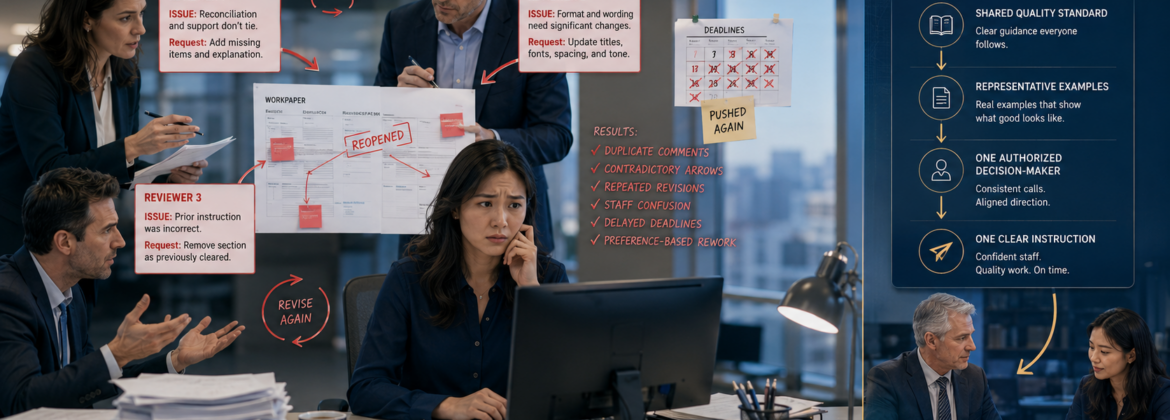
A senior accountant submits the same workpaper to two managers.
Reviewer A leaves three notes:
- Reconcile the schedule to the trial balance.
- Document the client explanation for the variance.
- Support the conclusion with the applicable authority.
Reviewer B leaves nine notes:
- Change the workpaper title.
- Move the variance analysis to a different tab.
- Use the reviewer’s preferred font and color.
- Rewrite the conclusion in the reviewer’s preferred style.
- Add three procedures not required by the engagement risk.
- Reconcile the schedule.
- Obtain client support.
- Research the authority.
- Change the indexing convention.
The employee asks:
“Which version of good work is the firm’s version?”
The answer cannot be:
“It depends on who reviews you.”
That response creates:
- Rework that does not improve quality
- Conflicting staff development
- Longer review cycles
- Reviewer shopping
- Manager frustration
- Unreliable promotion evidence
- Quality risk across offices and teams
A calibrated firm does not remove judgment. It makes the source, boundaries, and decision rights of judgment visible.
Who I Am and Why This Matters
I have practiced public accounting since 1990. I founded my accounting firm in 1993, merged it in 2001 to form Howard, Howard and Hodges, and helped grow the organization from three people to approximately 50 staff across multiple Florida locations and states. Our firm was named PASBA Firm of the Year in 2015.
As a firm grows, review quality becomes harder to maintain through informal proximity.
Different reviewers develop different:
- Risk tolerances
- Documentation preferences
- Technical specialties
- Client histories
- Review habits
- Ideas about what staff should already know
Without calibration, those differences become hidden rules.
Staff learn to satisfy individual reviewers instead of the firm’s quality standard.
Since 2020, I have built and run the SkillAbility accounting workforce development platform, used by more than 1,000 accounting professionals across dozens of PASBA firms.
That work has reinforced an important truth:
Staff development cannot be measured consistently when reviewers do not agree on what acceptable work looks like.
Calibration therefore supports both quality management and workforce development. Read Accounting Workforce Development for building shared performance standards, structured practice, and evidence-based progression across the firm.
What Is Reviewer Calibration in a CPA Firm?
Reviewer calibration is a recurring quality-management and workforce-development process in which reviewers apply shared criteria to representative accounting work, compare their conclusions, resolve differences using evidence and defined authority, document the resulting anchors, and test whether those anchors are applied consistently in future engagements.
Calibration answers five firm-level questions
- What must be present before work is review ready?
- How much review is appropriate for the risk, service, and employee?
- Which differences are true quality issues?
- Which differences reflect professional judgment?
- Which differences are merely reviewer preference?
Calibration is broader than a review-note template
A template can standardize the form of a note.
Calibration standardizes the reasoning behind:
- Whether a note is necessary
- How significant it is
- Who must resolve it
- What evidence clears it
- Whether the issue becomes a development pattern
Calibration should occur before important decisions depend on the ratings
Examples include:
- Promotion readiness
- Expanded review authority
- Quality monitoring
- Engagement assignment
- Training priorities
- Performance discussions
Why Reviewer Calibration Matters Now
CPA firms are now operating under the new quality-management era
AICPA quality-management standards require firms with accounting and auditing practices to operate a proactive, risk-based system of quality management. The implementation deadline for SQMS No. 1 was December 15, 2025.
Official source: AICPA Practice Aid for a CPA Firm’s System of Quality Management.
Peer review now examines whether the system works consistently
AICPA guidance published in June 2026 states that firms should be prepared to demonstrate consistent application across engagements, address inconsistencies across teams or offices, and strengthen monitoring and remediation. It also notes that peer reviewers themselves are calibrating judgments during the first cycle under the new quality-management standards.
Source: Peer reviews of QM systems: What firms need to know now.
Monitoring is intended to produce evidence and improvement
Current Journal of Accountancy guidance describes monitoring and remediation as an operating process, not a one-time documentation exercise.
Source: How to monitor a firm’s system of quality management.
Engagement-quality review has distinct responsibilities
SQMS No. 2 addresses the qualifications, eligibility, appointment, responsibilities, performance, and documentation of engagement quality reviews. Calibration cannot erase the independence and accountability required of an engagement quality reviewer.
Source: AICPA Quality Management: Engagement Quality Reviews.
Distributed teams increase the need for explicit anchors
When work crosses offices, managers, offshore teams, outsourced providers, specialties, or acquired firms, employees cannot rely on proximity to learn each reviewer’s unwritten expectations.
AI can multiply reviewer inconsistency
If reviewers apply different standards to AI-assisted analysis, one manager may reject all AI-supported work while another accepts polished output without sufficient validation.
Calibration should define:
- Permitted use
- Required source validation
- Documentation expectations
- Professional skepticism
- Confidentiality boundaries
- Human accountability
What Research Says About Reviewer Agreement
Independent reviewers naturally differ
A 2019 meta-analysis of supervisory performance ratings examined 224 independent samples. The estimated interrater reliability for overall job-performance ratings was 0.61 when ratings were collected for research and 0.45 when collected for administrative purposes.
Research source: Meta-Analysis of Interrater Reliability of Supervisory Performance Ratings.
Even direct supervisors do not produce perfect agreement
A 2024 meta-analysis using a more restrictive design found average observed interrater reliability of 0.65 for direct-supervisor ratings, including 0.60 in operational settings.
Research source: Meta-analytical estimates of interrater reliability for direct supervisor performance ratings.
Agreement Is Meaningful—but Rarely Perfect
The studies address performance ratings rather than CPA engagement review. They support the broader point that human judgment varies and should not be assumed to be automatically consistent.
Frame-of-reference training can improve agreement and accuracy
Research on frame-of-reference training found that trained raters developed greater agreement and more target-referent, less idiosyncratic representations of performance.
Research source: A Cognitive Evaluation of Frame-of-Reference Rater Training.
Training works best with a clear instrument
A meta-analytical review of 57 studies involving health-care professionals found that training, instrument improvement, and combined interventions all improved interrater reliability. Improving the instrument produced the largest average change in that review.
Research source: Reducing interrater variability and improving health care.
The CPA-firm implication
Training reviewers without improving the firm’s review criteria may standardize discussion but leave the underlying instrument vague.
Calibration Is Not Forced Uniformity
Professional judgment remains necessary
Comparable facts can lead qualified reviewers to different judgments when:
- Evidence is ambiguous
- Risk is uncertain
- Materiality requires context
- Alternative treatments are supportable
- Client or engagement circumstances differ
The firm should standardize the decision process
Reviewers should consistently identify:
- The objective
- The relevant facts
- The applicable standard or policy
- The risk
- The evidence
- The alternatives
- The decision authority
- The documentation required
Identical note counts are not the goal
One reviewer may write one integrated note.
Another may write three targeted notes.
The real questions are:
- Did both identify the material issue?
- Did both apply the same quality threshold?
- Did both avoid unnecessary preference notes?
- Would the cleared work meet the firm’s standard?
Calibration should protect justified differences
A reviewer should be able to depart from an anchor when the facts, risk, or authority differ—and explain why.
Why Conflicting Review Notes Happen
Unwritten standards
Reviewers rely on personal experience because the firm has not defined review-ready work.
Different risk assessments
One reviewer sees a routine issue.
Another sees a potential material error or client risk.
Different information
A relationship partner may know client history that another reviewer does not.
Different technical specialties
A tax specialist, audit partner, CAS manager, and generalist may focus on different risks.
Preference becomes policy
Reviewers may enforce personal choices involving:
- Formatting
- Wording
- Indexing
- Workpaper layout
- Calculation presentation
without showing a quality, usability, or consistency reason.
Reviewer drift
A reviewer’s expectations may change over time because of:
- A recent error
- A peer-review comment
- A difficult client
- A new standard
- Deadline stress
- Personal habit
Different beliefs about staff development
One reviewer leaves questions to build judgment.
Another rewrites the work to save time.
A third adds extensive notes to demonstrate thoroughness.
No disagreement protocol
Employees become the messenger between reviewers and receive multiple rounds of contradictory revisions.
Read Feedback Training for Accounting Managers for writing review notes that correct work while preserving employee ownership.
The CALIBRATE Framework for CPA Firm Reviewers
C-A-L-I-B-R-A-T-E
C — Clarify the Firm Standard and Review Purpose
Define what review ready means, what the reviewer is responsible for, and which professional or firm standards control.
A — Anchor Judgment With Representative Work
Use examples of acceptable, borderline, and unacceptable work tied to evidence—not reputation or reviewer personality.
L — Level Risk, Materiality, and Review Depth
Agree how risk, complexity, service, employee readiness, and deadline affect the nature and extent of review.
I — Inspect the Same Work Independently
Review before group discussion so consensus is not produced by hierarchy or the first person to speak.
B — Bring Differences Into Evidence-Based Comparison
Compare findings, severity, required action, and acceptance evidence rather than debating note count or style.
R — Resolve Principle, Judgment, and Preference
Use standards, policy, decision rights, and documented rationale to distinguish mandatory correction from acceptable variation.
A — Apply Shared Notes, Anchors, and Escalation
Convert the decision into examples, note language, checklists, decision trees, or specialist consultation triggers.
T — Test Transfer on New Work
Use new engagements to determine whether reviewers and staff apply the shared standard beyond the calibration example.
E — Evaluate Drift and Recalibrate
Monitor conflicting notes, reopened issues, reviewer patterns, new standards, and changed services, then update the anchors.
Clarify the Firm’s Review-Ready Standard
Start with the purpose of the work
Review-ready standards should reflect the engagement objective, not only workpaper appearance.
A useful standard addresses:
- Completeness
- Technical accuracy
- Evidence and support
- Documentation
- Judgment and conclusions
- Client communication
- Scope and project status
- Self-review
- Escalation
Define standards by service and level
A new staff accountant, experienced senior, manager, and partner should not have identical responsibilities.
The standard should show what the employee owns at each level.
Separate minimum quality from excellent work
| Level | Meaning | Reviewer Response |
|---|---|---|
| Unacceptable | Material error, missing evidence, unresolved risk, incomplete work, or failure to meet required standard | Required correction and appropriate escalation |
| Acceptable | Meets professional and firm requirements; conclusion is supportable and usable | Clear only necessary notes |
| Strong | Anticipates questions, communicates judgment clearly, and supports efficient review | Specific positive feedback and expanded responsibility evidence |
| Preferred style | One acceptable presentation among several | Optional suggestion unless firm consistency or usability requires it |
Make the standard observable
Weak standard:
“The workpaper should be clear.”
Observable standard:
“The workpaper identifies the objective, source data, procedure, result, investigated variance, supporting evidence, unresolved items, and conclusion.”
Do not convert every checklist item into a universal requirement
Some procedures depend on:
- Risk
- Materiality
- Service level
- Facts
- Professional judgment
Mark items as:
- Always required
- Required when triggered
- Recommended
- Optional presentation
Read Tax Return Review Process for a risk-based review structure that separates completeness, technical issues, judgment, and client communication.
Anchor Judgment With Representative Work
Use actual or realistically simulated work
Effective calibration examples include:
- A strong workpaper
- A borderline workpaper
- A materially deficient workpaper
- A technically correct but poorly documented conclusion
- An acceptable alternative presentation
- A workpaper containing preference-only differences
Remove identifying client information
Calibration materials should protect:
- Client identity
- Taxpayer information
- Confidential business data
- Employee identity where appropriate
- Privileged or sensitive communications
Build an anchor card
For each example, document:
- Service and risk level
- Employee level
- Facts and assumptions
- Applicable standard or policy
- Expected findings
- Severity
- Required correction
- Acceptable alternatives
- Preference-only items
- Escalation trigger
Use multiple acceptable examples
One “gold standard” file can accidentally make one reviewer’s style appear mandatory.
Show that different formats can meet the same quality objective.
Refresh anchors
Update examples after:
- New standards or tax law
- Peer-review or inspection findings
- New service offerings
- Technology changes
- Recurring review conflicts
- Material quality events
Level Risk, Materiality, and Review Depth
Review depth should be risk based
PCAOB supervision standards require the nature and extent of supervision to consider the nature of the company, assigned work, risk of material misstatement, and the knowledge, skill, and ability of engagement-team members.
Official source: PCAOB AS 1201: Supervision of the Audit Engagement.
The specific standard applies to PCAOB audits, but the management principle is broadly useful: review should be proportionate to risk and capability.
Calibrate the factors affecting review depth
- Engagement risk
- Materiality or economic significance
- Complexity
- New or unusual facts
- Employee experience
- Prior quality history
- Client behavior
- Specialist involvement
- Deadline pressure
Use a review-depth matrix
| Risk / Readiness | Possible Review Approach |
|---|---|
| Low risk / proven readiness | Targeted review of key outputs, exceptions, and conclusions |
| Low risk / developing employee | Broader review with developmental notes and self-review verification |
| High risk / proven readiness | Early planning, judgment, evidence, and final-conclusion review |
| High risk / developing employee | Early supervision, defined gates, specialist consultation, and controlled responsibility |
Do not calibrate by note volume
A high-risk file may require few notes because the work is strong.
A low-risk file may require many notes because the work is incomplete.
Inspect the Same Work Independently Before Discussion
Independent review protects against anchoring
If the senior partner speaks first, other reviewers may align with authority rather than evidence.
Use a common response form
Each reviewer records:
- Overall disposition
- Material findings
- Developmental findings
- Preference-only suggestions
- Risk level
- Required correction
- Acceptance evidence
- Escalation needed
Set a time boundary
Calibration should compare normal review behavior—not unlimited forensic analysis.
Preserve first judgments
Do not allow reviewers to revise their original findings before the differences are captured.
The firm needs to see where judgment actually diverged.
Classify Reviewer Differences Before Resolving Them
| Difference Type | Question | Resolution Source |
|---|---|---|
| Facts | Did reviewers understand the same client facts and engagement scope? | Clarify facts and assumptions |
| Professional standard | Is a requirement being interpreted differently? | Authoritative guidance and consultation |
| Firm policy | Does the firm have a documented requirement? | Quality-management system and designated owner |
| Risk or materiality | Did reviewers assess significance differently? | Risk criteria and decision authority |
| Evidence sufficiency | What evidence is needed to support the conclusion? | Objective, risk, standard, and documented rationale |
| Professional judgment | Are multiple supportable conclusions possible? | Alternatives, evidence, consultation, and accountable decision maker |
| Development level | Are reviewers expecting different ownership from the employee? | Role competency standard |
| Preference or style | Would the alternative still meet quality and usability requirements? | Accept variation or establish a firm convention |
Conflicts often contain more than one difference
A note about rewriting a conclusion may involve:
- A missing technical element
- An unclear explanation
- A personal wording preference
Separate the components before deciding what is mandatory.
Resolve Reviewer Disagreements Without Making Staff the Referee
Reviewers should resolve conflicts directly
The employee should not receive:
- One note requiring a change
- A second note reversing the change
- A third instruction to “ask the other reviewer”
Use a disagreement protocol
- State the issue and the competing positions.
- Confirm the relevant facts and scope.
- Identify the professional standard, firm policy, risk, or preference involved.
- Compare evidence and consequences.
- Identify the accountable decision maker.
- Document the decision and whether it becomes a firm anchor.
- Send one clear instruction to the employee.
Define decision rights
| Difference | Possible Decision Owner |
|---|---|
| Routine presentation and firm convention | Service-line leader or designated methodology owner |
| Engagement risk and client-specific judgment | Engagement partner or authorized leader |
| Technical accounting, audit, or tax position | Qualified technical authority or consultation process |
| Quality-management policy | Person assigned ultimate responsibility or operational responsibility under the firm’s system |
| Employee competency expectation | Talent and service leadership using the role standard |
| Engagement quality review matter | Resolved under applicable standards without compromising reviewer objectivity |
Use a preference test
Before making a note mandatory, ask:
- Does the current work violate a standard or firm policy?
- Does it obscure the objective, evidence, or conclusion?
- Does it create client, technical, review, or usability risk?
- Would another qualified reviewer reasonably accept it?
- Is firmwide consistency worth the conversion cost?
If the answers are no, the item may be a preference rather than a required correction.
Document disagreement when professional standards require it
Calibration discussions do not replace formal consultation, differences-of-opinion procedures, engagement-quality review requirements, or required engagement documentation.
Standardize Review-Note Quality
Use one note formula
Example:
“The workpaper conclusion states that revenue is reasonable but does not connect the expectation, recorded amount, investigated variance, and supporting evidence. Our review-ready standard requires those elements for a significant fluctuation. Revise the conclusion and link the support used to resolve the variance.”
Calibrate note severity
- Critical: Potential material error, report or filing risk, independence, ethics, security, or other issue requiring immediate escalation.
- Required: Work does not meet a professional or firm standard and must be corrected before release.
- Developmental: Current work may be acceptable, but the note builds judgment, efficiency, or future ownership.
- Suggestion: Optional improvement or alternative presentation.
Calibrate note closure
Reviewers should agree whether closure requires:
- Corrected amount
- Linked evidence
- Revised documentation
- Technical consultation
- Client confirmation
- Reviewer discussion
- Partner decision
Avoid reviewer-note inflation
More notes do not prove more quality.
Note inflation can result from:
- Preference comments
- Duplicated findings
- Questions already answered in the file
- Reviewers demonstrating activity
- Late planning decisions disguised as staff corrections
Give specific positive calibration feedback
Reviewers should identify work the firm wants repeated:
- Early issue escalation
- Clear judgment documentation
- Strong self-review
- Efficient support
- Client-ready communication
- Well-controlled scope and deadlines
Calibrate Across Tax, A&A, CAS, and Advisory
Tax review
Calibrate:
- Source-document and trial-balance reconciliation
- Prior-year and current-year analytical review
- State and local tax triggers
- Research and authority documentation
- Estimate and extension decisions
- Client communication and planning opportunities
Audit, review, and compilation engagements
Calibrate:
- Risk assessment
- Nature and extent of supervision
- Evidence sufficiency
- Significant findings and judgments
- Documentation
- Consultation and engagement quality review triggers
- Report and disclosure considerations
PCAOB documentation standards describe engagement documentation as the written basis for conclusions and the basis for reviewing the quality of the work.
Official source: PCAOB AS 1215: Audit Documentation.
CAS and monthly accounting
Calibrate:
- Close completeness
- Reconciliations
- Management-reporting commentary
- Client-responsibility cutoffs
- Forecast assumptions
- Advisory observations
- Recurring versus project scope
Advisory work
Calibrate:
- Facts and assumptions
- Analysis methodology
- Alternative scenarios
- Limitations
- Recommendation support
- Client decision ownership
- Implementation boundaries
Do not use one checklist across all services
The underlying principles may be shared.
The risks, evidence, deliverables, and review depth differ.
Connect Calibration to the Firm’s Quality-Management System
Calibration can be a quality response
A firm may identify quality risks such as:
- Inconsistent engagement performance across offices
- Insufficient reviewer competence
- Different interpretations of documentation expectations
- Unresolved differences of opinion
- Inconsistent use of specialists
- Reviewer overload
- New or emerging services
Calibration may form part of the firm’s response, monitoring, or remediation.
Calibration should create operating evidence
Evidence may include:
- Cases used
- Participants
- Independent reviewer conclusions
- Differences identified
- Resolution and authority
- Updated policy or anchor
- Transfer testing
- Follow-up results
Monitor whether policies are embedded in workflow
Current AICPA peer-review guidance emphasizes evidence of consistent application—not merely having written policies.
Use findings for remediation
A difference may reveal:
- Unclear methodology
- Training need
- Resource or capacity issue
- Weak consultation process
- Technology configuration problem
- Quality-management design deficiency
Do not confuse internal calibration with an engagement quality review
Internal reviewer development and consistency exercises do not replace the qualifications, eligibility, objectivity, performance, and documentation requirements applicable to formal engagement quality reviews.
Connect Calibration to Staff Feedback and Development
Employees need one firm standard
When reviewers conflict, employees learn to:
- Guess who will review
- Maintain multiple versions of work
- Wait for correction
- Avoid independent judgment
- Discount review notes as preference
Calibration makes feedback fairer
Managers can connect notes to:
- Shared review-ready criteria
- Role expectations
- Representative anchors
- Known escalation points
- Observable development evidence
Use calibration to improve the assignment
If multiple reviewers identify the same staff gap, the firm may need:
- Better instructions
- A stronger template
- Earlier coaching
- Scenario practice
- A different assignment sequence
Do not use calibration to rank reviewers by harshness
The strongest reviewer is not automatically the person who leaves the most notes or rejects the most work.
Read Accounting Onboarding KPIs for measuring first-pass quality, repeated notes, independence, and manager dependence.
Remote Teams, Outsourcing, Acquisitions, and AI
Remote teams need explicit review context
Include:
- Engagement objective
- Risk and materiality
- Employee responsibility
- Firm standard
- Decision authority
- Required response time
Outsourced teams need two-way calibration
Do not assume every recurring note reflects vendor capability.
It may reflect:
- Incomplete instructions
- Missing client context
- Different templates
- Internal reviewer disagreement
- Late handoffs
- Unclear acceptance evidence
Acquired firms need deliberate integration
Calibration should compare:
- Legacy methodology
- Review depth
- Documentation
- Client service expectations
- Escalation
- Quality-management responsibilities
AI-assisted work requires calibrated validation
Reviewers should agree on:
- What sources must be checked
- How generated calculations reconcile to source data
- How conclusions are documented
- What prompts or outputs may be retained
- What confidential data may be used
- Which judgments require human performance
AI can assist calibration
AI may help:
- Cluster review-note themes
- Identify conflicting reviewer language
- Compare anchors with current work
- Draft calibration cases
- Summarize decision logs
Human leaders remain responsible for standards, confidentiality, facts, professional judgment, and final decisions.
Worked Example: Three Reviewers, One Workpaper
Illustrative example only: The findings and scores below demonstrate the calibration method. They are not benchmarks or professional conclusions for a live engagement.
Three managers independently review a monthly close workpaper containing:
- An unreconciled $24,000 difference
- A variance explanation without supporting evidence
- A correct but poorly documented conclusion
- A nonstandard but usable tab order
- A client email draft lacking a decision deadline
Independent findings
| Issue | Reviewer A | Reviewer B | Reviewer C |
|---|---|---|---|
| $24,000 reconciliation difference | Required | Critical | Required |
| Unsupported variance explanation | Required | Required | Developmental |
| Conclusion documentation | Developmental | Required | Required |
| Tab order | No note | Required | Suggestion |
| Client email deadline | Required | No note | Required |
Calibration discussion
The reviewers compare facts, risk, standards, and the purpose of each note.
- The reconciliation difference is required and escalated if it affects a material balance or deadline.
- The variance explanation requires linked evidence because the client report relies on the conclusion.
- The conclusion must identify the expectation, result, investigated variance, and evidence.
- The tab order is an acceptable alternative because usability and firm indexing remain intact.
- The client email requires a decision deadline because the engagement schedule depends on the response.
Shared result
The firm issues four notes, not the union of all reviewer comments.
The tab-order preference is removed.
The severity definition for reconciliation differences is clarified.
The conclusion anchor is added to the firm’s monthly-close example library.
Illustrative note conflict before and after calibration
Calibration Reduces Preference Noise Without Hiding Quality Issues
Illustrative counts only. Fewer notes are not automatically better; the goal is complete coverage of material issues without duplicated or preference-only rework.
Transfer test
Two weeks later, the three reviewers independently review a different close package.
The firm tests whether they now agree on:
- Required reconciliation evidence
- Variance support
- Conclusion structure
- Client decision deadlines
- Acceptable formatting variation
Calibration is complete only when the shared reasoning transfers to new work.
The Reviewer Calibration Dashboard
Agreement measures
Track:
- Agreement on overall disposition
- Agreement on material findings
- Agreement on severity
- Agreement on required correction
- Agreement on note closure evidence
- Preference-only note rate
Conflict measures
Track:
- Conflicting notes issued to staff
- Notes reversed by another reviewer
- Reviewer disagreements escalated
- Time to resolve disagreement
- Files reopened after note clearance
- Staff questions caused by inconsistent standards
Quality and efficiency
Include:
- Review-ready first-pass rate
- Review cycle time
- Repeated review-note rate
- Manager rescue hours
- Late issue discovery
- Realization and WIP effects
- Peer-review or monitoring findings
Reviewer patterns
Look for reviewers who consistently:
- Leave more or fewer preference notes
- Underidentify material issues
- Overclassify routine issues as critical
- Rewrite rather than coach
- Delay decisions
- Require evidence beyond the agreed standard
Do not use one agreement score as proof of quality
High agreement can mean reviewers are consistently correct.
It can also mean reviewers share the same blind spot.
Pair internal agreement with:
- Authoritative standards
- External findings
- Consultation
- Monitoring
- Client and engagement outcomes
Calibration Cadence and Governance
Monthly micro-calibration
Use 20–30 minutes to review:
- One recurring conflict
- One new standard or firm decision
- One strong example
- One preference-versus-quality question
Quarterly case calibration
Reviewers independently evaluate one or two complete cases before discussion.
Preseason calibration
Before tax season, audit season, or a recurring deadline cycle, calibrate:
- Current law and standards
- Firm methodology
- Common prior-year findings
- Risk and escalation triggers
- Review-ready expectations
- AI and technology controls
Event-triggered calibration
Recalibrate after:
- Peer-review or inspection findings
- Material error or near miss
- New service launch
- Acquisition or office integration
- New software or AI workflow
- Repeated reviewer conflict
- Significant standard or tax-law change
Define governance
Assign:
- Calibration owner
- Methodology owner
- Technical consultation authority
- Quality-management connection
- Talent-development connection
- Anchor-library maintenance
- Monitoring and remediation responsibility
A 90-Day Reviewer Calibration Implementation Plan
Days 1–30: Diagnose inconsistency and define standards
- Collect conflicting and repeated review notes
- Interview reviewers and staff
- Identify preference-heavy areas
- Define review-ready standards by service and level
- Create severity and note-closure definitions
- Select representative cases
- Establish decision rights
Deliverable: Baseline conflict map, review standard, and calibration case set.
Days 31–60: Calibrate reviewers
- Conduct independent case reviews
- Compare findings and severity
- Classify difference types
- Resolve issues using standards and authority
- Build anchors, note examples, and escalation rules
- Practice preference tests
- Train reviewers to deliver one firm-consistent instruction
Deliverable: Initial anchor library and reviewer calibration record.
Days 61–90: Test on live work
- Apply anchors across multiple engagements
- Sample notes from different reviewers
- Measure conflict, reversal, and preference rates
- Observe review meetings
- Test transfer with new cases
- Update policies, templates, or training
- Report monitoring results and remediation
Deliverable: Live-work evidence and ongoing calibration cadence.
Start with one service and one review level
Do not attempt to calibrate every tax, audit, CAS, advisory, manager, partner, and specialist judgment in one meeting.
Protect candid disagreement
Calibration fails when reviewers perform consensus for hierarchy.
Independent review and evidence-based discussion should make real differences visible. Read Project Management Training for Accountants for decision rights, escalation, dependencies, and evidence-based status across client work.
The Complete 30-Day Reviewer Calibration Training Plan
Days 1–5: Review standards and roles
- Define review-ready work by service and employee level
- Distinguish minimum quality, strong work, and preference
- Define reviewer, engagement partner, specialist, and quality-review responsibilities
- Study risk-based review depth
- Review differences-of-opinion and consultation procedures
- Practice writing observable quality criteria
Evidence: Review-standard assessment, role map, and revised review-ready criteria.
Days 6–10: Anchors and independent review
- Review representative acceptable and unacceptable work
- Identify multiple acceptable presentations
- Complete independent case reviews
- Classify material, developmental, and preference findings
- Record severity and acceptance evidence
- Compare first judgments without editing them
Evidence: Completed independent cases and reviewer difference profile.
Days 11–15: Difference diagnosis and resolution
- Classify facts, standards, policy, risk, evidence, judgment, development, and preference differences
- Apply the preference test
- Use technical consultation and decision rights
- Resolve conflicting instructions
- Document calibration decisions
- Build anchor cards and note examples
Evidence: Calibration decision log and approved anchor set.
Days 16–20: Review-note and feedback consistency
- Use finding–basis–action–evidence notes
- Calibrate severity
- Calibrate note closure
- Identify duplicated and preference-only notes
- Give specific positive feedback
- Coach staff without recreating the work
Evidence: Scored note-writing exercise and feedback simulation.
Days 21–25: Service and technology application
- Apply calibration to tax
- Apply calibration to A&A
- Apply calibration to CAS and advisory
- Apply calibration to remote and outsourced work
- Validate AI-assisted work standards
- Connect findings to quality-management monitoring
Evidence: Multi-service calibration portfolio.
Days 26–30: Independent capstone
- Review an unfamiliar case independently
- Compare judgment with other reviewers
- Defend required findings
- Identify acceptable variation
- Resolve a disagreement
- Update the anchor library
- Present the decision to firm leadership
Evidence: Complete CALIBRATE package and 100-point scorecard.
Use Scenario-Based Training for Accountants to practice calibration on realistic work before live staff receive conflicting instructions.
The 30/60/90-Day Live-Work Progression
Days 31–60: Controlled reviewer application
The reviewer candidate may:
- Apply established anchors
- Write routine required and developmental notes
- Identify preference-only items
- Escalate technical and risk differences
- Participate in calibration meetings
- Track transfer on current engagements
Experienced leaders retain material technical, report, quality-management, engagement-quality-review, independence, and significant client-risk decisions. Read Tax Manager Development Program for building reviewer, coach, client-leader, and workflow-leader capability.
Days 61–90: Broader calibration ownership
Expand responsibility when the candidate consistently:
- Applies shared standards
- Identifies material issues
- Avoids preference inflation
- Matches review depth to risk and readiness
- Resolves differences through evidence
- Writes actionable notes
- Supports staff development
- Documents justified departures from anchors
After day 90: Authority remains defined
Firm leadership may retain authority for:
- Methodology changes
- Technical consultations
- Formal differences of opinion
- Engagement quality review matters
- Quality-management deficiencies and remediation
- Promotion or performance decisions
- Material client and report decisions
100-Point Reviewer Calibration Readiness Scorecard
| Capability | Points | Observable Evidence |
|---|---|---|
| Firm standard and review purpose | 12 | Applies service, role, quality, and reviewer responsibilities consistently |
| Risk and review-depth judgment | 12 | Matches review to risk, materiality, complexity, and employee readiness |
| Independent case evaluation | 10 | Identifies findings without hierarchy or group anchoring |
| Difference classification | 12 | Separates facts, standards, policy, risk, evidence, judgment, development, and preference |
| Evidence-based resolution | 12 | Uses authority, policy, rationale, and decision rights rather than seniority alone |
| Review-note quality | 10 | Writes finding, basis, action, severity, and acceptance evidence clearly |
| Preference control | 8 | Accepts supportable alternatives and avoids unnecessary rework |
| Quality-management connection | 10 | Links calibration findings with monitoring, risk response, and remediation |
| Staff development and feedback | 8 | Uses shared standards to coach and evaluate staff fairly |
| Transfer and recalibration | 6 | Tests new work and updates anchors when conditions change |
Suggested readiness rule: Require at least 84 points overall, no zero category, no material technical difference resolved by hierarchy alone, no employee used as the intermediary between conflicting reviewers, and leadership involvement where professional standards or the quality-management system require it.
Realistic Reviewer Calibration Scenarios
Scenario 1: The formatting conflict
One manager requires a specific tab order and font while another accepts the work. Reviewers must decide whether the difference affects usability or is preference.
Scenario 2: The unsupported conclusion
All reviewers notice weak documentation, but they disagree whether the current work is unacceptable or developmental.
Scenario 3: The materiality disagreement
A tax manager and partner assess the significance of a multistate exposure differently.
Scenario 4: The new senior
Reviewers agree the work is correct but disagree about how much explanation a newly promoted senior should own.
Scenario 5: The inherited acquired-firm template
An acquired office uses different indexing and documentation conventions that still satisfy professional requirements.
Scenario 6: The overreviewed low-risk account
A reviewer adds procedures because a similar account caused a problem on another client.
Scenario 7: The missed high-risk issue
Three reviewers agree with one another but all fail to identify an important technical problem.
Scenario 8: The partner-preference email
The manager rewrites a clear client email because it does not sound like the partner.
Scenario 9: The AI-generated memo
One reviewer rejects the memo because AI was used; another accepts it without source validation.
Scenario 10: The outsourced reconciliation
Internal reviewers leave contradictory notes because the vendor received different instructions from two offices.
Scenario 11: The engagement quality reviewer
The engagement team treats calibration consensus as a reason the formal EQ reviewer should accept the conclusion.
Scenario 12: The repeated reopened note
Employees clear notes under one manager, but a second reviewer later reopens them using a different acceptance standard.
Scenario 13: The reviewer with no notes
A manager consistently clears files quickly but monitoring later identifies missed issues.
Scenario 14: The reviewer with 40 notes
A manager appears thorough, but most notes involve wording and layout rather than quality.
Scenario 15: The peer-review remediation case
The firm must convert an external finding into a calibrated internal standard and prove it operates across engagements.
Each scenario should require independent review, difference classification, evidence-based resolution, one employee instruction, and transfer testing.
What the Firm Should Measure
| Metric | What It Reveals |
|---|---|
| Material-finding agreement | Whether reviewers identify the same significant quality issues |
| Severity agreement | Whether reviewers classify importance consistently |
| Preference-only note rate | Review work that creates rework without improving quality |
| Conflicting-note rate | How often employees receive incompatible directions |
| Note reversal rate | How often another reviewer changes a cleared or required instruction |
| Review cycle time | Operational effect of review consistency and disagreement |
| Reopened work | Whether note-closure standards are consistent |
| First-pass review-ready rate | Whether staff understand and meet the shared standard |
| Repeated review-note rate | Whether feedback and anchors transfer into future work |
| Late issue discovery | Whether reviewers miss risks during earlier review layers |
| Calibration transfer score | Whether agreement on training cases persists on new work |
| Reviewer drift | Whether individual severity or preference patterns change over time |
| External finding recurrence | Whether remediation changed operating behavior |
| Manager rescue hours | Whether unclear standards and inconsistent feedback consume senior capacity |
| Staff clarity | Whether employees understand what acceptable work looks like across reviewers |
Read Staff Leverage Ratio for Accounting Firms for the effect of review quality and manager rescue on usable capacity.
Common Reviewer Calibration Mistakes
Mistake 1: Calibrating after reviewers discuss the case
Hierarchy and the first opinion hide genuine differences.
Mistake 2: Using one perfect file
One reviewer’s style becomes the accidental firm standard.
Mistake 3: Measuring note count
Quantity replaces quality, risk, and usefulness.
Mistake 4: Forcing identical conclusions
Supportable professional judgment is treated as noncompliance.
Mistake 5: Allowing preference to become mandatory
Staff perform rework unrelated to quality.
Mistake 6: Ignoring reviewer underperformance
Calibration focuses only on harsh reviewers and misses reviewers who fail to identify risk.
Mistake 7: Making staff resolve reviewer conflicts
The least-authorized person becomes responsible for firm-level disagreement.
Mistake 8: Calibrating standards without calibrating severity
Reviewers notice the same issue but respond inconsistently.
Mistake 9: Omitting acceptance evidence
Notes are cleared and reopened because “done” means different things.
Mistake 10: Treating calibration as annual CPE
Anchors drift while services, staff, risk, and technology change.
Mistake 11: Replacing formal consultation
A group exercise is used instead of required technical or quality procedures.
Mistake 12: Ignoring remote and outsourced teams
Internal consistency never reaches the people producing the work.
Mistake 13: Using AI to score reviewers without validation
Automated classification becomes an unexamined quality decision.
Mistake 14: Failing to test transfer
Reviewers agree in the meeting and revert to old habits on live engagements.
Mistake 15: Confusing agreement with correctness
A unanimous team can share the same blind spot.
Frequently Asked Questions About Reviewer Calibration for CPA Firms
What is reviewer calibration in a CPA firm?
Reviewer calibration is a recurring process in which reviewers apply shared criteria to the same representative work, compare judgments, resolve differences through standards and evidence, document anchors, and test whether the decisions transfer to new engagements.
Why do CPA firm reviewers leave conflicting notes?
Common causes include unwritten standards, different risk assessments, incomplete information, technical specialization, reviewer preference, inconsistent role expectations, reviewer drift, and no defined disagreement protocol.
Does calibration eliminate professional judgment?
No. Calibration standardizes the firm’s decision process, quality thresholds, evidence expectations, and escalation rules while preserving supportable professional judgment.
Should every reviewer leave the same number of notes?
No. The goal is agreement on material issues, required corrections, severity, and acceptance evidence—not identical note counts or wording.
How is calibration different from reviewer training?
Reviewer training teaches concepts and methods. Calibration requires independent application to common cases, comparison of judgments, resolution of differences, and transfer testing.
What is frame-of-reference training?
It is rater training that teaches a shared model of performance using dimensions, standards, examples, practice, and feedback so judgments become less idiosyncratic and more consistent.
How often should reviewers calibrate?
Use short monthly micro-calibration, deeper quarterly cases, preseason sessions, and event-triggered recalibration after new standards, peer-review findings, quality events, acquisitions, or technology changes.
What work should firms use for calibration?
Use anonymized actual or realistic examples representing acceptable, borderline, deficient, high-risk, and preference-only situations across the firm’s services.
How should firms handle reviewer preferences?
Ask whether the current work violates a standard, obscures the objective or evidence, creates risk, or conflicts with a justified firm convention. If not, accept the supportable alternative or label the suggestion optional.
Who resolves disagreements between reviewers?
The owner depends on the issue. Technical matters may require consultation, engagement judgments may belong to the engagement partner, methodology may belong to a service leader, and quality-management matters may require designated quality leadership.
Should staff resolve conflicting review notes?
No. Reviewers should resolve the disagreement directly and give the employee one clear, authorized instruction.
How should review notes be standardized?
Use a shared structure that identifies the finding, quality basis, required action, severity, and acceptance evidence. Standardize the logic, not necessarily every word.
How does calibration improve staff development?
It gives employees one firmwide definition of acceptable work, reduces preference-based rework, improves feedback fairness, and creates more reliable evidence for independence and promotion readiness.
How does reviewer calibration support quality management?
Calibration may serve as a quality response, monitoring procedure, or remediation activity by addressing inconsistent engagement performance, reviewer competence, methodology, consultation, and application across teams.
Can calibration be used for tax and CAS work?
Yes. The method applies to tax, accounting and auditing, CAS, advisory, client communication, project review, and other work, but the criteria must be tailored to the service and risk.
How should CPA firms calibrate AI-assisted work?
Agree on permitted use, source validation, reconciliation, documentation, confidentiality, skepticism, escalation, and human accountability before comparing reviewer conclusions.
What metrics show whether calibration is working?
Track material-finding agreement, severity agreement, preference-only notes, conflicting notes, reversals, reopened work, review cycle time, first-pass quality, late issue discovery, transfer, and external finding recurrence.
Can high reviewer agreement still be a problem?
Yes. Reviewers may share the same blind spot. Internal agreement must be tested against authoritative standards, monitoring, consultation, and external findings.
Do Your Staff Know What Review-Ready Work Looks Like Before They Learn Which Manager Is Reviewing It?
SkillAbility helps CPA firms build review-ready staff, capable reviewers, stronger managers, confident advisors, and future partners through structured practice, feedback, judgment development, and measurable readiness.
Book Your Free 10-Minute Structural Alignment Review →
Includes our 45-Day Out-of-Pocket Performance Guarantee.
To standardizing quality without standardizing away judgment,
Vincent Howard, CPA
Managing Partner, Howard, Howard and Hodges
SkillAbility for Accounting Firms
About the Author
Vincent Howard, CPA has practiced public accounting since 1990. He earned a Bachelor of Science in Accounting and a Master’s in Taxation from the University of Central Florida, founded his accounting firm in 1993, and serves as Managing Partner of Howard, Howard and Hodges. He helped grow the organization from three people to approximately 50 staff across multiple Florida locations and states. He has participated in PASBA since 1997, and the firm was named PASBA Firm of the Year in 2015. Since 2020, he has built and run the SkillAbility accounting workforce development platform, used by more than 1,000 accounting professionals across dozens of PASBA firms.
© 2026 SkillAbility for Accounting Firms. This article provides general educational information and does not replace accounting, tax, audit, attestation, legal, ethics, independence, quality-management, peer-review, inspection, employment, professional-liability, or regulatory advice. Firms should tailor reviewer standards, calibration, monitoring, consultation, documentation, and decision rights to their services, facts, policies, professional obligations, and applicable law.