By Vincent Howard, CPA | Managing Partner, Howard, Howard and Hodges | SkillAbility for Accounting Firms
Last updated: August 17, 2026 | 52-minute read
- What S corporation tax training means
- Why Form 1120-S is deceptively difficult
- 2026 preparer watchlist
- The S-CORP READY framework
- Verify election status and shareholder eligibility
- Close and reconcile the books before tax input
- Classify shareholder transactions correctly
- Reasonable compensation
- 2% shareholder health insurance and fringe benefits
- Ordinary income vs separately stated items
- Stock basis, debt basis, and Form 7203
- Loss limitation sequence
- Distributions and taxable gain
- AAA, accumulated E&P, and Schedule M-2
- Shareholder loans and debt basis
- Schedule K and K-1 preparation
- Section 199A / QBI information
- Schedules K-2 and K-3
- Built-in gains and other entity-level tax alerts
- State returns and PTE elections
- Schedule L, M-1, and M-2
- Build reviewer-ready workpapers
- Worked 1120S example
- 90-day firm implementation plan
- 30-day staff training curriculum
- 30/60/90 live-work progression
- 100-point readiness scorecard
- 15 realistic S corporation scenarios
- What the CPA firm should measure
- Common training mistakes
- Frequently asked questions
A sole shareholder owns a profitable S corporation. The books show $180,000 of net income, $48,000 of wages to the owner, $140,000 of cash distributions, a $75,000 shareholder loan balance, and $18,000 of personal expenses paid by the company.
A beginning preparer sees a straightforward pass-through return. A review-ready preparer sees a sequence of questions:
- Is the S election valid and unchanged?
- Is $48,000 reasonable compensation for the services performed?
- Were the personal expenses wages, distributions, loans, or something else?
- Does the shareholder have enough stock basis for the distributions?
- Is the $75,000 really direct shareholder debt basis?
- Does the corporation have accumulated earnings and profits from a prior C corporation period?
- Do Schedule M-2 and the shareholder basis workpapers roll forward?
- Which items must be separately stated on Schedule K and K-1?
A Form 1120-S can balance and still be wrong. Review-ready preparation means the shareholder story, tax return, payroll, balance sheet, basis, distributions, and K-1 all tell the same story.
Who I Am and Why This Matters
I have practiced public accounting since 1990. I founded my accounting firm in 1993, merged it in 2001 to form Howard, Howard and Hodges, and helped grow the organization from three people to approximately 50 staff across multiple Florida locations and states. Our firm was named PASBA Firm of the Year in 2015.
S corporation returns are one of the clearest examples of why staff development cannot stop at software navigation. The tax software may calculate a K-1 correctly from the data entered while the preparer still misses the underlying problem: unreasonable owner wages, a distribution in excess of basis, a shareholder loan that never created debt basis, a prior C corporation attribute, an incomplete shareholder change, or an unreconciled M-2.
Since 2020, I have built and run the SkillAbility accounting workforce development platform, used by more than 1,000 accounting professionals across dozens of PASBA firms.
The training objective should therefore be observable: can the staff accountant prepare an unfamiliar S corporation return that another tax professional can review without rebuilding the shareholder and entity story?
Read Tax Manager Development Program for the broader tax-career pathway and Scenario-Based Training for Accountants for developing tax judgment before client deadlines depend on it.
What Is S Corporation Tax Training for Staff Accountants?
S corporation tax training is a structured development process that teaches staff accountants to verify S status, reconcile the books, classify shareholder transactions, prepare Form 1120-S and Schedule K-1, understand basis and distribution consequences, identify reasonable-compensation and fringe-benefit issues, complete tax workpapers, and escalate advanced entity, shareholder, international, and state tax questions before review.
The preparer’s job is broader than “prepare Form 1120-S”
Form 1120-S is the output. The actual work includes:
- Entity status and election verification
- Shareholder and ownership rollforward
- Book-to-tax reconciliation
- Officer compensation analysis
- Shareholder health insurance and fringe benefits
- Related-party and shareholder transactions
- Separately stated items
- Basis support
- Distributions
- AAA and accumulated E&P
- Schedule K-1 reporting
- QBI information
- K-2/K-3 analysis
- State and PTE-tax coordination
“Review-ready” is an evidence standard
A review-ready preparer can answer:
- Where did this number come from?
- Why is it on this line?
- What shareholder consequence does it create?
- What changed from prior year?
- What assumption requires reviewer judgment?
- What form, schedule, or workpaper supports it?
Why Form 1120-S Is Deceptively Difficult
It is a pass-through return with entity-level consequences
The IRS describes S corporations as corporations that generally pass income, losses, deductions, and credits through to shareholders for federal tax purposes. But an S corporation can still owe certain entity-level taxes, including tax on certain built-in gains and passive income.
Source: IRS — S Corporations.
The shareholder consequences depend on facts outside the face of the return
A K-1 can show:
- Ordinary income
- Rental activity
- Interest
- Capital gain
- Charitable contributions
- Section 179 expense
- Credits
- Distributions
But the shareholder’s actual tax result can depend on:
- Stock basis
- Debt basis
- At-risk amount
- Passive activity status
- Excess business loss limitation
- QBI rules
The same cash transfer can have different tax classifications
A payment to a shareholder might be:
- Wages
- Distribution
- Loan repayment
- Reimbursement
- Rent
- Interest
- Purchase of property
The label in the general ledger is not dispositive.
The return is highly sensitive to prior-year continuity
Staff need prior-year support for:
- Shareholder basis
- Debt basis
- Suspended losses
- AAA
- Accumulated E&P
- Depreciation
- Accounting methods
- State elections
- QBI carryforward information where applicable
That makes S corporation preparation a knowledge-transfer problem as much as a form-preparation problem.
The 2026 S Corporation Preparer Watchlist
Current-year context: As of August 2026, the current finalized Form 1120-S instructions are for tax year 2025. They are the primary filing instructions for calendar-year 2025 S corporation returns being prepared and filed in 2026. Staff should always check the current-year form and IRS “future developments” page before preparing a later-year return.
1. Domestic research expenditures changed under the 2025 tax law
The 2025 Form 1120-S instructions reflect new section 174A under P.L. 119-21. For tax years beginning after 2024, domestic research or experimental expenditures may generally be deducted currently, with an alternative election to capitalize and amortize them over at least 60 months. Transition procedures also apply to certain amounts capitalized in 2022 through 2024.
Source: IRS — 2025 Instructions for Form 1120-S.
2. Schedule K-1 has new reporting for domestic R&E
The 2025 instructions added Schedule K-1 box 17 code BA for domestic research or experimental expenditures relevant when a shareholder makes a section 59(e) election.
3. K-2/K-3 filing exceptions expanded
The 2025 S corporation K-2/K-3 instructions expanded the domestic filing exception and added a small S corporation filing exception for corporations with total receipts under $250,000 and total assets under $250,000 at year end, subject to the actual exception requirements.
Source: IRS — 2025 S Corporation K-2/K-3 Instructions.
4. Filing penalties remain meaningful
For a return with no tax due, the 2025 instructions state that a late-filing / incomplete-return penalty can be $255 per month or part of a month, for up to 12 months, multiplied by the number of people who were shareholders during any part of the tax year, absent reasonable cause. The instructions also state that incorrect or late Schedule K-1 / K-3 information can trigger a $340 penalty per schedule, subject to the applicable rules and relief provisions.
Three-Shareholder S Corporation, No Entity-Level Tax Due
Illustrative calculation: $255 × months late × 3 shareholders, using the 2025 Form 1120-S instruction rule for returns with no tax due. Actual penalties, reasonable-cause relief, minimum penalties when tax is due, and other information-return penalties require fact-specific analysis.
5. Due dates and extensions still need calendar discipline
IRS Publication 509 for 2026 states that Form 1120-S and shareholder K-1s are generally due on the 15th day of the third month after the tax year ends. Form 7004 generally provides a six-month extension to file.
Source: IRS Publication 509 — 2026 Tax Calendar.
The S-CORP READY Framework
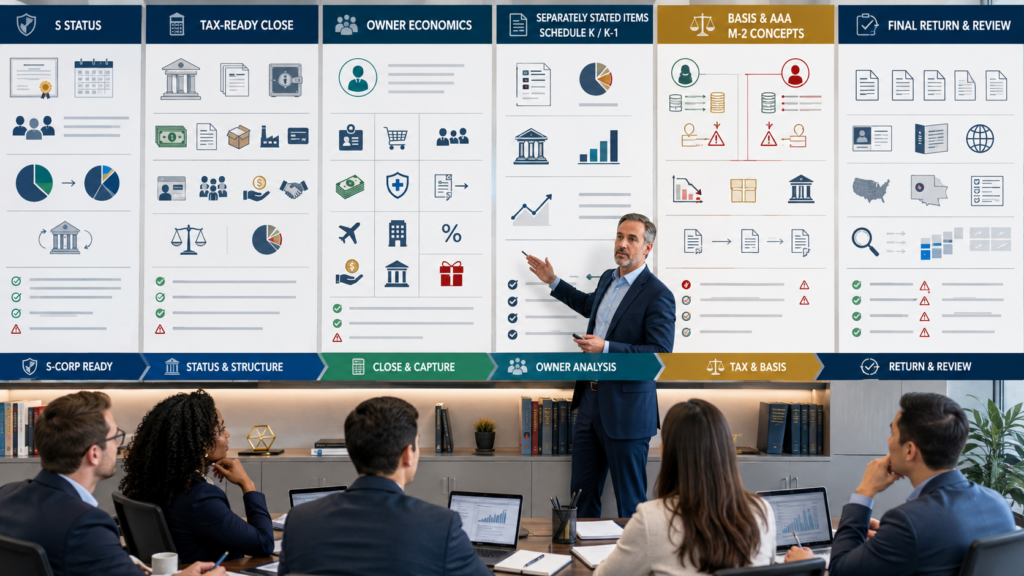
S-CORP READY
S — Status and Shareholders
Verify election, eligibility, ownership, stock changes, tax year, and prior C corporation history.
C — Close and Reconcile
Tie books, bank, payroll, fixed assets, debt, retained earnings, shareholder accounts, and prior-year balances.
O — Owner Compensation and Benefits
Analyze officer wages, distributions, personal expenses, health insurance, fringe benefits, reimbursements, rent, and interest.
R — Report Separately Stated Items
Move items that affect shareholders differently out of ordinary business income and into Schedule K / K-1 reporting.
P — Pro Rata Allocation and K-1s
Validate ownership dates, per-share / per-day allocations, shareholder changes, and all attached K-1 statements.
R — Reconcile Basis, Distributions, and Loans
Separate stock basis, debt basis, capital contributions, direct shareholder loans, distributions, and suspended losses.
E — Examine AAA, E&P, and Entity Taxes
Complete M-2 thoughtfully and identify prior C corporation attributes, built-in gains, passive income, and other entity-level taxes.
A — Assess State and International Reporting
Address PTE taxes, nonresident withholding, state K-1s, K-2/K-3, foreign items, and filing exceptions.
D — Document Review Evidence
Support material judgments, diagnostics, tie-outs, elections, basis, compensation, and return-to-workpaper references.
Y — Year-to-Year Rollforward
Leave clean basis, M-2, fixed asset, state, shareholder, and technical carryforward schedules for next year.
Verify S Election Status and Shareholder Eligibility
Do not confuse state-law entity formation with federal S status
An LLC or corporation does not become an S corporation merely because the client says it is one. Form 1120-S should be filed only when an S election is in effect.
The IRS states that an S corporation generally must be domestic, have only allowable shareholders, have no more than 100 shareholders, have only one class of stock, and not be an ineligible corporation. Form 2553 must be signed by the shareholders as required for the election.
Source: IRS — S Corporations.
Build a permanent-file election checklist
Keep:
- Accepted Form 2553 or IRS election confirmation
- Effective date of S election
- Entity formation documents
- Stock ownership history
- Shareholder eligibility support
- Prior C corporation years
- Any QSub elections
- Any late-election relief documentation
Watch shareholder changes
Ask about:
- New shareholders
- Redemptions
- Gifts
- Deaths
- Trust ownership
- Transfers to entities
- Divorce or estate transfers
One class of stock is not a software diagnostic
Staff should flag arrangements that may create different distribution or liquidation rights, including unusual shareholder agreements, preferred economics, side agreements, or disproportionate distributions. The legal conclusion may require specialist review.
Election timing matters
IRS Publication 509 states that Form 2553 is generally due no more than two months and 15 days after the beginning of the tax year for which the election is intended to take effect, or during the preceding tax year, subject to late-election relief rules.
Close and Reconcile the Books Before Tax Input
Start with a tax-ready close
At minimum, reconcile:
- Cash
- Accounts receivable
- Inventory where applicable
- Fixed assets
- Credit cards
- Loans
- Payroll liabilities
- Sales / payroll tax liabilities
- Shareholder receivables and payables
- Equity accounts
Tie payroll to the return
Reconcile:
- Forms W-2
- Forms 941
- State payroll reports
- Officer compensation
- Other salaries and wages
- Shareholder health insurance
- Retirement contributions
Tie fixed assets to deductions and K-1 reporting
Look for:
- New assets
- Disposals
- Trade-ins
- Vehicles
- Listed property
- Section 179
- Bonus depreciation
- Repairs that may require capitalization analysis
Reconcile retained earnings—but do not equate it with AAA
Book retained earnings is an accounting equity balance. AAA is a tax account governed by S corporation distribution rules. They can move differently because of tax-exempt income, nondeductible expenses, timing differences, prior C corporation history, and other items.
Use a rollforward before opening tax software
Then build separate tax schedules for AAA and shareholder basis.
Read Tax Return Review Process for a broader framework for making tax workpapers easier to review and harder to misunderstand.
Classify Shareholder Transactions Correctly
Owner transactions deserve their own workpaper
List every material transaction between the corporation and each shareholder:
- Wages
- Distributions
- Capital contributions
- Loans to corporation
- Loans from corporation
- Loan repayments
- Rent
- Interest
- Health insurance
- Retirement contributions
- Personal expenses
- Vehicle use
- Expense reimbursements
Do not let “shareholder draw” become a catch-all
A single equity account can hide:
- Taxable wages
- Nondeductible personal expenses
- Loan balances
- Distributions in excess of basis
- Rent or interest that should be separately reported
Ask who benefited and why the corporation paid
A personal credit-card charge paid by the company might be:
- A distribution
- Additional wages
- A bona fide receivable from shareholder
The facts and intent matter. Staff should not “clean up” shareholder activity by automatically pushing everything to distributions.
Related-party accruals require tax awareness
The 1120-S instructions remind preparers that an accrual-basis S corporation may be unable to deduct certain expenses and interest owed to a related party until the amount is includible by the related party under section 267.
Reasonable Compensation: The S Corporation Issue Staff Cannot Skip
Shareholder-employees who perform services cannot simply take distributions instead of wages
The IRS states that S corporations must pay reasonable compensation to shareholder-employees for services provided before making non-wage distributions to them, and that the IRS can reclassify distributions or other payments as wages when appropriate.
Source: IRS — S Corporation Compensation and Medical Insurance Issues.
Reasonable compensation is facts-based
IRS factors include:
- Training and experience
- Duties and responsibilities
- Time and effort devoted to the business
- Dividend history
- Payments to non-shareholder employees
- Timing and manner of bonuses
- Comparable compensation
- Compensation agreements
- Use of formulas
Start with the source of gross receipts
The IRS specifically frames the analysis around whether gross receipts are generated by:
- The shareholder’s services
- Non-shareholder employee services
- Capital and equipment
Build a reasonable-compensation memo, not a magic percentage
A staff workpaper should document:
- Shareholder role
- Hours / time commitment
- Major duties
- Revenue-producing activities
- Management duties
- Comparable pay data supplied or researched under firm policy
- Actual wages
- Distributions / other economic benefits
- Reviewer conclusion
Training rule: Never teach “60/40,” “50/50,” or another fixed wage-distribution split as an IRS safe harbor. Reasonable compensation depends on the services and facts.
Zero wages plus large distributions is an obvious review trigger
It does not automatically establish the final wage amount, but it should force the preparer to investigate.
2% Shareholder Health Insurance and Fringe Benefits
More-than-2% shareholder-employees have special treatment
IRS guidance says health and accident insurance premiums paid on behalf of a more-than-2% shareholder-employee are generally deductible by the S corporation and reportable as wages in box 1 of Form W-2. Under the conditions described by the IRS, those additional wages generally are not included in Social Security, Medicare, or FUTA wages.
Reconcile the W-2 before finalizing the return
Check:
- Premiums paid or reimbursed by the corporation
- W-2 box 1 inclusion
- Box 14 information
- Payroll treatment
- Shareholder’s potential self-employed health-insurance deduction
Other fringe benefits need 2% shareholder awareness
Do not assume a benefit treated as tax-free for a rank-and-file employee receives identical treatment for a more-than-2% S corporation shareholder.
Ordinary Business Income vs Separately Stated Items
Separately stated items matter because shareholder consequences differ
Items commonly requiring separate Schedule K / K-1 treatment include:
- Rental real estate income or loss
- Other rental activity
- Interest income
- Dividend income
- Capital gains and losses
- Section 1231 gain / loss
- Charitable contributions
- Section 179 expense
- Credits
- Foreign taxes
- Tax-exempt income
- Nondeductible expenses
Ask whether the item could affect shareholders differently
If yes, it may need to be separately stated instead of buried in ordinary business income.
Rental activities require activity-level thinking
Rental real estate generally flows through Form 8825 and K-1 reporting, and shareholders may face passive activity rules depending on their facts.
Charitable contributions are not ordinary business deductions
They pass through for shareholder-level treatment and can also affect basis.
Read Professional Skepticism Training for Junior Accountants for building the habit of asking what an account balance actually represents before accepting the book label.
Stock Basis, Debt Basis, and Form 7203
Basis is a shareholder calculation—but the 1120S preparer must understand it
The IRS states that shareholders are responsible for computing stock and debt basis. Form 7203 is generally used to figure stock and debt basis and to determine potential limitations on S corporation losses, deductions, credits, and distributions.
Source: IRS — S Corporation Stock and Debt Basis and IRS — Form 7203.
Teach the annual stock-basis ordering rule
The IRS shareholder instructions generally apply stock-basis adjustments in that order, subject to special rules and elections.
Basis can never go below zero
When decreases exceed available basis, different consequences can arise:
- Distributions may trigger gain.
- Losses may be suspended.
- Nondeductible expenses may have basis consequences under the ordering rules.
Debt basis is separate from stock basis
Do not combine the two in one generic “owner basis” number.
A corporate bank loan guaranteed by the shareholder is generally not shareholder debt basis
IRS guidance states that a shareholder generally gets debt basis only for loans personally made to the S corporation. Merely guaranteeing or co-signing corporate debt does not generally create debt basis unless the shareholder actually makes a payment under the guarantee.
Form 7203 is not merely a tax-return attachment
Use it as a training tool to teach:
- Beginning basis continuity
- Capital contributions
- Income increases
- Distributions
- Nondeductible expenses
- Loss limitations
- Debt basis reductions and restorations
Review insight: If the preparer cannot explain the basis rollforward without the software, the return is not truly review-ready.
The S Corporation Loss Limitation Sequence
The IRS identifies four major shareholder loss limitations that generally apply in sequence:
Source: IRS — S Corporation Loss Limitations.
A K-1 loss is not permission to deduct the loss
The preparer should not tell a shareholder, “You have a $60,000 deductible loss,” simply because box 1 shows a $60,000 loss.
Basis comes first
Losses and deductions generally require sufficient stock and/or debt basis.
At-risk comes next
Even with tax basis, the shareholder may not be economically at risk for the full amount.
Passive activity may further limit the loss
The answer can depend on the shareholder’s participation and activity classification.
Excess business loss is a separate individual-level limitation
That analysis belongs on the shareholder return, but the S corporation preparer should understand why K-1 loss does not equal current deduction.
Suspended basis losses carry their character
IRS guidance explains that basis-limited losses generally carry forward and retain their character when later allowed, subject to the applicable rules.
S Corporation Distributions: Why Stock Basis Matters
Most nondividend S corporation distributions are tax-free only to the extent of stock basis
The IRS states that a nondividend distribution is generally tax-free to the extent it does not exceed the shareholder’s stock basis. Debt basis is not considered in determining whether a distribution is tax-free.
Excess distributions can create capital gain
When a nondividend distribution exceeds stock basis, the excess generally creates capital gain, subject to the shareholder’s holding period and other applicable rules.
Debt basis does not protect distributions
This is one of the most common S corporation misunderstandings. Debt basis may support losses. It does not generally make a cash distribution tax-free.
Prior C corporation earnings can complicate distribution ordering
If the S corporation has accumulated earnings and profits from C corporation years or acquired C corporation attributes, distributions may not follow the simple “tax-free to basis, then capital gain” path without additional analysis.
Reconcile distributions from multiple sources
Compare:
- General ledger distributions
- Bank transfers
- Personal expenses paid by corporation
- Credit-card activity
- Property distributions
- Schedule K-1 box 16 reporting
Do not use retained earnings as shareholder basis
Retained earnings is a corporate book account. Stock basis is shareholder-specific and can differ by acquisition history, contributions, distributions, income, loss, and other adjustments.
AAA, Accumulated E&P, and Schedule M-2
AAA is a corporate tax account
The 2025 Form 1120-S instructions describe the accumulated adjustments account as an S corporation account that generally reflects accumulated undistributed post-1982 S corporation net income.
Source: IRS — 2025 Form 1120-S Schedule M-2 Instructions.
AAA is not shareholder stock basis
AAA is maintained at the corporation level. Stock basis is maintained separately for each shareholder.
AAA is not book retained earnings
Differences can arise from:
- Tax-exempt income
- Nondeductible expenses
- Timing differences
- Prior C corporation history
- Distributions
Accumulated E&P changes the stakes
An S corporation with accumulated C corporation earnings and profits must pay closer attention to AAA and distribution ordering and may also face the excess net passive income tax under certain circumstances.
Make Schedule M-2 a real workpaper
Roll forward:
- AAA
- Shareholders’ undistributed taxable income previously taxed, if applicable
- Accumulated earnings and profits
- Other adjustments account
Do not make M-2 “work” by plugging it
Every unexplained difference is either:
- A missing transaction
- A classification problem
- A prior-year carryforward problem
- A tax-account misunderstanding
Shareholder Loans and Debt Basis
“Loan from shareholder” should be supported as debt
Document:
- Who advanced the funds
- Date
- Amount
- Promissory note where applicable
- Interest terms
- Repayment history
- Whether the loan is open account or evidenced by a note
Direct indebtedness matters
IRS Form 7203 instructions distinguish actual shareholder loans from corporate debt merely guaranteed by a shareholder.
Debt basis can be reduced by losses
If losses exceed stock basis and the shareholder uses debt basis to deduct additional losses, debt basis can be reduced.
Repaying reduced-basis debt can create taxable income
This is why a reviewer needs a debt-basis rollforward, not just a balance-sheet liability account.
Distributions do not reduce debt basis
Another common training error is to treat stock and debt basis as one bucket. They are separate systems with different consequences.
Schedule K and K-1: The Shareholder Delivery System
Schedule K summarizes shareholder-level tax items
Schedule K-1 allocates the appropriate pro rata share to each shareholder.
Ownership changes need allocation analysis
When a shareholder enters or exits during the year, the preparer should understand the general per-share, per-day allocation rules and identify situations where special elections or other rules may apply.
Attached statements matter as much as boxes
Many K-1 items need supplemental detail, including:
- Section 199A information
- State information
- Credits
- Basis-related information
- Foreign information
- Multiple activities
Tie all K-1s back to Schedule K
Before review:
- Sum shareholder allocations.
- Verify ownership percentages / dates.
- Verify distributions.
- Verify tax-exempt and nondeductible items.
- Verify state modifications.
- Verify shareholder names, SSNs / EINs, addresses, and ownership data under firm security procedures.
Section 199A / QBI Information
The S corporation supplies information; the shareholder computes the final deduction
The 2025 Form 1120-S instructions require the corporation to separately identify information that shareholders may need to determine the section 199A qualified business income deduction, including qualified items of income, gain, deduction and loss, W-2 wages, and unadjusted basis immediately after acquisition of qualified property where applicable.
Do not collapse multiple trades or businesses into one unsupported number
The instructions require information to be identified by trade or business where necessary, including specified service trade or business information and aggregation information.
QBI workpapers should tie to K-1 statements
Review:
- Business activity
- Qualified items
- W-2 wages
- UBIA
- SSTB status
- Aggregation
- Rental activity treatment where relevant
Schedules K-2 and K-3: Do Not Assume “Domestic Business” Means “No Analysis”
K-2/K-3 report international tax relevance
The IRS describes Schedule K-2 as an extension of Schedule K and Schedule K-3 as an extension of Schedule K-1 for international tax information.
2025 includes expanded filing exceptions
Current instructions include:
- A domestic filing exception, subject to detailed criteria.
- A small S corporation filing exception for corporations with total receipts below $250,000 and total assets below $250,000, subject to the full requirements.
The domestic exception still requires process
The preparer may need to evaluate:
- Foreign income taxes
- Foreign source income or loss
- Foreign assets or entities
- Shareholder notification
- Shareholder requests for K-3
Calendar-year 2025 has a specific 2026 timing point
The 2025 instructions state that for a calendar-year S corporation filing on extension, the latest “1-month date” for certain shareholder K-3 requests is August 17, 2026.
Source: IRS — 2025 S Corporation K-2/K-3 Instructions.
Training principle: “We have no foreign operations” is not a substitute for walking through the filing-exception criteria.
Built-In Gains and Other Entity-Level Tax Alerts
S corporation does not always mean “no entity-level federal tax”
The IRS notes that S corporations can be subject to certain taxes at the entity level.
Built-in gains tax is a prior-C-corporation history issue
If a corporation converted from C to S status or acquired assets carrying C corporation built-in gain attributes in certain transactions, a later disposition may create section 1374 built-in gains tax during the applicable recognition period.
Passive income tax can matter when accumulated E&P exists
An S corporation with accumulated earnings and profits from C corporation years may be subject to tax on excess net passive income if the statutory conditions are met.
Other corporate-level items can also appear
Staff should flag:
- Built-in gains
- Excess net passive income
- LIFO recapture history
- Recapture taxes
- Credit recapture
- Estimated tax requirements where applicable
Prior C corporation history belongs in the permanent file
Do not rediscover the issue every time an appreciated asset is sold.
State Returns and Pass-Through Entity Tax Elections
Federal completion is not the end of the return
State S corporation work can include:
- Entity income or franchise taxes
- Pass-through entity tax elections
- Composite returns
- Nonresident withholding
- State K-1 equivalents
- Apportionment
- Nexus
- State-specific modifications
PTE tax treatment varies materially by state
A staff accountant should never copy last year’s PTE election or payment treatment without confirming:
- Whether the election remains available
- Election deadline
- Payment deadline
- Which owners qualify
- Deductibility / book treatment
- State credit treatment
- Estimated-payment requirements
State activity can affect shareholder workpapers
Maintain a state matrix showing:
- Where returns are filed
- Which shareholders are nonresidents
- Withholding / composite status
- PTE election status
- State taxes paid
- Credit information passed to shareholders
Read Strategic Tax Planning Training for Accountants for teaching staff to surface elections and planning items before filing season removes the options.
Schedule L, M-1, and M-2: The Reviewer’s Map of the Return
Schedule L should tell the same balance-sheet story as the tax workpapers
Review:
- Cash
- Receivables
- Inventory
- Fixed assets / accumulated depreciation
- Loans
- Shareholder loans
- Capital stock
- Additional paid-in capital
- Retained earnings
Schedule M-1 explains book-to-tax income
Typical reconciling items can include:
- Tax-exempt income
- Nondeductible expenses
- Meals limitations
- Depreciation differences
- Related-party timing
- Book / tax gain differences
- Other accounting-method differences
Schedule M-2 explains S corporation tax accounts
It should not be used as a balancing mechanism for Schedule L.
Teach staff to explain all three schedules in plain language
A reviewer should be able to ask:
- Why did retained earnings move by this amount?
- Why does tax income differ from book income?
- Why does AAA differ from retained earnings?
The preparer should answer without reopening every source document.
How to Build Reviewer-Ready 1120S Workpapers
1. Start with a return-control sheet
Include:
- Entity name / EIN
- Tax year
- Election effective date
- Shareholders and ownership percentages
- States filed
- Extension status
- Open technical issues
2. Build a shareholder transaction schedule
For each shareholder:
- Wages
- Health insurance
- Distributions
- Contributions
- Loans advanced
- Loans repaid
- Rent / interest
- Personal expenses
3. Build a separately stated item checklist
Do not rely on tax software diagnostics alone.
4. Roll forward basis and M-2 before final K-1s
The preparer should see the shareholder consequences before the reviewer does.
5. Document technical judgments
Examples:
- Reasonable compensation
- Shareholder loan classification
- Prior C corporation history
- Gross receipts / accounting methods
- K-2/K-3 filing exception
- State PTE election
6. Run a final cross-return tie-out
| Item | Tie To | Reviewer Question |
|---|---|---|
| Officer wages | W-2 / payroll / 1120-S line 7 | Does compensation analysis support it? |
| Distributions | GL / bank / K-1 / basis | Any excess over stock basis? |
| Shareholder loans | Notes / GL / debt-basis workpaper | Direct indebtedness? Reduced basis? |
| K-1 income | Schedule K / ownership | Allocation correct for shareholder changes? |
| AAA | M-2 / prior year / distributions | Any accumulated E&P? |
| QBI statement | K-1 / wage / fixed asset support | Trade/business detail complete? |
Read How to Reduce Review Notes in Accounting for a broader approach to teaching staff to anticipate reviewer questions before submission.
Worked Example: The 1120S That Looked Easy Until Basis and Compensation Were Reviewed
Illustrative training example only: The numbers below demonstrate S corporation preparation logic. They are not compensation benchmarks or tax conclusions for a real taxpayer.
Consider a calendar-year consulting S corporation with one shareholder.
Book and shareholder facts
- Gross receipts: $725,000
- Book net income before owner compensation: $238,000
- Owner W-2 wages: $60,000
- Cash distributions: $155,000
- Shareholder health insurance paid by corporation: $14,000
- Personal expenses in company credit card: $9,000
- Year-end “loan from shareholder”: $80,000
- Beginning stock basis: $35,000
- Prior-year suspended basis loss: $20,000
The first draft
The beginning preparer:
- Deducts $60,000 of officer compensation.
- Leaves the $14,000 health insurance in employee benefits.
- Moves the $9,000 personal expenses to distributions.
- Assumes the $80,000 balance sheet loan creates debt basis.
- Passes ordinary income to the shareholder.
- Does not prepare a basis workpaper because the client is profitable.
The review-ready analysis
Compensation: The owner performs nearly all client-facing professional services. $60,000 of wages against the total economic benefit received is a reasonable-compensation review trigger. The preparer documents role, hours, comparable compensation, and the source of gross receipts for reviewer conclusion.
Health insurance: The $14,000 is tested under the more-than-2% shareholder rules and reconciled to W-2 reporting rather than left in employee benefits without review.
Personal expenses: The $9,000 is classified based on facts. If treated as a distribution, it joins the cash distributions for stock-basis analysis; if facts support wage treatment or a bona fide receivable, the workpaper reflects that instead.
Debt basis: The $80,000 liability is traced to source documents. Suppose $50,000 was personally advanced by the shareholder and $30,000 was a bank loan to the corporation that the shareholder only guaranteed. The preparer does not treat the guaranteed $30,000 as debt basis.
Suspended loss: Current-year income first increases stock basis. The preparer evaluates whether prior suspended basis losses become allowable, while recognizing that later at-risk and passive rules remain shareholder-level considerations.
Illustrative stock-basis waterfall
Why Profitable Years Still Need Basis Workpapers
Illustrative numbers only. Actual basis must use all applicable income, distribution, nondeductible expense, loss, and other adjustments in the required order. Debt basis is tracked separately.
The point of the exercise
The return is not review-ready merely because taxable ordinary income was entered correctly. The preparer must connect wages, health insurance, distributions, debt, basis, suspended losses, and K-1 reporting into one coherent file.
A 90-Day S Corporation Tax Training Implementation Plan
Days 1–30: Standardize the firm’s S corporation architecture
- Build permanent-file election checklist
- Build shareholder rollforward
- Build owner transaction schedule
- Build reasonable-compensation workpaper
- Build 2% health-insurance checklist
- Build stock / debt basis rollforward
- Build AAA / M-2 rollforward
- Build K-2/K-3 decision checklist
- Build state / PTE matrix
- Define reviewer-ready evidence standards
Deliverable: One standardized S corporation preparation playbook.
Days 31–60: Train with scenario files
- No-wage shareholder
- Distribution exceeding basis
- Guaranteed corporate debt
- 2% health insurance omitted from W-2
- Shareholder change midyear
- Prior C corporation E&P
- Suspended basis loss
- State PTE election
- K-2/K-3 filing exception
- Domestic R&E expenditure
Deliverable: Scored returns, workpapers, reviewer notes, and corrected returns.
Days 61–90: Controlled live-return progression
- Start with clean single-shareholder service S corporations.
- Move to multiple shareholders.
- Add shareholder loans and distributions.
- Add rental / investment items.
- Add multi-state returns.
- Add prior C corporation history only after fundamentals are reliable.
Deliverable: Evidence that the staff accountant can transfer the framework to an unfamiliar return.
The Complete 30-Day S Corporation Tax Training Curriculum
Days 1–5: S corporation foundations
- S election and Form 2553
- Eligible shareholders
- One class of stock
- Tax year
- Prior C corporation history
- Form 1120-S architecture
Evidence: Permanent-file status review and shareholder map.
Days 6–10: Books, payroll, and owner transactions
- Trial balance clean-up
- Schedule L tie-out
- Officer compensation
- Reasonable compensation
- 2% shareholder health insurance
- Personal expenses
- Contributions / distributions
- Shareholder loans
Evidence: Reconciled return-control file and owner-transaction workpaper.
Days 11–15: Separately stated items and K-1 reporting
- Ordinary business income
- Rental activity
- Interest / dividends
- Capital and section 1231 items
- Charitable contributions
- Section 179
- Credits
- Tax-exempt income
- Nondeductible expenses
Evidence: Schedule K / K-1 classification case.
Days 16–20: Basis, distributions, and M-2
- Stock basis
- Debt basis
- Form 7203
- Loss limitations
- Distribution consequences
- AAA
- Accumulated E&P
- Schedule M-2
Evidence: Multi-year basis and M-2 rollforward.
Days 21–25: Advanced reporting awareness
- QBI information
- K-2/K-3
- Built-in gains
- Passive income tax
- State PTE elections
- Nonresident withholding
- Research expenditure changes
- Filing deadlines / penalties
Evidence: Technical-issue checklist with appropriate escalation.
Days 26–30: Independent 1120S capstone
- Receive an unfamiliar S corporation file
- Verify status and shareholders
- Reconcile books
- Analyze owner transactions
- Prepare 1120-S
- Prepare K-1s
- Prepare basis support
- Complete L / M-1 / M-2
- Address QBI and K-2/K-3
- Prepare reviewer note memo
Evidence: Complete S-CORP READY capstone and 100-point readiness score.
The 30/60/90-Day Live-Work Progression
Days 31–60: Controlled preparation responsibility
The learner may independently prepare:
- Clean single-shareholder S corporation returns
- Trial-balance tie-outs
- Officer compensation schedules
- Shareholder health-insurance workpapers
- Basic basis rollforwards
- Schedule K / K-1 support
- Schedule L / M-1 / M-2 tie-outs
Days 61–90: Add moderate complexity
Expand responsibility when the preparer can handle:
- Multiple shareholders
- Shareholder changes
- Direct shareholder loans
- Suspended basis losses
- Rental / investment items
- State PTE elections
- QBI statements
- K-2/K-3 decision workpapers
After day 90: Add judgment-heavy returns deliberately
Prior C corporation E&P, built-in gains, complex reorganizations, questionable one-class-of-stock arrangements, advanced international reporting, complex state nexus, and material shareholder transaction disputes should remain subject to tax-manager / partner review.
100-Point S Corporation Tax Preparer Readiness Scorecard
| Capability | Points | Observable Evidence |
|---|---|---|
| S status / shareholder verification | 8 | Confirms election, shareholders, ownership, tax year, and prior C corporation history |
| Book / payroll reconciliation | 12 | Ties trial balance, payroll, fixed assets, debt, equity, and prior-year balances |
| Owner transaction classification | 12 | Separates wages, distributions, contributions, loans, benefits, rent, interest, and personal expenses |
| Reasonable compensation / 2% benefits | 10 | Identifies wage risk and supports health-insurance / fringe-benefit reporting |
| Separately stated items / K-1 | 12 | Classifies Schedule K items and produces complete K-1 statements |
| Stock / debt basis | 14 | Explains Form 7203 logic, direct debt basis, distribution effects, and suspended losses |
| AAA / M-2 / prior C corp awareness | 10 | Rolls AAA independently and recognizes E&P / entity-level tax triggers |
| State / international / QBI awareness | 8 | Completes decision checklists and escalates complex issues |
| Reviewer-ready workpapers | 9 | Cross-references material amounts and documents judgments clearly |
| Year-to-year continuity | 5 | Leaves clean basis, M-2, shareholder, state, and technical carryforwards |
Suggested readiness rule: Require at least 85 points overall, no zero category, no unresolved stock/debt basis issue, no unsupported shareholder wage conclusion, accurate K-1 tie-out, and successful transfer to an unfamiliar S corporation before the preparer is assigned independent responsibility for a material 1120S engagement.
15 Realistic S Corporation Tax Training Scenarios
Scenario 1: The Owner Takes $200,000 of Distributions and $20,000 of Wages
The preparer must identify the reasonable-compensation issue and build a facts-based workpaper rather than applying a fixed wage/distribution percentage.
Scenario 2: The Bank Loan Is Personally Guaranteed
The client says the guarantee gives the shareholder basis. The preparer recognizes that a guarantee generally does not create shareholder debt basis until the shareholder actually pays under the guarantee.
Scenario 3: The K-1 Shows a $90,000 Loss
The shareholder has $25,000 of stock basis and no direct debt basis. The preparer separates K-1 allocation from currently deductible loss and identifies the basis limitation.
Scenario 4: Distribution Exceeds Stock Basis but Debt Basis Exists
The preparer must recognize that debt basis does not shelter a nondividend distribution from gain.
Scenario 5: Health Insurance Was Deducted but Not Added to W-2 Wages
The learner identifies the more-than-2% shareholder issue and coordinates the payroll correction process under firm policy.
Scenario 6: New Shareholder Acquired Stock on July 1
The preparer must determine the allocation method, ownership dates, K-1 percentages, and whether any special election requires reviewer analysis.
Scenario 7: Shareholder “Loan” Is Really Years of Personal Expenses
The learner challenges the receivable classification and gathers evidence about repayment intent, documentation, and treatment.
Scenario 8: Book Retained Earnings and AAA Differ
The learner explains why that can be correct and reconstructs the M-2 instead of plugging it to the balance sheet.
Scenario 9: Former C Corporation Sells Appreciated Property
The learner recognizes a built-in-gains review trigger and escalates before finalizing Schedule D.
Scenario 10: Prior C Corporation E&P Plus Large Passive Income
The preparer identifies potential excess net passive income tax and distribution-ordering complexity.
Scenario 11: Domestic Company Has a Small Foreign Tax on an Investment Statement
The preparer walks through K-2/K-3 rules and filing exceptions instead of checking “not applicable” because the operating business is domestic.
Scenario 12: Small S Corporation Has $180,000 of Receipts and $120,000 of Assets
The learner evaluates the current small-S-corporation K-2/K-3 filing exception and its full requirements instead of relying on size alone.
Scenario 13: R&D Costs Were Capitalized in 2023 and New Domestic R&E Occurs in 2025
The preparer identifies section 174A and transition-procedure issues created by the 2025 law changes and routes the accounting-method decision appropriately.
Scenario 14: State PTE Tax Was Paid but Booked to Shareholder Distributions
The learner identifies the state-specific tax / deduction / K-1 reporting issue and verifies the applicable election and payment rules.
Scenario 15: Return Is Complete but Basis Workpapers Are Missing
The learner recognizes that a clean software diagnostic is not the same as a complete tax file.
Each scenario should require the preparer to identify the tax issue, source document, shareholder consequence, workpaper, return location, reviewer decision, and year-to-year carryforward.
What the CPA Firm Should Measure
| Metric | What It Reveals |
|---|---|
| Review notes per 1120S | Overall preparation quality |
| Recurring basis / M-2 review notes | Whether core S corporation concepts are transferring |
| Reviewer rebuild hours | Whether the preparer is actually review-ready |
| Returns submitted with complete basis support | Shareholder tax-risk control |
| Returns submitted with owner-transaction workpaper | Compensation / distribution / loan discipline |
| K-1 tie-out errors | Allocation and finalization control |
| Technical issues surfaced before review | Professional skepticism and escalation judgment |
| Preparation hours by complexity level | Training efficiency and scoping |
| First-year vs repeat-client review time | Quality of carryforward and institutional knowledge |
| Staff capable of independently preparing target S corp tier | Capacity beyond one manager or partner |
Read Accounting Onboarding KPIs for measuring development through observable productivity and independence rather than course completion alone.
15 Common S Corporation Tax Training Mistakes
Mistake 1: Training staff on software before tax architecture
They learn where to type without learning why the answer belongs there.
Mistake 2: Assuming an LLC is automatically an S corporation
State formation and federal tax election are different.
Mistake 3: Treating “shareholder draw” as a valid classification
Wages, distributions, loans, and personal expenses become blurred.
Mistake 4: Using a fixed reasonable-compensation percentage
Facts-based wage analysis is replaced with a shortcut that the IRS does not present as a safe harbor.
Mistake 5: Missing 2% shareholder health-insurance treatment
Payroll and shareholder deduction reporting can become inconsistent.
Mistake 6: Treating retained earnings as stock basis
Corporate book equity is confused with shareholder-specific tax basis.
Mistake 7: Combining stock and debt basis
The preparer misses the fact that debt basis may support losses but generally does not shield distributions.
Mistake 8: Giving basis for a shareholder guarantee
The preparer assumes economic exposure equals direct tax debt basis.
Mistake 9: Deducting every K-1 loss
Basis, at-risk, passive, and excess-business-loss limitations are ignored.
Mistake 10: Plugging Schedule M-2
A continuity problem is hidden instead of resolved.
Mistake 11: Ignoring prior C corporation history
Accumulated E&P, built-in gains, and passive-income issues are missed.
Mistake 12: Treating K-2/K-3 as automatically irrelevant
The preparer skips the decision process and current filing exceptions.
Mistake 13: Copying prior-year state PTE treatment
Changing state rules and election deadlines are missed.
Mistake 14: Letting software diagnostics substitute for workpapers
The return may be internally consistent without being technically supported.
Mistake 15: Measuring readiness by number of returns completed
Volume without reduced reviewer intervention does not demonstrate development.
Frequently Asked Questions About S Corporation Tax Training
What is S corporation tax training for staff accountants?
It is structured training that teaches staff to verify S status, reconcile books, classify shareholder transactions, prepare Form 1120-S and K-1s, understand basis and distributions, identify compensation and fringe-benefit issues, and build reviewer-ready tax workpapers.
What makes a Form 1120-S preparer review-ready?
A review-ready preparer can support material return amounts from source documents, explain shareholder consequences, reconcile Schedule L / M-1 / M-2, prepare basis support, identify unresolved tax issues, and leave a clean carryforward file.
What are the basic requirements to qualify as an S corporation?
IRS guidance generally requires a domestic corporation, allowable shareholders, no more than 100 shareholders, one class of stock, and no ineligible-corporation status, together with a valid S election.
When is Form 1120-S due?
It is generally due on the 15th day of the third month after the end of the S corporation’s tax year. A properly filed Form 7004 generally provides a six-month extension to file.
Can an S corporation shareholder take distributions without wages?
If a shareholder-employee performs services, IRS guidance requires reasonable compensation for those services and allows the IRS to reclassify certain distributions or payments as wages. The appropriate wage depends on facts rather than a fixed percentage.
What is the difference between stock basis and debt basis?
Stock basis comes from the shareholder’s investment and annual S corporation basis adjustments. Debt basis generally comes from direct loans from the shareholder to the corporation and has separate rules. They should not be combined.
Does guaranteeing an S corporation loan create debt basis?
Generally no. IRS guidance says merely guaranteeing or co-signing corporate debt does not create shareholder debt basis unless the shareholder actually makes a payment under the guarantee.
Can debt basis make an S corporation distribution tax-free?
Generally no. The taxability of a nondividend S corporation distribution is measured against stock basis, not debt basis.
What is Form 7203?
Form 7203 is used by S corporation shareholders to figure stock and debt basis and potential basis limitations on losses, deductions, credits, and distributions.
Is every S corporation loss on Schedule K-1 deductible?
No. IRS guidance identifies stock/debt basis, at-risk, passive activity, and excess business loss limitations that can restrict a shareholder’s current deduction.
What is AAA in an S corporation?
The accumulated adjustments account is a corporation-level tax account that generally tracks accumulated undistributed post-1982 S corporation income for distribution-ordering purposes. It is not the same as book retained earnings or shareholder stock basis.
Why does prior C corporation history matter?
Prior C corporation earnings and appreciated assets can create accumulated E&P, distribution-ordering issues, built-in gains tax, and excess net passive income tax exposure.
How are more-than-2% shareholder health-insurance premiums treated?
IRS guidance generally requires qualifying premiums paid on behalf of a more-than-2% shareholder-employee to be included in Form W-2 box 1 wages, with special Social Security / Medicare / FUTA treatment when the applicable conditions are satisfied.
What are Schedule K-2 and K-3 for an S corporation?
They report international tax information relevant to the S corporation and shareholders. Current 2025 instructions include domestic and small-S-corporation filing exceptions, but preparers should apply the actual criteria rather than assume the schedules are unnecessary.
What changed for S corporation R&D costs in 2025?
The 2025 Form 1120-S instructions reflect new section 174A, which generally allows current deductions for domestic research or experimental expenditures for tax years beginning after 2024, with an alternative capitalization-and-amortization election and transition rules for certain earlier capitalized domestic amounts.
Should an S corporation’s AAA equal retained earnings?
Not necessarily. AAA is a tax account; retained earnings is a book equity account. Tax-exempt income, nondeductible expenses, timing differences, distributions, and prior C corporation attributes can make them differ.
How should CPA firms train S corporation preparers?
Use a standardized playbook, realistic scenarios, basis and M-2 rollforwards, shareholder-transaction cases, reviewer feedback, and increasingly complex live returns. Measure readiness by reduced reviewer rebuilding—not merely returns completed.
What should be in a reviewer-ready 1120S workpaper file?
At minimum: S-election / shareholder support, reconciled trial balance, payroll tie-out, owner-transaction schedule, reasonable-compensation support, basis workpapers, M-2 rollforward, K-1 tie-outs, QBI / K-2/K-3 / state decision workpapers, and a clear list of open technical issues.
Related SkillAbility Guides for Building Stronger Tax Staff
- Accounting Workforce Development — build structured development pathways instead of relying on repetition and shadowing.
- Staff Accountant Competency Checklist — define observable readiness before expanding responsibility.
- Tax Season Readiness Checklist — align staffing, workflows, client data, and training before compression begins.
- Feedback Training for Accounting Managers — turn review comments into reusable development instead of recurring corrections.
- Project Management Training for Accountants — strengthen deadline, dependency, and client-document control around tax engagements.
Can Your Staff Prepare the 1120S—or Does the Reviewer Still Have to Rebuild the Basis, Distributions, Compensation, and M-2 Story?
SkillAbility helps accounting firms move tax development beyond forms and review notes with structured practice, realistic tax scenarios, objective readiness evidence, and development pathways that build stronger preparers, reviewers, advisors, and future leaders.
Book Your Free 10-Minute Structural Alignment Review →
Includes our 45-Day Out-of-Pocket Performance Guarantee.
To building tax staff who make review faster instead of simply moving work downstream,
Vincent Howard, CPA
Managing Partner, Howard, Howard and Hodges
SkillAbility for Accounting Firms
About the Author
Vincent Howard, CPA has practiced public accounting since 1990. He earned a Bachelor of Science in Accounting and a Master’s in Taxation from the University of Central Florida, founded his accounting firm in 1993, and serves as Managing Partner of Howard, Howard and Hodges. He helped grow the organization from three people to approximately 50 staff across multiple Florida locations and states. He has participated in PASBA since 1997, and the firm was named PASBA Firm of the Year in 2015. Since 2020, he has built and run the SkillAbility accounting workforce development platform, used by more than 1,000 accounting professionals across dozens of PASBA firms.
© 2026 SkillAbility for Accounting Firms. This article is general educational information and is not tax, legal, payroll, compensation, state-tax, international-tax, valuation, or accounting-method advice for any specific taxpayer. Tax law and IRS forms change. Confirm the applicable-year instructions and facts before preparing or reviewing an actual return.