
By Vincent Howard, CPA | Managing Partner, Howard, Howard and Hodges | SkillAbility for Accounting Firms
Last updated: August 21, 2026 | 20-minute read
- What span of control means in a CPA firm
- Reporting span vs. review span vs. development span
- What current research says about manager team size
- Why CPA-firm managers are different
- Practical CPA-firm span guardrails
- The SPAN READY framework
- Calculate manager capacity before assigning staff
- Why review load is not headcount
- Weekly feedback creates a hard capacity requirement
- How strong seniors safely widen manager span
- Busy-season span planning
- Remote, offshore, and distributed teams
- AI and manager capacity
- Signs the span is too wide
- 100-point manager-span health scorecard
- 90-day span redesign
- 12 CPA-firm span scenarios
- FAQs
What Does Manager Span of Control Mean in a CPA Firm?
Manager span of control is the number and mix of people, engagements, review responsibilities, client relationships, technical decisions, and development obligations a manager can oversee effectively at the same time.
That definition matters because simply counting direct reports produces a misleading answer.
A tax manager with six first-year staff during busy season may carry more developmental and review load than a CAS manager overseeing ten experienced accountants working through standardized monthly-close processes.
A manager with four direct reports may still be overloaded if that person also maintains a large personal client book, prepares complex work personally, reviews high-risk returns or workpapers, handles every technical escalation, manages deadlines, answers repetitive procedural questions, leads client meetings, and is responsible for staff development.
CPA Firms Need to Measure Three Different Spans
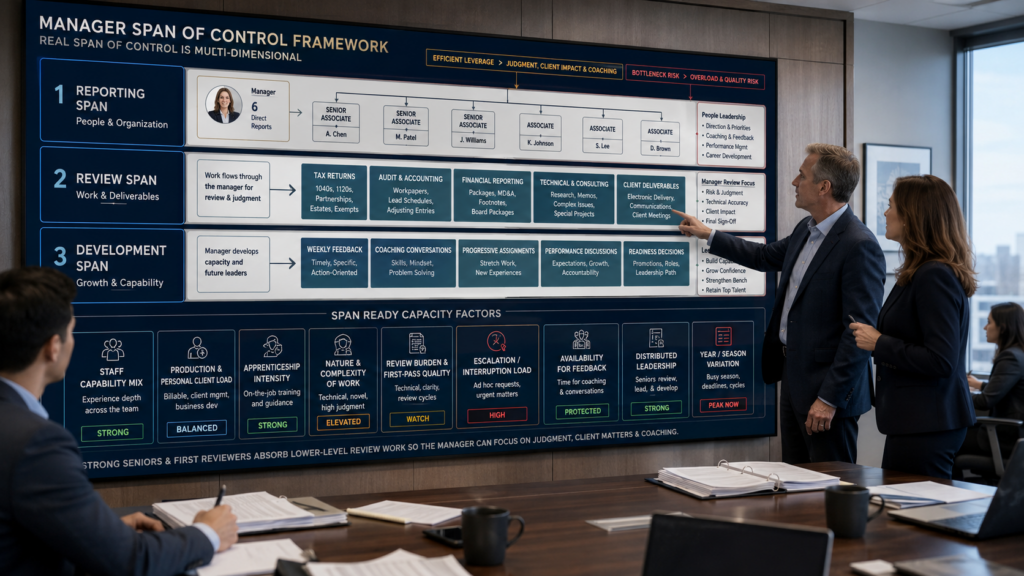
Most firms use one number where they actually need three.
| Span | Question | Typical Constraint |
|---|---|---|
| Reporting Span | How many people formally report to the manager? | Organization structure |
| Review Span | How much work can the manager review at the required risk and quality level? | Complexity, volume, first-pass quality, deadlines |
| Development Span | How many people can the manager meaningfully coach, give feedback to, assess, and advance? | Protected time, staff readiness, feedback frequency, manager skill |
A manager may have eight formal direct reports, review work from eleven people across pooled engagements, and only have enough protected time for five meaningful development relationships.
On the organization chart, the span is eight. Operationally, the manager is carrying three different spans.
If leadership manages only the reporting span, development is usually what disappears first.
What Current Span-of-Control Research Says
Gallup: the median team is still about five to six
Gallup reported in January 2026 that the average number of people reporting to U.S. managers rose to 12.1 in 2025, but the median remained around five to six. Very large teams pull the average upward.
Median U.S. span
Gallup 2026 span-of-control research.
Median manager IC workload
Managers reported a median 40% of time spent on individual-contributor work.
Minutes
Gallup says short, meaningful weekly feedback conversations can be enough.
Gallup also found 97% of managers report some individual-contributor responsibility. Managers spending more than the 40% median on individual work tend to lead smaller teams, and heavier individual-contributor loads become more difficult as span expands.
That is directly relevant to public accounting because managers are often player/coaches rather than pure people managers.
Gallup: meaningful weekly feedback matters
Gallup’s current research emphasizes meaningful feedback at least weekly. The implication for a CPA firm is straightforward:
McKinsey: span should follow the work
McKinsey argues against a universal number and instead matches span to managerial work design.
| Manager Archetype | Typical Span | Work Characteristics | CPA-Firm Analogy |
|---|---|---|---|
| Player/Coach | 3–5 | High personal production, complex work, long apprenticeship | Technical tax/audit/advisory manager carrying substantial client work |
| Coach | 6–7 | Substantial own work, structured processes, meaningful apprenticeship | Manager with developed seniors and protected coaching/review time |
| Supervisor | 8–10 | Standard processes, moderate manager production, faster independence | Accounting manager overseeing mature recurring workflows |
| Facilitator | 11–15 | Highly standardized recurring work, mostly exception management | Large AP/AR or highly standardized processing team |
McKinsey specifically uses an accounting manager as an example of the supervisor archetype: standardized accounting processes, accountants who arrive with baseline training, and apprenticeship required for company-specific work.
Why Span of Control Matters to CPA Firms in 2026
The AICPA’s 2026 PCPS CPA Firm Top Issues Survey included 629 respondents and makes the capacity problem visible:
- Firms with 11–30 professionals ranked managing staff workload and capacity No. 3.
- Firms with 31–100 professionals ranked finding the next generation of leadership No. 1 and included managing firm workflow among their leading issues.
- Firms with 101–500 professionals included managing staff workload and firm leadership development among leading issues.
- Technology and AI change management ranked first across firm sizes for expected five-year impact.
These issues are connected. If manager capacity is overloaded, workflow slows, leadership development gets postponed, staff remain dependent longer, and technology savings get consumed by review and exception handling.
Why CPA-Firm Managers Are Different
A CPA manager may simultaneously be a reviewer, coach, technical expert, project manager, client relationship lead, producer, scheduler, scope manager, billing owner, escalation point, and future partner.
That makes manager capacity unusually sensitive to interruptions and weak preparation.
Read The Manager Bottleneck for the larger organizational problem: when firm-specific knowledge lives inside managers, every procedural question consumes the same scarce capacity needed for review, coaching, client leadership, and development.
Review demand is not proportional to headcount
It is influenced by risk, complexity, first-pass quality, staff independence, deadline compression, and reviewer standardization.
A manager with five new preparers can have more review demand than a manager with nine mature accountants.
How Many Staff Can One CPA Manager Actually Develop?
There is no universal number, but firms still need an operating starting point. The following are SkillAbility guardrails synthesized from the research above and the player/coach realities of public accounting.
| Active Development Span | When It Can Work | Primary Risk |
|---|---|---|
| 3–4 | New manager, highly technical work, weak staff independence, performance-turnaround situations, heavy personal client load | May be too narrow if work is standardized and staff are mature |
| 4–6 | Typical CPA player/coach with meaningful review, client, project, and development responsibility | Still fails if manager carries too much preparation or repetitive support work |
| 6–8 | Strong manager, capable senior layer, structured training, standardized workflows, good first-pass quality, protected coaching time | Development becomes episodic if review spikes |
| 8–10 | Supervisor-style role, mature staff, strong senior reviewers, predictable recurring work, limited manager production | Firm may mistake supervision for development |
| 10+ | Highly standardized work with distributed team leads and exception-based management | High-touch apprenticeship is unlikely unless development is distributed |
These are not AICPA benchmarks or rules. Move the range up or down based on staff independence, senior leverage, manager production, service complexity, deadline volatility, technology, and the firm’s real development expectations.
The SPAN READY Framework
Before adding another person to a manager’s team, evaluate nine factors.
| Factor | Question | Span Effect |
|---|---|---|
| S — Staff capability mix | How independent are the people? | More new/developing staff → narrower span |
| P — Production & personal client load | How much work must the manager personally produce? | More personal production → narrower span |
| A — Apprenticeship intensity | How much coaching and judgment transfer does the work require? | Longer apprenticeship → narrower span |
| N — Nature & complexity of work | How variable, technical, risky, and deadline-sensitive is the portfolio? | More complexity → narrower span |
| R — Review burden & first-pass quality | How much manager review and reconstruction does work require? | More rework → narrower span |
| E — Escalation / interruption load | How often does routine work interrupt the manager? | More interruptions → narrower span |
| A — Availability for feedback | Is coaching time protected? | Protected time → wider sustainable span |
| D — Distributed leadership | Do seniors/first reviewers carry real review and coaching responsibility? | Strong senior layer → wider manager span |
| Y — Year / season variation | Does workload spike during tax season, audit deadlines, or year-end? | Compressed season → temporarily narrower effective span |
Calculate Manager Capacity Before Assigning Another Person
What remains is the capacity for feedback, coaching, development planning, delegation, follow-up, and performance conversations.
Illustrative normal-week capacity
| Responsibility | Illustrative Hours |
|---|---|
| Personal client / technical production | 12 |
| Review | 12 |
| Client & project leadership | 8 |
| Admin / firm leadership | 4 |
| Exception buffer | 3 |
| Remaining development capacity | 6 |
This is not a recommended timesheet. It demonstrates the arithmetic. If the firm expects weekly feedback, review coaching, quarterly development planning, and follow-up, six development hours can support a handful of active learners. It cannot support unlimited reports simply because the manager works longer.
For the broader workload lens, see CPA Firm Utilization Rate: Measure Productive Capacity Without Rewarding Burnout.
Review Load Is Not Headcount
Consider two managers with six staff.
Manager A
- Two experienced seniors
- Three second-year staff
- One new hire
- Strong self-review checklist
- Senior first review
- Standard client files
Manager B
- Five first-year staff
- One underperforming senior
- No consistent self-review standard
- Manager is first reviewer on everything
- Complex clients
- Compressed deadlines
Both have a reporting span of six. They do not have the same review span or development span.
A simple review-load model should consider risk, complexity, preparation quality, reviewer level required, deadline proximity, and revision cycles.
Project Management Training for Accountants makes the related point: preparation, review, manager, partner, and specialist capacity are distinct layers, and the smallest qualified capacity layer constrains delivery.
Weekly Meaningful Feedback Creates a Hard Capacity Requirement
Gallup’s 2026 span research says short, consistent 15-to-30-minute feedback conversations can be meaningful.
| Direct Reports | 15 Minutes Each | 30 Minutes Each |
|---|---|---|
| 4 | 1.0 hour | 2.0 hours |
| 6 | 1.5 hours | 3.0 hours |
| 8 | 2.0 hours | 4.0 hours |
| 10 | 2.5 hours | 5.0 hours |
| 12 | 3.0 hours | 6.0 hours |
And that is only conversation time. It excludes review notes, observed work, preparation, follow-up, development goals, performance documentation, and assignment planning.
If a manager has ten reports and no realistic five-hour block in the workload for weekly feedback conversations, the firm should not assume development is happening consistently.
Use Feedback Training for Accounting Managers to improve the quality of that limited feedback time.
A Strong Senior Layer Is How Manager Span Expands Safely
Without a strong senior layer, the manager becomes first reviewer, coach, fixer, and escalation point for everything.
With a capable senior layer:
The second model reduces low-value manager review while creating development responsibility for the senior.
That is why Tax Manager Development Program builds reviewers, coaches, and advisors before promotion.
Use Reviewer Calibration for CPA Firms and the Workpaper Review Checklist so delegated review is consistent enough that the manager does not simply re-review everything.
Busy Season Shrinks Effective Span Even When the Org Chart Stays the Same
During compressed periods, review volume rises, deadlines converge, technical exceptions increase, clients interrupt more, and managers intervene more directly.
The formal reporting span may not change. The effective development span does.
Do not cancel development—change the mode
- Shorten feedback loops
- Use brief post-review coaching
- Protect office hours
- Batch routine questions
- Move procedural training into structured resources
- Delegate first review
- Schedule deferred career conversations rather than abandoning them
- Capture recurring issues for post-season practice
The worst model is suspending development for months and then wondering why staff remain dependent next season.
Remote, Offshore, and Distributed Teams Change the Management Work
Remote work removes informal observation. Managers cannot rely on overhearing questions, seeing who is stuck, or giving desk-side correction.
Distributed teams therefore need explicit review-ready standards, escalation rules, question channels, recorded workflow training, recurring 1:1s, visible development goals, first-review ownership, and response expectations.
Gallup’s 2026 research also found span interacts with work location and manager workload. The practical lesson is not that remote teams always require smaller spans. It is that distributed work punishes ambiguity faster.
AI Can Increase Manager Span—or Flood the Review Queue
Technology increases manager capacity only when it removes work from the constrained layer.
AI can reduce manager load when it:
- Answers repeatable process questions accurately
- Automates preparation
- Improves self-review
- Surfaces anomalies before submission
- Standardizes documentation
- Routes exceptions correctly
AI can increase manager load when it:
- Creates more output faster than humans can review
- Produces plausible but unsupported conclusions
- Makes staff overconfident
- Moves judgment errors downstream
See Accountants Are Shifting From Preparers to Reviewers.
12 Signs Your Manager Span Is Already Too Wide
- Managers cancel 1:1s first. Development is the buffer sacrificed to deadlines.
- Managers rewrite work. There is no time for revision cycles or coaching.
- The same review note repeats. Current work gets fixed but capability does not transfer.
- Staff wait for answers. Manager response time becomes a workflow dependency.
- Seniors do not really review. The manager remains first reviewer on nearly everything.
- Managers work as individual contributors after hours. Management is funded through overtime.
- Client work crowds out people leadership.
- Performance issues surprise leadership.
- Development plans are stale.
- Managers cannot tell who is ready for more responsibility.
- Partner review expands downward.
- Turnover rises among the strong managers or seniors carrying the system.
Can a Manager Span Be Too Narrow?
Yes. Very narrow spans can create excess layers, micromanagement, slow decision-making, weak delegation, and unnecessary managerial cost.
Before widening the span, determine why it is narrow. The problem may be weak delegation, manual workflow, a manager title used as a promotion reward, poor senior development, or work that should move to another level.
Span optimization works in both directions. The goal is not smaller teams. The goal is enough management capacity for the work while maintaining efficient leverage.
Create a Manager Capacity Dashboard
| Measure | Question |
|---|---|
| Direct reports | Is the formal span appropriate for the work? |
| Active development relationships | How many people need meaningful current coaching? |
| Manager IC / production share | Is personal production consuming management capacity? |
| Review hours / queue | Is review demand forecasted before work lands? |
| First-pass quality | Is manager time spent on judgment or reconstruction? |
| Weekly feedback coverage | Who received meaningful feedback this week? |
| Repeated review-note rate | Is feedback transferring? |
| Manager rescue hours | How much work is being pulled upward? |
| 1:1 cancellation rate | Is development protected or optional? |
| Senior first-review coverage | Is leadership distributed? |
100-Point CPA Manager Span Health Scorecard
| Capability / Condition | Points | Evidence |
|---|---|---|
| Staff capability mix | 12 | Enough independent staff/seniors for assigned span |
| Manager production load | 10 | Personal production leaves time to manage, review, and coach |
| Review capacity | 15 | Review queue fits qualified reviewer time without chronic rescue |
| Feedback & development capacity | 15 | Meaningful feedback and follow-up occur consistently |
| Senior / first-review leverage | 10 | Capable seniors handle appropriate first review and coaching |
| Workflow & training standardization | 10 | Routine questions do not require manager interruption |
| Client / project load | 8 | Client ownership fits alongside people leadership |
| Interruption control | 7 | Questions are routed/batched and repeated issues systematized |
| Seasonal resilience | 6 | Busy-season capacity adjusts before overload |
| Manager sustainability | 7 | Span does not depend on chronic overtime or cancelled development |
- 90–100: Likely sustainable; expand only if quality and development remain strong.
- 80–89: Generally workable; address one or two constraints before expanding.
- 70–79: Fragile; capacity may be protected by overtime, rescue, or inconsistent development.
- Below 70: Redesign responsibilities before adding more people or review work.
A 90-Day Manager Span Redesign
Days 1–30: Measure the real span
Map formal direct reports, active development relationships, review responsibilities, client portfolio, manager production, project-management work, senior-review layer, interruptions, and peak seasonal load.
Days 31–60: Remove avoidable manager demand
Target repeated procedural questions, basic workpaper-readiness issues, duplicate review layers, manager-prepared work that can be delegated, meetings without decisions, manual workflow, and client tasks that should move to seniors.
Read CPA Firm Staff Development: Beyond 70-20-10: experience develops people when it is structured and paired with feedback—not when managers serve as the on-demand training department.
Days 61–90: Reset the span
Define target reporting span, active development span, review portfolio, senior-review assignments, protected feedback time, escalation channels, busy-season adjustments, and metrics for manager rescue and first-pass quality.
12 CPA Firm Manager Span Scenarios
1. Six new tax staff
A strong tax manager has six reports, all with less than one year of experience, and is first reviewer for their returns. Six is not automatically a reasonable development span because staff independence and review intensity are both low.
2. Eight staff with two strong seniors
Two seniors conduct first review, work is standardized, and weekly feedback is protected. Eight may be more sustainable than the prior scenario’s six.
3. Four reports but 65% personal production
The formal span is small; management capacity is smaller.
4. Ten mature monthly-CAS accountants
Standard close checklists, experienced staff, visible exceptions, and team leads can make ten workable as a supervisor-style reporting span while development is distributed.
5. Eight staff, no senior layer
The manager is first reviewer on all work. The issue is not only headcount; it is review architecture.
6. Twelve offshore preparers
A larger span may work with team leads, strong instructions, review standards, and escalation channels. Without them, distributed interruptions can overwhelm the manager.
7. AI cuts preparation time
More files arrive at review sooner. If first-pass quality does not improve, the manager bottleneck can worsen.
8. Strong organizer, weak coach
The manager can coordinate many people but rewrites work rather than transferring judgment. Coordination talent does not equal development capacity.
9. Busy season doubles review arrivals
The annual direct-report number does not change, but effective review and development capacity does.
10. Two managers each have five reports
One team is experienced and standardized. The other has three new hires and complex clients. Equal headcount is not equal load.
11. 1:1s cancelled for six weeks
The span may look successful because deadlines are met, but development capacity has already failed.
12. Leadership wants a benchmark ratio
Distinguish partner leverage, manager reporting span, review span, and development span before copying an external ratio from a different operating model.
Common CPA Firm Span-of-Control Mistakes
- Copying another firm’s ratio. External leverage says little about your service mix, senior layer, workflow, manager production, or staff readiness.
- Treating all reports as equal load.
- Counting review as development.
- Expanding span without reducing manager production.
- Assuming AI automatically creates capacity.
- Using overtime as managerial leverage.
- Leaving seniors out of the development architecture.
- Cancelling development during busy season.
- Making managers the training library.
- Measuring span only once per year.
How SkillAbility Changes Manager Span
SkillAbility does not make managers infinitely scalable. It changes what managers have to spend time doing.
Without structured development
Manager time goes to explaining repeatable procedures, answering the same questions, locating samples, correcting basic readiness, and recreating incomplete work.
With structured development
Manager time can shift toward judgment, review, risk, client nuance, feedback, issue framing, career development, delegation, and building future reviewers.
This is why the Accountant Development Plan matters: responsibility should expand as observable capability increases, reducing unnecessary manager touch over time.
Frequently Asked Questions About CPA Firm Manager Span of Control
How many staff should report to one CPA firm manager?
There is no universal number. Current management research suggests roughly three to five for heavy player/coaches, six to seven for coach-style managers, and eight to ten for supervisor-style accounting roles with more standardized work and independent staff. CPA-firm review, client, production, and development responsibilities often narrow the effective development span.
What is a good manager-to-staff ratio for an accounting firm?
A good ratio is the largest span at which review quality, client delivery, weekly feedback, coaching, deadlines, and manager sustainability remain healthy. Four to six active development relationships is a reasonable SkillAbility starting guardrail for many player/coach CPA managers, but it is not an industry rule.
Is six direct reports the ideal span?
No. Gallup reported a U.S. median span around five to six, but manager workload, staff independence, feedback quality, work location, and work design affect the correct number.
Can a CPA manager supervise 10 staff?
Yes in some models, especially with mature staff, strong first reviewers, standardized work, limited manager production, and distributed development. Ten formal reports does not mean the manager can personally provide high-touch development to all ten.
What is development span?
Development span is the number of people a manager can meaningfully coach, give regular feedback to, assess, assign progressively harder work to, and prepare for greater responsibility.
How does manager billable work affect span?
Heavy individual-contributor or billable work reduces the time available for management. Widening the span without reducing that workload can weaken review, feedback, and development.
How often should CPA managers give feedback?
Gallup’s current research supports meaningful feedback at least weekly and notes that short 15-to-30-minute conversations can be effective when consistent and useful.
How do senior accountants increase manager capacity?
Capable seniors can conduct first review, coach routine corrections, control workflow, and escalate judgment issues, allowing managers to focus on higher-risk review, client leadership, and development.
Does AI allow managers to supervise more people?
Only if it reduces total manager demand. AI that improves preparation, self-review, and routine support can expand capacity; AI that simply creates more output requiring validation can worsen the review bottleneck.
How do you know if a manager has too many direct reports?
Warning signs include cancelled 1:1s, repeated review notes, manager rewriting, slow answers, growing review queues, after-hours production, partner rescue, stale development plans, and weak visibility into staff readiness.
Current Research and Authority Resources
- Gallup — Span of Control: What’s the Optimal Team Size for Managers? (2026)
- McKinsey — How to Identify the Right Spans of Control
- AICPA & CIMA — 2026 CPA Firm Top Issues Survey Results
- Journal of Accountancy — AICPA Top Issues Survey
- Google Search Central — Optimizing for Generative AI Features
The Bottom Line
CPA firms should stop asking, “What is the industry-standard manager-to-staff ratio?”
Start asking:
Separate reporting span from review span.
Separate review span from development span.
Measure manager production before adding direct reports.
Forecast review demand before the queue arrives.
Build capable seniors who create the next review layer.
Move repeatable training out of manager interruptions.
Protect meaningful feedback.
Adjust the model for busy season.
Use AI only when it actually removes demand from the constrained layer.
The best span is not the largest team the manager can survive.
It is the largest team the manager can make better.
Measure the work.
Protect the review.
Protect the coaching.
Build the next reviewer.
Then expand the span.
Protect Knowledge. Develop People. Scale the Firm.
Are Your Managers Developing Staff—or Just Keeping the Review Queue Moving?
SkillAbility helps CPA and accounting firms move repeatable training out of manager interruptions, build review-ready staff, develop capable first reviewers, standardize feedback, and create measurable pathways from new hire to future manager and partner.
Book Your Free 10-Minute Structural Alignment Review →
Includes our 45-Day Out-of-Pocket Performance Guarantee.
To managers who create capacity by developing people—not by working later,
Vincent Howard, CPA
Managing Partner, Howard, Howard and Hodges
SkillAbility for Accounting Firms
About the Author
Vincent Howard, CPA has practiced public accounting since 1990. He earned a Bachelor of Science in Accounting and a Master’s in Taxation from the University of Central Florida, founded his accounting firm in 1993, and serves as Managing Partner of Howard, Howard and Hodges. He helped grow the organization from three people to approximately 50 staff across multiple Florida locations and states. He has participated in PASBA since 1997, and the firm was named PASBA Firm of the Year in 2015. Since 2020, he has built and run the SkillAbility accounting workforce development platform, used by more than 1,000 accounting professionals across dozens of PASBA firms.
How This Guide Was Developed
This guide combines Vincent Howard’s public-accounting and workforce-development experience with Gallup’s 2026 span-of-control research, McKinsey’s work-design approach to managerial spans, the AICPA’s 2026 CPA Firm Top Issues Survey, and current SkillAbility frameworks for manager bottlenecks, feedback, review readiness, reviewer calibration, project management, and staff development. The three-span model and SPAN READY framework are SkillAbility operating frameworks designed to help CPA firms distinguish organization-chart leverage from actual review and development capacity.
© 2026 SkillAbility for Accounting Firms. This article provides general educational information and does not replace employment, HR, legal, accounting, audit, tax, quality-management, professional-standards, compensation, organizational-design, or other qualified professional advice.