

By Vincent Howard, CPA | Managing Partner, Howard, Howard and Hodges | Skillability for Accounting Firms
Last updated: 2026 | 13-minute read
The Short Answer (TL;DR)
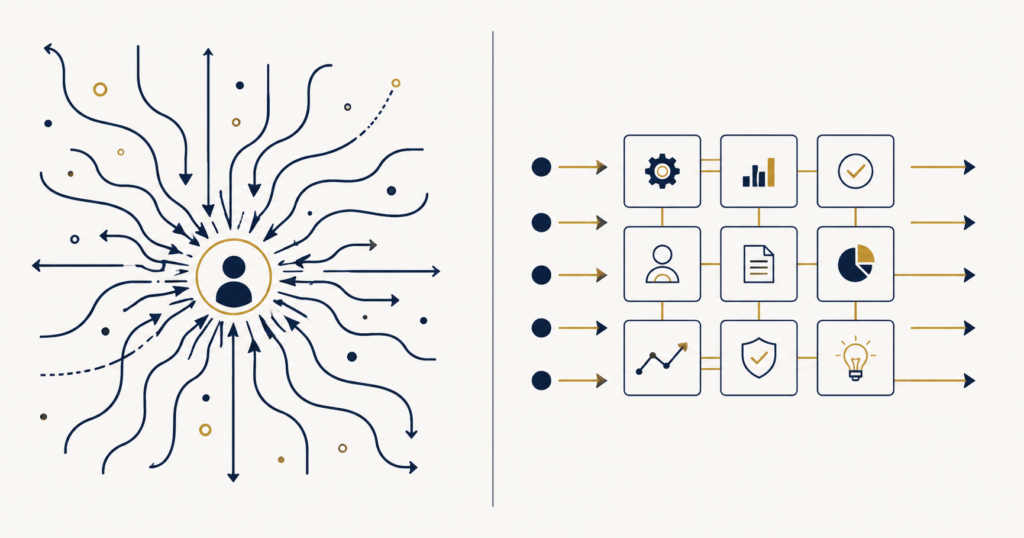
The manager bottleneck is the hidden constraint on most CPA firm growth: your most capable people — the managers and senior accountants who should be reviewing work, developing staff, and serving your best clients — spend hours every day answering the same repetitive questions instead. It feels like “being available.” It is actually the single largest unmeasured drain on firm capacity, and it gets worse exactly when you grow. The cause is not bad managers or needy staff. It is the absence of a system: when the answer to “how do we do this here” lives only in people’s heads, every question has to route through a person. The fix is to move that knowledge out of heads and into a structured system staff can access on demand — so managers answer genuinely new questions once, not the same answered questions forever.
I ran a firm with this exact bottleneck for over a decade before I understood what it actually was. Here is the full anatomy — and how to dismantle it.
Who I Am and Why You Should Listen
I’ve practiced public accounting since 1990. I founded my own firm in 1993, merged it in 2001 to form Howard, Howard and Hodges, and grew it from a three-person shop to 50 staff across four locations and multiple states. Our firm was named PASBA Firm of the Year.
For most of that growth, I was the bottleneck. I told myself I had an open-door policy and that being constantly interruptible made me a good leader. What I actually had was a firm that could not function for more than twenty minutes without me — and a calendar so fragmented by “quick questions” that I did my own real work after 6 p.m.
Since 2020 I’ve built and run a structured training and knowledge-transfer platform that more than a thousand accounting professionals across dozens of PASBA member firms have moved through. That gave me something I never had as a firm owner operating on instinct: measured data on exactly which questions repeat, how often, and what it costs to keep answering them by hand. Everything below comes from that experience — my own firm’s pain first, then the patterns that show up across every firm we work with.
What Is the Manager Bottleneck in Accounting Firms?
The manager bottleneck is the condition where a firm’s growth is capped not by clients, leads, or even headcount — but by how much of your senior people’s time gets consumed answering staff questions, reviewing routine work, and re-explaining processes that were never written down.
It shows up as a specific, recognizable pattern. Your most valuable employee — the manager who carries your most complex client relationships — is also the person every staff member walks to when they’re stuck. Where’s the template for this engagement? How did we handle this client’s sales tax last year? Which adjustment goes here? Each question takes ninety seconds to answer and breaks twenty minutes of the manager’s focus to recover from. Multiply that across a day, a team, and a busy season, and your highest-billing professional is functionally working part-time as a help desk.
The defining feature of the manager bottleneck is that it scales in the wrong direction. Add more staff and you don’t relieve the bottleneck — you intensify it, because every new hire is a new source of questions routing to the same few people. Firms hit this wall precisely when they try to grow, which is why so many owners describe growth as “exhausting” rather than rewarding.
The Cost Nobody Puts on the P&L
Let’s do the math most firm owners avoid, because the number is uncomfortable.
Say a manager or senior bills at $200 an hour — conservatively. In a busy firm, that person fields interruptions throughout the day: a process question here, a software question there, a “can you just look at this” every twenty minutes. Suppose it adds up to two hours a day of answering things that were answered before.
Two hours a day, at $200 an hour, is $400 a day. Across roughly 240 working days, that’s $96,000 a year in lost billable capacity — from a single manager — spent re-transmitting knowledge that already exists in their head but nowhere else. Multiply across two or three senior people and the firm is quietly absorbing a quarter of a million dollars in vaporized capacity it has never once put on a line item.
And that is only the visible cost. The interruption tax is worse than the clock suggests, because focused professional work doesn’t resume the instant the question ends. Research on knowledge work has long found it takes significant time to fully regain concentration after an interruption — so a ninety-second answer can cost fifteen or twenty minutes of real productivity. The manager isn’t losing the two hours they spent answering. They’re losing the two hours plus the fractured remainder of a day that never reassembles into deep work.
You are not running an accounting firm at that point. You’re running an extremely expensive, permanently-open question desk.
Why the Bottleneck Forms (It’s Not Who You Think)
The instinct is to blame someone. The staff are too needy. The managers won’t delegate. The new hire isn’t picking it up fast enough. All of that misreads the problem. The manager bottleneck is structural, and it forms for five specific reasons.
1. The knowledge only exists in people’s heads
Most firms run on tribal knowledge — the accumulated “how we do it here” that lives in the memories of your longest-tenured people and was never documented. When the only copy of an answer is in someone’s head, every instance of that question must route through that head. The bottleneck isn’t a people problem; it’s a single-point-of-failure architecture problem.
2. Onboarding taught people to ask, not to find
If your onboarding is the shadowing method — sit next to a senior, watch, ask — then you have explicitly trained every new hire that the way to get an answer is to interrupt a person. You built the behavior you’re now frustrated by. Staff ask too many questions because asking is the only retrieval system you ever gave them.
3. The same questions repeat because nothing captures them
Here is the detail that surprises owners most when we show them the data: the overwhelming majority of staff questions are not new. They are the same few dozen process and software questions, asked again by each successive person, because the answer was never captured anywhere reusable. Your managers aren’t fielding a stream of novel problems requiring judgment. They’re re-answering a finite, knowable set of repeat questions — indefinitely.
4. “Being available” is mistaken for good leadership
Many owners — I was one — wear constant interruptibility as a badge of honor. But there is a difference between being available for genuine judgment calls and being the permanent answer to questions a system should handle. The first is leadership. The second is a bottleneck wearing leadership’s clothing.
5. It’s invisible on every report you look at
The cost is distributed. It never appears as a line item, never triggers a variance, never shows up in a month-end review. Because the firm can’t see it, the firm never fixes it — it just quietly absorbs it as “the cost of doing business,” year after year.
The Bottlenecked Firm vs. The Systematized Firm
| Factor | Bottlenecked Firm | Systematized Firm |
|---|---|---|
| Where answers live | In a few people’s heads | In a structured system staff can access on demand |
| How staff get unstuck | Interrupt a manager | Check the system first; escalate only genuine judgment calls |
| Repeat questions | Re-answered live, every time, forever | Answered once, captured, reused indefinitely |
| Effect of adding staff | Bottleneck intensifies | Bottleneck stays flat — the system absorbs the load |
| Manager’s day | Fragmented by interruptions; real work after hours | Protected focus; time spent on review and development |
| Key-person risk | Severe — knowledge walks out with the person | Contained — knowledge stays in the firm |
| Owner’s role | Human help desk | Actual owner |
How to Dismantle the Manager Bottleneck
The bottleneck is an architecture problem, so the fix is architectural: stop routing repeat questions through people, and start routing them through a system. Here is the concrete sequence that works, in order.
Step 1 — Separate the two kinds of questions
Not all questions are equal. There are judgment questions — how should we approach this unusual client situation, is this position defensible, how do we frame this recommendation — which genuinely require a senior’s expertise and should reach them. And there are system questions — where’s the template, how do I process this in the software, what’s our standard for this task — which should never touch a manager’s calendar. The first step is simply recognizing that the second category is most of the volume, and it is entirely solvable.
Step 2 — Get the knowledge out of heads and into a system
Every repeat question is a piece of firm knowledge that currently has only one copy, stored in a person. Moving it into a structured, accessible system — where the process is documented and demonstrated, not just remembered — converts a single point of failure into a resource the whole firm can draw on without consuming the person. This is the core move, and everything else depends on it.
Step 3 — Train people to retrieve, not interrupt
A system only relieves the bottleneck if people use it first. That’s a function of how you onboard. If new hires learn the firm through a structured pathway — working through real processes in your actual software, with the answers built into the training — they develop the habit of finding answers in the system rather than reflexively interrupting a senior. You replace “ask a person” with “check the system, then escalate” as the default behavior, starting on day one.
Step 4 — Reserve your managers for what only they can do
Once the system handles the repeat volume, your managers’ expertise gets reallocated to where it actually creates value: reviewing work, coaching judgment, developing the next tier of staff, and serving the complex client relationships that justify their rate. This is the payoff. The goal was never to make managers less available — it was to make their availability count.
A structured system doesn’t replace your best manager. It liberates them. It handles the mechanical, repeatable knowledge with perfect consistency and infinite patience — so the manager’s judgment is reserved for the genuine judgment calls. Firms that make this shift consistently report that manager-to-staff relationships improve, because the manager stops being the answer desk and starts being a mentor.
“But My Staff Should Be Able to Ask Questions”
They should — and they will. Dismantling the bottleneck doesn’t mean closing your door or telling people to figure it out alone. It means changing which questions reach you. When the system handles “where’s the template” and “how do I process this,” the questions that do reach you are the ones worth your attention: the judgment calls, the genuine exceptions, the moments where a staff member is ready to learn something that actually requires you. That’s a better use of an open door than answering the same software question for the fortieth time — and it’s a better experience for the staff member, too, who gets unstuck instantly instead of waiting for you to be free.
Frequently Asked Questions
What is the manager bottleneck in an accounting firm?
The manager bottleneck is when a firm’s growth is limited by how much of its senior people’s time is consumed answering repetitive staff questions, reviewing routine work, and re-explaining undocumented processes. Because the knowledge lives only in those people’s heads, every question must route through them — so the firm’s capacity is capped by their availability. It intensifies as the firm adds staff, because each new hire becomes another source of questions routing to the same few people.
Why do my accounting staff ask so many questions?
Usually for two structural reasons, neither of which is the staff’s fault. First, the answers they need aren’t documented anywhere, so interrupting a person is the only retrieval method available. Second, if they were onboarded through shadowing, they were explicitly trained that “ask a senior” is how you get unstuck. The volume drops dramatically when you give staff a structured system to check first and train the habit of using it before escalating.
How do I reduce staff interruptions without being less available?
Separate judgment questions from system questions. Judgment questions — unusual client situations, defensible positions, how to frame a recommendation — should still reach you. System questions — where’s the template, how do I process this, what’s our standard — should be answered by a documented, accessible system instead. Moving the repeat, mechanical questions into a structured platform protects your focus while keeping you fully available for the questions that actually need you.
How much does the manager bottleneck cost a firm?
More than most owners realize, because the cost is never on a report. A single manager billing $200/hour who spends two hours a day answering repeat questions loses roughly $96,000 a year in billable capacity — and that’s before the interruption tax, since focused work takes 15–20 minutes to resume after each break. Across two or three senior people, firms commonly absorb a quarter-million dollars a year in vaporized capacity they have never quantified.
What’s the difference between tribal knowledge and a knowledge-transfer system?
Tribal knowledge is “how we do it here” stored only in employees’ memories and never written down. It’s fragile (it walks out the door when someone leaves), inconsistent (everyone has a slightly different version), and it forces every question through a person. A knowledge-transfer system captures that same knowledge in a structured, accessible, demonstrable form — so it survives turnover, stays consistent across the firm, and can be retrieved without consuming the person who originally held it.
Will documenting processes (SOPs) fix the bottleneck?
SOPs help, but they rarely fix it alone. A written SOP tells someone what to do; it doesn’t verify they can actually do it, and dense process documents often go unread. The bottleneck fully breaks only when knowledge is paired with structured, execution-based training — staff working through the real process in your actual software, with the answers built in — so they build genuine competence and the habit of self-service, not just a binder they ignore.
The Bottom Line
The manager bottleneck survives in firms not because anyone chooses it, but because it’s invisible, it feels like good leadership, and dismantling it requires a decision most owners never get around to making. Yet it is, quietly, the single largest constraint on most firms’ growth and the single largest drain on their most expensive people.
The cause is always the same: knowledge that lives only in heads, and onboarding that trained people to interrupt rather than retrieve. So is the fix: move the knowledge into a system, train people to use it, and reserve your managers for the judgment only they can provide. Do that, and adding staff stops intensifying the bottleneck and starts actually growing the firm.
You are not capped by your clients or your market. You are capped by how your firm transfers what it knows. And that is the most fixable constraint you have.
Want to see where your firm’s bottleneck actually is?
Book Your Free 10-Minute Structural Review →
In ten minutes we’ll map where your senior time is leaking, identify which repeat questions are eating your managers’ days, and show you what a structured knowledge-transfer system looks like inside the software your firm already uses — the BASE → MAPS → Summit development pathway that takes your people from new hire to advisor to future partner.
Backed by the Skillability Performance Guarantee: put your next hires through our system — if it doesn’t improve your onboarding, we’ll refund your investment.
To your firm’s capacity,
Vincent Howard, CPA
Managing Partner, Howard, Howard and Hodges
Skillability for Accounting Firms
Vincent Howard, CPA has practiced public accounting since 1990. He holds a Master’s degree in Taxation, leads a 50-person multi-state firm, and built the Skillability training platform used by accounting firms nationwide through the PASBA network — the source of the 1,000+ trainee dataset referenced in this article. Howard, Howard and Hodges was named PASBA Firm of the Year and has offices in Lake Mary, Sarasota, and Winter Springs, Florida.