
By Vincent Howard, CPA | Managing Partner, Howard, Howard and Hodges | Skillability for Accounting Firms
Last updated: 2026 | 14-minute read
The Short Answer (TL;DR)
Most “skill development” spending at accounting firms doesn’t develop skills — it accumulates certificates. The platform market sorts into three tiers that firm owners routinely confuse: credential platforms (CPE providers, exam prep) that maintain licenses, knowledge platforms (webinar libraries, video courses) that transfer information, and capability platforms (execution-based, software-embedded, assessment-gated systems) that produce verified ability to do new work. Only the third tier changes what your firm can bill for. The evaluation test that separates them takes one question: after the employee finishes, can they execute a new task in your actual software that they couldn’t execute before — and can you prove it with their work product? Applied honestly, that test disqualifies most of what firms currently buy. Below: the full platform landscape sorted by tier, an evaluation scorecard, the development-pathway architecture that retains staff (firms with structured development cut first-year turnover 30–40%), and how to build a development stack for under $10K a year that outperforms a $50K conference-and-CPE budget.
Who I Am and Why You Should Listen
I’ve been in public accounting since 1990. I founded my own firm in 1993, merged it in 2001 to form Howard, Howard and Hodges, and grew it from three people to 50 staff across four locations and multiple states. Our firm was named PASBA Firm of the Year.
I have spent money on every tier of this market. Decades of CPE budgets. Conference registrations. Exam-prep sponsorships for staff pursuing licensure. Vendor certifications. Webinar subscriptions. A generic LMS I personally spent years building curriculum on top of. And finally, the purpose-built capability platform that build became — which more than a thousand accounting professionals across dozens of PASBA member firms have now moved through, generating measured data on what development approaches actually change performance and which ones change nothing but the training-budget line.
That spending history is the qualification that matters here. I’m not reviewing these platforms from demo videos. I’ve written the checks, watched my staff use (and ignore) the products, and measured what happened to their work afterward. This article is the sorting system I wish I’d had before the first check.
The Distinction Nobody Makes: Training vs. Skill Development
First, a definitional boundary, because conflating these two functions is where development budgets go to die.
Training is getting a new hire from zero to competent — onboarding, ramp-up, the first 30 days. It has a finish line. (We’ve covered that system exhaustively: see our complete guide to training accounting staff and the structured onboarding pathway that produces independent productivity in 2–3 weeks.)
Skill development is everything after the finish line: the continuous, career-long expansion of what your existing people can do. The bookkeeper learning financial statement analysis. The staff accountant mastering Section 754 elections. The senior learning to review returns instead of just preparing them. The compliance processor becoming a tax advisor.
Development is the harder problem and the higher-stakes one — because while training failures cost you per-hire, development failures cost you the whole next decade. The profession’s data-entry layer has a three-to-five-year automation horizon; the talent pipeline is short roughly 120,000 professionals; and staff turnover peaks at the three-to-five-year mark precisely because that’s when capable people conclude their development has stalled. Firms with structured development programs cut first-year turnover by 30–40% — and CPA-track staff retain at 73% versus 49% for peers with no credential pathway. Your development infrastructure is simultaneously your capability engine, your retention system, and your AI-transition insurance.
Which makes it worth asking hard questions about what the platforms you’re buying actually do.
The Three-Tier Hierarchy: Credentials, Knowledge, Capability
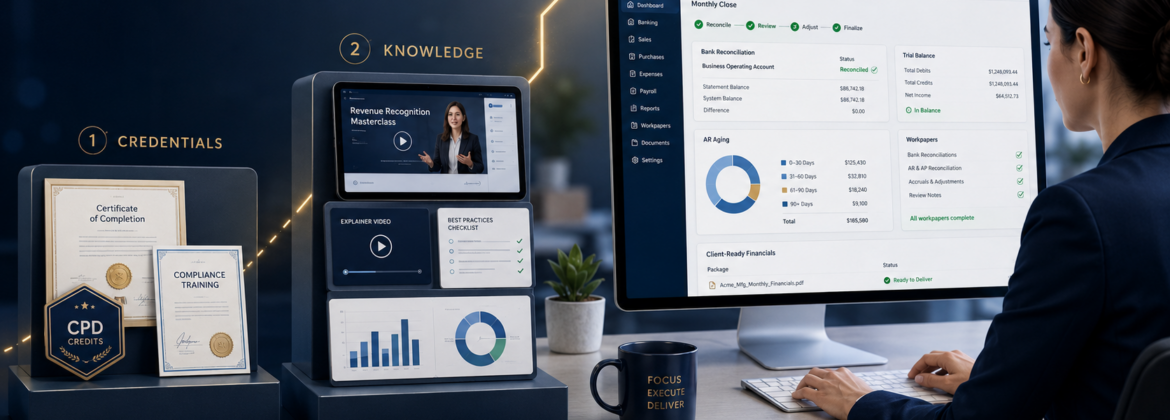
Every platform in this market does one of three things. The marketing rarely tells you which, so here’s the sorting system:
Tier 1 — Credential platforms maintain licenses and produce designations. The output is a certificate with regulatory or market value. Necessary, but the certificate measures attendance and exam performance — not job execution.
Tier 2 — Knowledge platforms transfer information. The output is understanding: your staff member now knows what a 754 election is. Useful — but knowing-about and being-able-to-do are separated by a canyon that only practice crosses.
Tier 3 — Capability platforms produce verified execution. The output is demonstrated ability: your staff member has now performed a 754 election inside your actual tax software, on realistic data, and passed an assessment derived from the work they produced. This is the only tier whose output you can bill.
The one-question test for any platform demo: “When my employee finishes, what new task can they execute in our software — and how will I verify it?” Tier 1 answers with credit hours. Tier 2 answers with course completions. Tier 3 answers with work product. Buy accordingly.
The Platform Landscape, Sorted
Tier 1: Credential platforms — buy for licenses, not for skills
Becker Professional Education remains the gold standard for CPA exam preparation — rigorous, well-structured, worth the investment for staff pursuing licensure. And the licensure pathway itself is a development asset: the retention gap between credential-track staff (73%) and non-credentialed peers (49%) justifies exam-prep sponsorship on retention math alone. Just be clear-eyed about what you bought: a Becker-credentialed staff member has demonstrated exam mastery, not operational capability in your workflow.
Surgent CPE and similar providers (MasterCPE, CPE Think, Checkpoint Learning) handle license maintenance competently and affordably. CPAacademy does it nearly free via webinars. All legitimate for their function. None of them will change what your staff can execute on Monday, and a firm that audits its “development program” and finds only a CPE budget has found a compliance program wearing a development costume.
Earmark deserves a mention as the modern entrant — CPE credit earned from podcast listening. Genuinely clever for making compliance painless. Still Tier 1.
Tier 2: Knowledge platforms — useful supplements, dangerous foundations
LinkedIn Learning, Coursera, and Udemy offer broad business-skill libraries at low cost. For genuinely general skills — Excel techniques, business writing, presentation skills — they’re reasonable. For accounting-specific development they fail the capability test completely: generic content built for individual learners rather than multi-client firm workflows, zero gating, zero work-product verification, and completion certificates that measure persistence rather than skill.
AICPA learning products and certificate programs sit at the premium end of Tier 2 — authoritative, current, credible. The certificates (in areas like client advisory services) carry real market signaling value, and for audit-heavy firms the technical content is well-matched. For the typical small-business tax and accounting firm, expect maybe a fifth of the catalog to map onto daily work, and expect knowledge transfer rather than verified execution.
Intuit Academy and vendor certifications (QuickBooks ProAdvisor, Xero certifications) are the floor every firm should stand on — free, current, and useful for baseline software orientation plus the marketing value of the badge. But they teach the vendor’s perspective (the small business owner’s workflow, not the professional’s multi-client workflow), and they re-stale every time the vendor redesigns the interface — which Intuit does with enthusiasm.
Conferences and live seminars — the Gear Up–style intensive update events — earn a special note: for fast-changing annual tax law content, a live expert-led update is genuinely hard to replace, and I say that as someone who builds digital training for a living. Budget for them as knowledge infusions and network maintenance. Just don’t book them as development strategy; the half-life of un-practiced conference knowledge is measured in weeks.
Tier 3: Capability platforms — where development actually happens
This tier is nearly empty, which is the market’s biggest problem and the reason I ended up building in it. The defining requirements:
- Execution inside your actual software — QuickBooks Online, Accounting CS, UltraTax, Xero — because capability that lives in a simulation dies on contact with the real interface
- Realistic work product as the medium — full sample-client scenarios, not abstract exercises
- Gated, work-derived assessment — an 80% threshold on questions generated from the numbers the learner actually produced, so passing is the verification
- Role-progression architecture — defined pathways from bookkeeper → staff accountant → senior → advisor, with an on-demand advanced library (the 754s, 1202s, multi-state apportionment, year-end addbacks) available at the moment of need rather than as forced marches
- Measurable progress data — time-on-task, attempts, completion benchmarks visible to managers
Generic LMS containers (TalentLMS, LearnUpon, Moodle) can theoretically host all of this — after you spend years building the curriculum, which I did and do not recommend to anyone running a practice (the full autopsy is in our LMS for accountants guide). Purpose-built systems ship with it. Skillability is my entry in this tier — the complete pre-built pathway architecture, from onboarding through the MAPS advisory catalyst that develops compliance staff into retainer-generating advisors — and I’ll let the rest of this article’s framework, rather than adjectives, make that case.
The Scorecard: Evaluating Any Development Platform
Seven questions, in priority order, with the honest pass/fail for each tier:
| Question | Tier 1 (Credential) | Tier 2 (Knowledge) | Tier 3 (Capability) |
|---|---|---|---|
| Does learning happen inside our actual software? | No | Rarely | Yes — definitional |
| Is progression gated on verified work product? | No (exam-gated at best) | No | Yes — 80% thresholds |
| Is there a visible role-progression pathway? | Within credentials only | No | Yes — mapped roles and milestones |
| Can managers see progress data and benchmarks? | Credit-hour tracking | Completion tracking | Time, attempts, pass rates |
| Does it build toward advisory/AI-era capability? | No | Conceptually | Yes — structured advisory track |
| Does it satisfy license compliance? | Yes — its actual job | Sometimes | Partially — pair with Tier 1 |
| Cost relative to outcome | Low cost, narrow outcome | Low cost, soft outcome | Moderate cost, billable outcome |
The takeaway the table forces: the tiers aren’t competitors — they’re layers, and the standard firm mistake is buying layers 1 and 2 generously while leaving layer 3, the only one that changes billable capability, completely empty.
The Development Stack: What a Complete Setup Looks Like
For a 10–50 person firm, the full architecture — with realistic annual numbers:
Layer 1 — Compliance (≈$0–$3,000/yr): CPAacademy or similar for routine CPE; Earmark for the podcast crowd. Exam-prep sponsorship (Becker/Surgent) for licensure-track staff as a targeted retention investment.
Layer 2 — Knowledge currency (≈$2,000–$6,000/yr): One annual live tax update event for your tax leads; vendor certifications maintained as the software floor; selective AICPA certificates where a market signal matters (e.g., a CAS practice lead).
Layer 3 — Capability engine (≈$9,100/yr): The execution-based platform carrying onboarding, the advanced on-demand library, benchmark data, and the advisory development track — at $675/month for five seats plus a $1,000 setup, this is the layer that converts the rest of the stack into billable outcomes.
Total: roughly $12,000–$18,000 a year for the complete stack — against which a single compliance client converted to an advisory retainer ($9,000–$13,000 in annual uplift) recovers most of the spend, and the turnover reduction (30–40% on first-year attrition, against replacement costs of 50–400% of salary) quietly recovers it again. Compare that to the firm spending $50,000 on conferences and CPE with an empty third layer: more spend, no new capability, and a development program their best bookkeeper — the one reading AI headlines and recruiter emails — can’t see herself in.
That last sentence is the part to sit with. The visible development pathway is itself the retention product. A platform whose progression map your staff can see, with their own name and next milestone on it, answers the question every recruiter implicitly asks. Certificates on a shelf don’t.
Frequently Asked Questions
What is the best skill development platform for accounting firms?
It depends on which of three jobs you’re hiring the platform for. For license compliance: CPE providers like Surgent or CPAacademy do it cheaply and well. For knowledge transfer: AICPA programs, vendor certifications, and an annual live tax update cover it. For actual capability development — verified new abilities your firm can bill — the platform must train inside your real software (QuickBooks Online, Accounting CS, UltraTax, Xero), gate progression on work-product assessments, and provide role-progression pathways from bookkeeper through advisor; purpose-built systems like Skillability occupy this tier. The evaluation test: after the employee finishes, what new task can they execute in your software, and how is it verified? Most platforms can’t answer; the right one answers with work product.
What is the difference between CPE and skill development?
CPE is regulatory compliance: accumulating credit hours through courses and webinars to maintain a license, measuring attendance and point-in-time knowledge. Skill development is capability building: structured, verified expansion of what an employee can execute — new software workflows, new return types, advisory abilities. They are non-interchangeable: a staff member can hold 40 fresh CPE hours and be unable to perform a Section 754 election in the firm’s tax software, because no CPE course gates completion on actual work product. Well-run firms maintain both — CPE for the license, execution-based development for the capability — and never let the first masquerade as the second.
How do accounting firms develop staff skills effectively?
Five elements with measured impact: (1) a written, visible development pathway mapping each role to the next with explicit skill milestones — bookkeeper to staff accountant to senior to advisor; (2) execution-based learning inside the firm’s actual software, gated by assessments built on the learner’s own work product; (3) an on-demand advanced library (complex tax elections, multi-state issues, year-end addbacks) available at the moment of need rather than as mandatory sequences; (4) structured development check-ins at 30/90/180 days, which research links to 30–40% reductions in first-year turnover; (5) a deliberate advisory upskilling track that moves compliance staff up the value chain ahead of automation. The common failure is substituting CPE budgets and conference attendance for all five.
Are LinkedIn Learning or Udemy good for accounting staff development?
For general business skills — Excel, writing, presentations — they’re reasonable low-cost supplements. For accounting-specific development they fail on every structural requirement: content built for individual learners rather than multi-client firm workflows, no firm-software specificity, no gated verification, and completion certificates that measure persistence rather than capability. A staff member can finish a QuickBooks course on these platforms while checking their phone and receive the same certificate as one who mastered it. Use them at the margins; never as the foundation of a development program.
How much should an accounting firm spend on staff development?
A complete three-layer stack for a 10–50 person firm runs roughly $12,000–$18,000 annually: near-free-to-$3,000 for CPE compliance, $2,000–$6,000 for knowledge currency (one live tax update, vendor certifications, selective AICPA certificates), and about $9,100 for an execution-based capability platform ($675/month for five seats plus setup). The return math: one compliance client converted to an advisory retainer recovers $9,000–$13,000 annually; structured development cuts first-year turnover 30–40% against replacement costs of 50–400% of salary; and structured onboarding saves roughly $9,500 per hire versus shadowing. Spend less than this and the missing layer is almost always the capability one — the only layer that produces billable outcomes.
How does staff skill development reduce turnover at accounting firms?
Turnover in public accounting peaks at the three-to-five-year mark — the point where capable staff conclude their development has stalled and the future they were vaguely promised isn’t coming. A visible development infrastructure attacks that mechanism directly: firms with structured development programs report 30–40% lower first-year turnover (some studies show 47%), and credential-track staff retain at 73% versus 49% for peers without a pathway. The effect compounds in the AI era: bookkeeping staff who can see a funded route from data processing to advisory work stay; those told “don’t worry” leave for firms whose answer is a curriculum. The development platform, in other words, is simultaneously a capability investment and the strongest retention message a firm can send.
The Bottom Line
The skill development market sells three different products under one label, and the accounting profession has spent decades buying the first two — credentials and knowledge — while leaving the third, capability, almost entirely unpurchased. That’s why the average firm’s development program is a CPE ledger and a conference budget, why its best people leave at year three for firms that wrote the pathway down, and why “training” somehow never changes what anyone can actually bill.
The sorting test fits on an index card: after they finish, what can they execute in our software — and how do we verify it? Ask it of every platform, every renewal, every conference registration. Tier 1 keeps your licenses. Tier 2 keeps your knowledge current. Only Tier 3 changes your firm.
You are not under-spending on development. You are spending on the wrong tier. Fix the stack, and the spending finally starts compounding.
Want to see the capability tier already built — pathways, gates, benchmarks, and the advisory track included?
Book a 10-minute structural alignment review at calendly.com/skillabilitydemo
In ten minutes we’ll audit your current development stack against the three tiers, identify what your spend is actually producing, and show you the execution-based system running inside the software your firm already uses — from new-hire onboarding through the MAPS Tax Advisor Catalyst.
Put your team through our system. If new hires don’t pass our modules and aren’t autonomously delivering client-ready work within 45 days, we refund 100% of your enrollment fee and pay your monthly subscription out of our own pocket.
To your firm’s capacity,
Vincent Howard, CPA
Managing Partner, Howard, Howard and Hodges
Skillability for Accounting Firms
Vincent Howard, CPA has practiced public accounting since 1990. He holds a Master’s degree in Taxation, leads a 50-person multi-state firm, and built the Skillability training platform used by accounting firms nationwide through the PASBA network — the source of the 1,000+ learner dataset referenced in this article. His firm was named PASBA Firm of the Year.
© 2026 Skillability for Accounting Firms. 45-Day Out-of-Pocket Performance Guarantee applies to qualifying onboarding engagements. Contact us for full terms.