

By Vincent Howard, CPA | Managing Partner, Howard, Howard and Hodges | Skillability for Accounting Firms
Last updated: 2026 | 13-minute read
The Short Answer (TL;DR)
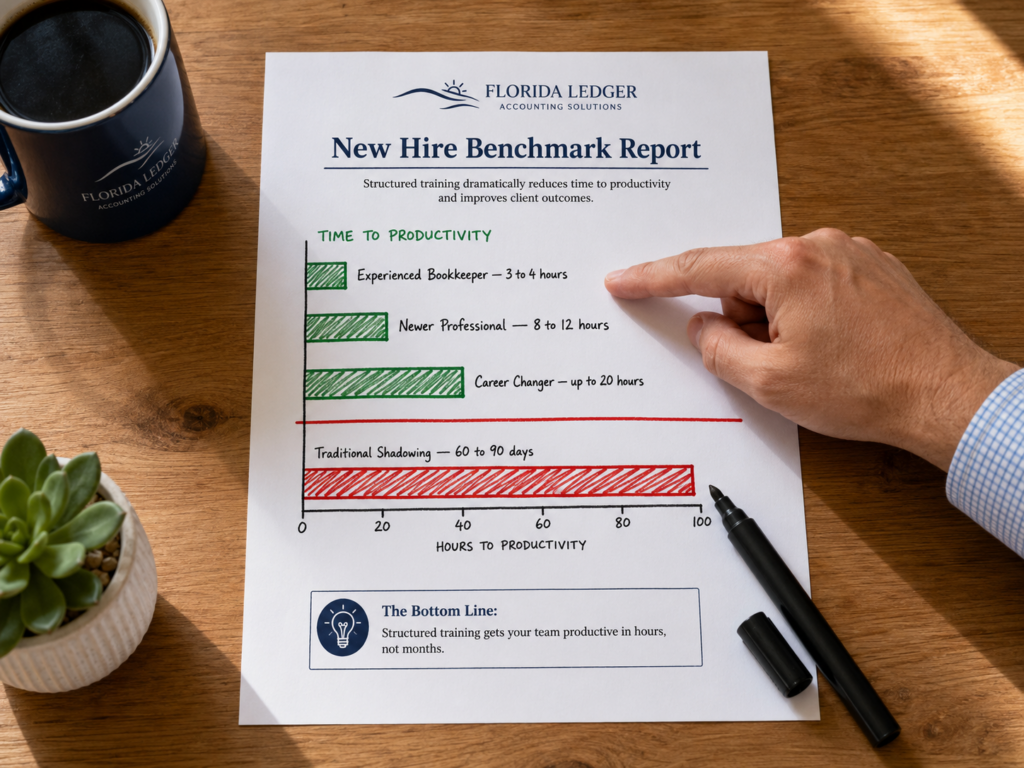
General HR research says a new employee takes 6 to 12 months to reach full productivity — Gallup puts it at around 12 months, other studies at 8 months on average. For accounting firms specifically, those numbers are both wrong and irrelevant — because they describe unstructured onboarding, and 58% of companies never measure time to productivity at all. Based on data from more than 1,000 trainees across dozens of accounting firms, here are the real benchmarks: a new bookkeeper inside a structured, execution-based onboarding pathway reaches independent productivity in 2 to 3 weeks. An experienced bookkeeper completes the foundational module in 3–4 hours; a newer professional takes 8–12 hours; a tax professional with no bookkeeping background takes up to 20 hours — and a hire at 200%+ of benchmark with failed assessments is a mis-hire announcing itself in week one, not month three. Under traditional shadowing, the same bookkeeper takes 60–90 days. The gap between those two timelines is worth roughly $9,500 per hire.
Below: the full benchmark tables, what the variance means diagnostically, why accounting ramp-up defies general HR averages, and how to measure your own firm’s numbers starting Monday.
Who I Am and Where These Numbers Come From
I’ve been in public accounting since 1990. I founded my own firm in 1993, merged it in 2001 to form Howard, Howard and Hodges, and grew it from three people to 50 staff across four locations and multiple states.
The benchmarks in this article are not survey results or estimates. Since 2020, I’ve built and operated a structured training platform that more than a thousand accounting professionals — new-hire bookkeepers, staff accountants, tax preparers, and managers — have moved through across dozens of PASBA member firms nationwide. Every one of those learners generated timestamped data: hours per module, assessment scores, attempts per gate, full-pathway completion times. Because every trainee works the same sample client data through the same gated sequence, the numbers are directly comparable across people, roles, and firms — which makes this, as far as I know, the only published apples-to-apples ramp-up dataset specific to accounting firm staff.
I’ll also tell you why I started measuring: because for the first decade-plus of running my firm, I didn’t. I “knew” how long onboarding took the way most managing partners know — by feel, anecdote, and the vague sense that the new person would be useful “in a few months.” When I finally instrumented the process, nearly every assumption I held about ramp-up time turned out to be wrong, including some that were costing me five figures per hire. This article is the corrected version.
Why the General HR Benchmarks Fail Accounting Firms
If you search “how long does it take a new employee to become productive,” you’ll find a consistent answer: a long time. Gallup research puts full productivity at around 12 months. Other studies land at five to eight months. Role-based research suggests 1–3 months for entry-level roles, 3–6 for mid-level, and 6–12 for senior or technical positions.
Here’s what those figures actually measure: the speed of unmanaged osmosis. They describe employees absorbing a role through exposure — meetings attended, questions asked, mistakes corrected — inside organizations where, per the research, 58% of companies don’t measure time to productivity at all. The benchmark isn’t describing how long the learning takes. It’s describing how long the learning takes when nobody designed it.
Accounting firm work breaks the general model in both directions, and understanding why is the key to everything else in this article:
It compresses faster than almost any profession — when structured. Bookkeeping and tax preparation are unusually teachable: the work is procedural, the outputs are objectively verifiable (the reconciliation balances or it doesn’t), and a full year of job reality can be simulated with sample data. You cannot simulate a year of sales relationships or a year of management judgment. You absolutely can simulate a year of client processing — twelve months of transactions, sales tax returns, payroll filings, and year-end work — and have a trainee complete all of it, gated by assessments, in two to three weeks. The general HR benchmarks never imagine this because most professions can’t do it.
And it drags longer than the averages — when unstructured. The same verifiability that makes accounting fast to train makes it slow to absorb by osmosis, because errors compound silently. A new hire “learning by shadowing” doesn’t know what they don’t know; their mistakes surface weeks later in review, get corrected without systematic feedback, and the cycle repeats. That’s how a profession with 2-to-3-week trainable mechanics ends up with the industry-standard 60-to-90-day ramp — and with first-year turnover of 25–35%, much of it seeded in those exact disorienting first weeks.
In other words: accounting has the widest gap I know of between structured and unstructured time-to-productivity. Which is precisely why the benchmarks matter.
The Benchmarks: What 1,000+ Trainees Actually Show
Module-level: the foundational accounting module (client setup + first quarter processing)
This is the single most diagnostic number in the dataset — the time a trainee takes to set up a client and process their first months of transactions, reconciliations, sales tax returns, and financial statements inside real accounting software, then pass an assessment built on the numbers they produced.
| Trainee profile | Time to complete foundational module | What it tells you |
|---|---|---|
| Experienced bookkeeper, familiar software | 3–4 hours | Your internal speed baseline |
| Experienced bookkeeper, new software | 4–8 hours | Software transition cost, isolated |
| Newer professional / career changer | 8–12 hours | Normal, healthy learning curve |
| Tax professional with no bookkeeping background | Up to 20 hours | Expected — different cognitive workflow, not a deficiency |
| Any profile at 200%+ of their bracket, with failed assessment attempts | 16+ hours, incomplete | Mis-hire signal — act in week one |
Two findings in that table genuinely surprised me when the data first showed them.
The first: the tax-manager anomaly. Credentialed, experienced tax professionals routinely took three to five times longer than entry-level bookkeepers on foundational transactional work. Not because they lacked ability — because tax preparers think backward from a return while bookkeepers think forward through transactions, and the workflows don’t transfer. The practical implication for every firm owner: “ten years in accounting” on a resume tells you almost nothing about ramp-up time for a specific function. Benchmark by function, not by years.
The second: the variance is the value. Before we measured, a struggling hire looked identical to a normal one for months. After we measured, the distribution itself became a diagnostic instrument — anyone dramatically outside their bracket had surfaced a problem (or a hidden strength) within days. One member firm watched a new hire log 16 hours against a 4-hour office baseline, still short of finishing January’s financials; the hire resigned on day six, before either side had sunk a quarter into the mismatch. That early-warning capability alone justifies measuring.
Pathway-level: full onboarding to independent productivity
| Onboarding approach | Time to independent client work | Senior staff time consumed | What “productive” means |
|---|---|---|---|
| Structured, gated, real-software pathway | 2–3 weeks (full-time training) | Near zero — a readiness review at the end | Has completed 12 months of financials, 12 sales tax returns and reconciliations, 4 quarterly payroll cycles, and year-end W-2/1099 processing on sample data, validated at 80%+ gates |
| Traditional shadowing | 60–90 days | 40+ hours of senior/partner time (~$8,000 at $200/hr) | A senior staffer’s gut feeling that “they’re probably ready” |
| General workforce average (all industries, mostly unstructured) | ~8 months to ~12 months | Unmeasured | Varies; 58% of companies never define it |
Note what the structured definition of “productive” contains that the others don’t: a complete simulated year. By the time that bookkeeper touches a live client file, they have already processed every month-end, every quarter-end payroll filing, the personal-use-of-company-car calculation, and the 2% S-corp health insurance addback — the year-end items that undertrained hires miss annually. The shadowed hire at day 90 has experienced whatever happened to occur in those 90 days. The structured hire at day 21 has experienced the whole year.
The pace pattern: slow start, fast finish
One more pattern worth knowing because it prevents premature panic: trainees are slowest on the first two modules and accelerate sharply from the third onward. Managers and career-changers especially front-load their struggle — we’ve watched people take 20 hours on module one and finish the back half of the pathway at near-veteran pace. The diagnostic window is the first two modules against bracket benchmarks, not raw early speed alone. Judge the trajectory, not the first data point — but judge it in week one, with numbers, not in month three, with regret.
Translating the Benchmarks Into Money
The gap between the structured and shadowed timelines is not academic. Priced out:
A shadowed hire consumes roughly $9,500 before independence — about $8,000 in senior billable hours redirected into hand-holding, plus ~$1,500 in early error write-offs — across 60–90 days in which they produce little net revenue. A structured hire consumes a platform subscription and almost no senior time, and is billing in week three or four. On a $52,000 bookkeeper, the difference between billing at day 21 versus day 75 is nearly two months of productive capacity per hire — multiplied by every hire you make, in a labor market where you’ll be making more of them than you’d like.
And the measurement itself has a second payoff the spreadsheet undersells: Gallup’s research ties strong onboarding to 82% better new-hire retention and 70% higher productivity — and in accounting specifically, structured early-tenure processes cut first-year turnover by 30–40%. The same infrastructure that compresses ramp-up is the infrastructure that keeps the person you ramped.
How to Benchmark Your Own Firm (Starting Monday)
You don’t need my dataset to start — you need your own baseline and a stopwatch the software runs for you. The sequence:
1. Define “productive” in work product, not vibes. Write the sentence: “A new bookkeeper is independently productive when they can process a client’s monthly financials, reconciliation, and sales tax return without review catching material errors.” If your firm can’t write that sentence, that’s the first finding.
2. Run your best person through the gauntlet first. Have an experienced staff member complete your foundational training sequence (or your platform’s). Their time is your firm’s speed-of-light — the number every future hire gets read against. In our data, that’s the 3–4 hour bracket.
3. Instrument actual training time, not calendar time. Calendar time lies — it counts lunch, client interruptions, and idle days waiting for a trainer. Measure active in-course or on-task hours. (One operational detail from running this at scale: tell trainees to keep the module open while working and close it when they step away, or your timer data turns to mush.)
4. Set the brackets and the red line. Normal = your baseline × 2–3 for newer hires. Investigate = 200% of bracket. Act = 200%+ plus failed assessment gates after two attempts. The combination matters — slow-but-passing is a learning curve; slow-and-failing is a hiring error.
5. Review the data weekly during any active onboarding. Five minutes. The entire point of measurement is that the conversation happens in week one — remediation with a defined timeline, or a clean early exit — instead of at the 90-day review, where every option is expensive.
6. Re-benchmark after any software or curriculum change. When we added an hour of detailed UltraTax walkthrough video to a module that previously took 90 minutes, the old benchmark became impossible by definition. Benchmarks are living numbers; stale ones generate false alarms.
Frequently Asked Questions
How long does it take a new accountant to become fully productive?
Under traditional unstructured onboarding (shadowing a senior staff member), 60 to 90 days to baseline independence is typical for bookkeepers and staff accountants — consistent with general research showing 1–3 months for entry-level roles and far faster than the ~12-month full-productivity figure Gallup reports across all professions. Inside a structured, execution-based pathway — real software, sample client data, gated pass/fail assessments — the same hire reaches independent productivity in 2 to 3 weeks, having completed a full simulated year of client processing (12 months of financials, sales tax returns, reconciliations, quarterly payroll, and year-end W-2/1099 work) before touching a live file.
What is a good ramp-up time for a new bookkeeper?
Benchmark data from 1,000+ trainees: an experienced bookkeeper completes a foundational module (client setup plus first-quarter processing with assessments) in 3–4 hours; a newer professional in 8–12 hours; the full pathway to independent productivity runs 2–3 weeks of full-time structured training. A hire running at more than double their experience bracket with failed assessment attempts is a mis-hire signal that warrants a structured conversation in week one. Under shadowing-based onboarding, expect 60–90 days — and budget roughly $9,500 per hire in senior time and error costs for the difference.
How do you measure time to productivity for accounting staff?
Define productivity as verifiable work product (e.g., independently processing monthly financials, reconciliation, and sales tax return without material review errors), then measure active training hours — not calendar days — from start date to the date that standard is met and sustained. Establish a firm baseline by timing an experienced employee through the same training sequence first, set normal brackets at 2–3× baseline for newer hires, and flag any trainee at 200%+ of bracket with failed assessment gates. Most companies skip all of this — research shows 58% never measure time to productivity — which is why their ramp-up times match the unmanaged 6–12 month averages.
Why do experienced tax preparers struggle with bookkeeping tasks?
Because the cognitive workflows differ: tax preparers reason backward from a completed return toward its inputs, while bookkeepers reason forward through transactions toward financial statements. In measured training data, credentialed tax professionals with no bookkeeping background took up to 20 hours on foundational transactional modules that experienced bookkeepers finished in 3–4 hours — a 3–5× gap unrelated to intelligence or work ethic. The practical implications: never assume cross-function proficiency from years of experience, benchmark ramp-up by function rather than by tenure, and expect tax-side hires to front-load their learning curve before accelerating in later modules.
How can accounting firms reduce new hire ramp-up time?
Four moves with measured impact: (1) replace shadowing with a structured, gated pathway in the firm’s actual software — this alone compresses 60–90 days to 2–3 weeks; (2) use realistic sample client data covering a full year, so the trainee experiences every month-end, quarter-end, and year-end event before live work; (3) gate progression with assessments built on the trainee’s actual work product at an 80% threshold, which both verifies competence and surfaces mis-hires within days; (4) benchmark and monitor active training time against role-specific brackets, intervening at 200% of bracket rather than waiting for a 90-day review. The supporting infrastructure typically pays for itself against the ~$9,500-per-hire cost of the unstructured alternative.
Does faster onboarding hurt training quality?
Not when speed comes from structure rather than skipping. A structured 2–3 week pathway is more thorough than 90 days of shadowing, not less: the trainee processes a complete simulated year — including low-frequency, high-stakes items like quarterly 941 filings, asset dispositions, personal use of company car, and 2% S-corp health insurance addbacks — and cannot advance past any stage without passing an assessment derived from their own work product. Shadowing covers only whatever happens to occur during the shadowing window and verifies nothing objectively. The risk to quality isn’t speed; it’s the absence of gates. Fast and gated beats slow and vibes-based on every measurable dimension, including downstream error rates and first-year retention.
The Bottom Line
The accounting profession runs on numbers and somehow never produced its own number for the question every managing partner asks at every hire: how long until this person is actually productive? The general HR answer — six months to a year — describes unmeasured, unstructured drift, and 58% of companies can’t even tell you their own figure.
Now you have the accounting-specific benchmarks: 3–4 hours per foundational module for experienced hands, 8–12 for newer professionals, up to 20 for cross-function converts, 2–3 weeks to full independence inside a structured pathway — and a bright red line at 200% of bracket that turns mis-hires from a 90-day tragedy into a week-one correction.
The deeper point isn’t the specific numbers. It’s that ramp-up time is a managed variable, not a fact of nature — and the gap between firms that manage it and firms that don’t is measured in months of capacity, thousands of dollars per hire, and the retention of every person who experiences week one as a system instead of a shrug.
You are not waiting on your new hires to get faster. You are waiting on your firm to start measuring. Start Monday.
Want your firm’s benchmarks without building the measurement system yourself?
Book a 10-minute structural alignment review at calendly.com/skillabilitydemo
In ten minutes we’ll show you the structured pathway that produces the 2–3 week benchmark — gated modules inside QuickBooks Online, Accounting CS, UltraTax, and Xero, with per-module time tracking, assessment data, and trainer benchmarks built in — and calculate what your current ramp-up timeline is costing per hire.
Put your next hires through our system. If they don’t pass our modules and aren’t autonomously delivering client-ready work within 45 days, we refund 100% of your enrollment fee and pay your monthly subscription out of our own pocket.
To your firm’s capacity,
Vincent Howard, CPA Managing Partner, Howard, Howard and Hodges Skillability for Accounting Firms
Vincent Howard, CPA has practiced public accounting since 1990. He holds a Master’s degree in Taxation, leads a 50-person multi-state firm, and built the Skillability training platform used by accounting firms nationwide through the PASBA network — the source of the 1,000+ trainee benchmark dataset referenced in this article. His firm was named PASBA Firm of the Year.
© 2026 Skillability for Accounting Firms. 45-Day Out-of-Pocket Performance Guarantee applies to qualifying onboarding engagements. Contact us for full terms.