

 By Vincent Howard, CPA | Managing Partner, Howard, Howard and Hodges | SkillAbility for Accounting Firms
Last updated: August 3, 2026 | 42-minute read
- What CPA firm client segmentation means
- Why client segmentation matters now
- Why traditional A/B/C segmentation fails
- The SEGMENT framework
- The seven dimensions of client value
- The data required
- Value, load, fit, and risk scores
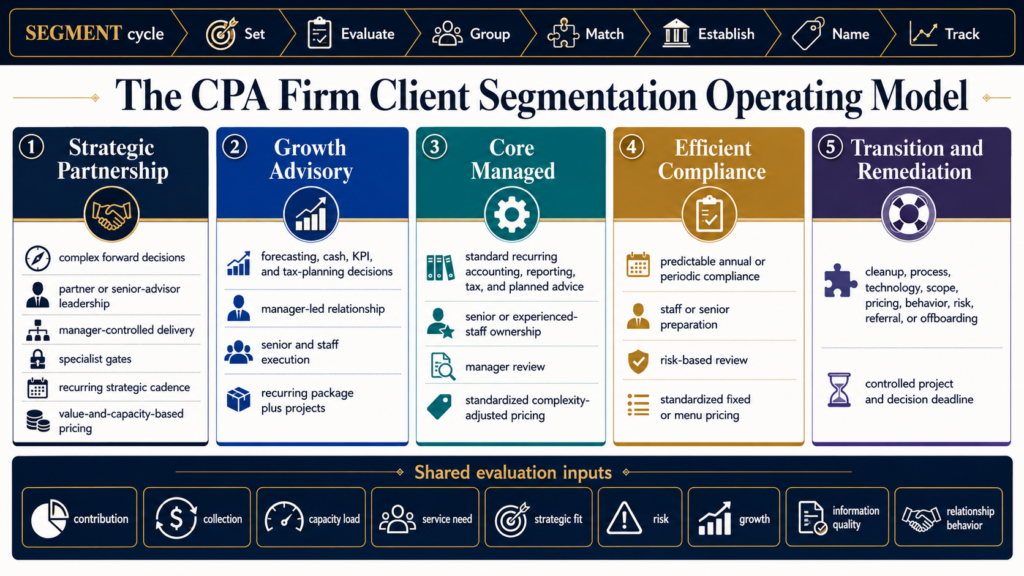
- The five-segment portfolio architecture
- Strategic Partnership segment
- Growth Advisory segment
- Core Managed segment
- Efficient Compliance segment
- Transition and Remediation segment
- Match services to the segment
- Match talent and review responsibility
- Match pricing to value and capacity load
- Match meetings, access, and client experience
- Match technology and workflow
- Illustrative portfolio analysis
- Client migration rules
- How to communicate segmentation changes
- Governance and decision authority
- 90-day implementation plan
- 30-day manager training plan
- 100-point competency scorecard
- Realistic segmentation scenarios
- What the firm should measure
- Common segmentation mistakes
- Frequently asked questions
A CPA firm has two clients that each generate $60,000 in annual fees.
The first client provides complete records on time, uses the firm’s standard technology, accepts a defined monthly close, meets quarterly with a manager, and purchases a separate annual planning engagement. Most work is completed by trained staff and reviewed by a senior or manager.
The second client provides late and changing information, requests weekly calls, sends urgent questions to three partners, requires unique reports, expands the scope without notice, and expects the firm’s most experienced manager to resolve routine issues.
The revenue is the same.
The relationship is not.
The first client may create strong contribution, repeatable expertise, staff development, and predictable advisory opportunity.
The second may consume the firm’s scarcest capacity while creating lower margin, greater risk, and disruption for other clients.
A revenue-only segmentation model places them in the same tier.
A useful operating model does not.
Client segmentation should not rank which clients matter as people. It should define which service, talent, pricing, workflow, access, and risk model each relationship requires so the firm can keep its promises consistently.
The segment then determines:
- What the firm provides
- Who performs and reviews it
- How often the client meets with the firm
- Which service levels and response times apply
- Which systems and workflows are required
- How the relationship is priced
- What changes require a new segment or engagement
Segmentation is not a marketing label.
It is a capacity-allocation decision.
Who I Am and Why This Matters
I have practiced public accounting since 1990. I founded my accounting firm in 1993, merged it in 2001 to form Howard, Howard and Hodges, and helped grow the organization from three people to approximately 50 staff across multiple Florida locations and states. Our firm was named PASBA Firm of the Year in 2015.
When a firm is small, client service often develops relationship by relationship.
One client gets monthly calls because the partner enjoys the relationship.
Another gets annual service because that is what the firm has always provided.
A third receives informal advisory help because the manager knows the business well.
As the firm grows, those exceptions become the service model.
Staff cannot tell which promises apply.
Managers do not know which clients deserve proactive planning versus efficient compliance.
Partners remain attached to relationships that should be led lower in the organization.
Pricing does not reflect service level or capacity load.
The result is inconsistent client experience and uneven firm economics.
Since 2020, I have built and run the SkillAbility accounting workforce development platform, used by more than 1,000 accounting professionals across dozens of PASBA firms.
That work has made one issue especially clear:
A firm cannot match talent to clients unless it first defines what each client relationship requires.
A staff-development plan that says “become more advisory” is incomplete.
Advisory to whom?
For which decisions?
At what service level?
Under whose review?
For what fee?
Client segmentation turns broad career goals into controlled relationship responsibility.
Read Client Profitability Analysis for Accounting Firms for the economics and capacity analysis that should support—not replace—the segmentation decision.
What Is a CPA Firm Client Segmentation Strategy?
A CPA firm client segmentation strategy is a documented portfolio-management system that groups clients according to their service and decision needs, economic contribution, capacity requirements, complexity, risk, strategic fit, growth potential, and relationship behavior, then assigns each group a defined combination of services, talent, review, technology, meeting cadence, pricing, access, boundaries, and migration rules.
Segmentation operates at three levels
- Market segmentation: Which industries, sizes, ownership types, and client profiles the firm wants to serve
- Portfolio segmentation: Which relationship model each existing client belongs in
- Service segmentation: Which services, cadence, roles, and pricing apply within that relationship
Segmentation is not the same as an ideal client profile
An ideal client profile guides marketing, prospecting, and acceptance.
Segmentation manages the clients already in the portfolio.
A client may fit the firm’s niche but require a different service level because of size, complexity, lifecycle, or management needs.
Segmentation is not the same as client profitability
Profitability is one dimension.
A high-contribution client may still consume too much partner capacity.
A temporarily low-contribution client may be a strong strategic fit undergoing a priced transition.
A financially profitable client may create unacceptable professional risk.
Segmentation should be operational
A segment is useful only when it changes decisions about:
- Services
- Team
- Review
- Meetings
- Technology
- Pricing
- Scope
- Response model
- Renewal or transition
Why Client Segmentation Matters Now
Firms are growing while workload and workflow remain constrained
The AICPA’s 2025 National MAP Survey reported a median 6.7 percent increase in total net client fees. Eighty-one percent of respondents represented firms with revenue of $5 million or less.
Official source: AICPA 2025 National MAP Survey findings.
The AICPA’s 2026 PCPS Top Issues Survey included 629 respondents. Managing staff workload and capacity ranked third for firms with 11–30 professionals, while managing firm workflow tied for fourth among firms with 31–100 professionals.
Official source: AICPA 2026 CPA Firm Top Issues Survey.
When demand is strong and talent is constrained, firms cannot allocate the same service intensity and senior attention to every client.
Niche and ideal-client discipline are associated with stronger CAS results
The latest completed CPA.com and AICPA PCPS CAS benchmark reported:
- Practices with more than half of revenue from defined industry niches had 38 percent higher median CAS revenue.
- Those niche-focused practices reported 51 percent higher net revenue per client.
- Practices with formal CAS business plans reported nearly $10,000 more in median average annual client revenue.
- Practices generating substantial CFO or higher-level business-insight revenue earned more than 30 percent higher monthly recurring revenue.
- Seventy-eight percent reported dedicated CAS staff.
Official source: CPA.com and AICPA 2024 CAS Benchmark Survey findings.
The 2026 survey is open, but its results were not yet published at the time of this article.
Pricing, capacity, and client load are connected
Journal of Accountancy guidance recommends reviewing client fees and services based on factors such as profitability, responsiveness, satisfaction, referral value, complexity, frequency, and client “load.” It also recommends working through one segment of clients at a time.
Source: Why firms should review their pricing.
Intentional client focus improves standardization
CPA.com guidance recommends defining the ideal client profile before finalizing CAS pricing, staffing, and technology. Industry, client size, geography, and strategic fit can support repeatable processes, templates, metrics, and stronger service.
Source: CPA.com: considerations before pricing CAS services.
Focused Practices Report Stronger Revenue, Client Economics, and Staffing Discipline
Source: CPA.com and AICPA PCPS 2024 CAS Benchmark Survey. Results describe self-selected CAS practices and do not prove that segmentation alone caused the reported differences.
Why Traditional A/B/C Client Segmentation Fails
Failure 1: Revenue determines the letter
Revenue ignores delivery cost, review burden, peak-period timing, scope, risk, and strategic fit.
Failure 2: The segment does not change the service
The firm labels the client “A” but does not define what the client receives that differs from another tier.
Failure 3: The segment becomes a judgment about the client
Staff interpret “C client” as permission to provide weaker service.
Every accepted client deserves the agreed quality and professional care.
Failure 4: Partners create exceptions
Clients receive higher access or added work because of individual partner preferences rather than documented economics and relationship need.
Failure 5: Segments are permanent
Clients grow, shrink, change ownership, improve systems, add complexity, create new risks, or need different services.
Failure 6: Talent is ignored
The firm defines service tiers without naming who can perform, review, manage, and lead them.
Failure 7: Pricing is disconnected
Different service intensity and access are delivered under the same pricing logic.
Failure 8: No client migration path exists
The firm identifies a mismatch but does not know how to standardize, rescope, reprice, elevate, refer, or offboard the relationship.
The SEGMENT Client Portfolio Framework
S-E-G-M-E-N-T
S — Set the Portfolio Strategy
Define the clients, niches, services, economics, talent experiences, risks, and growth the firm intends to support.
E — Evaluate Complete Client Value
Measure contribution, collection, capacity load, complexity, fit, risk, growth, relationship behavior, and decision needs.
G — Group by Relationship Model
Place clients into operational segments based on how the relationship should be served—not on fee alone.
M — Match Service, Talent, and Technology
Define services, roles, review, meetings, access, workflows, systems, and specialist support for each segment.
E — Establish Pricing and Boundaries
Align fees with value, complexity, frequency, capacity, risk, access, timing, and change-control rules.
N — Name Migration Rules
Define what moves a client upward, downward, into remediation, to another provider, or out of the firm.
T — Track Portfolio Outcomes
Measure client experience, margin, load, leverage, service adoption, staff development, risk, retention, and capacity released.
The framework creates a closed loop.
Segmentation changes delivery.
Delivery produces evidence.
Evidence changes the segment.
The Seven Dimensions of Client Value
No single number can determine the correct client segment.
1. Economic contribution
Review the client across all entities and services:
- Fees billed and collected
- Direct preparation and review cost
- Manager and partner time
- Technology, outsourcing, and specialist cost
- Rework, collection, and friction
- Contribution margin
Use client profitability analysis rather than revenue alone.
2. Scarce-capacity load
Measure how much of the firm’s constrained capacity the relationship uses:
- Review hours
- Manager judgment
- Partner access
- Specialist involvement
- Peak-period timing
- Knowledge concentrated in one person
3. Service and decision need
A client may need:
- Efficient annual compliance
- Recurring accounting and reporting
- Controller-level governance
- Cash-flow and forecasting support
- Complex tax planning
- Transaction, succession, or strategic advice
The segment should reflect the decision complexity the firm is being asked to support.
4. Strategic fit
Evaluate:
- Industry or niche alignment
- Service-model alignment
- Technology compatibility
- Repeatable expertise
- Desired geographic or ownership profile
- Appropriate referral quality
5. Risk and information quality
Consider:
- Management integrity
- Professional and regulatory risk
- Financial distress
- Record reliability
- Internal controls
- Payment behavior
- Scope stability
- Data-security requirements
6. Growth and lifecycle potential
The client may be:
- Stable
- Scaling
- Contracting
- Preparing for a transaction
- Changing ownership
- Building an internal finance team
- Moving from compliance to advisory needs
7. Relationship behavior and mutual fit
Evaluate whether the client:
- Provides information on time
- Uses the agreed communication channels
- Includes decision makers
- Respects firm staff
- Acts on recommendations
- Accepts clear scope and pricing
- Pays according to terms
Relationship behavior should be evaluated factually, not emotionally.
The Data Required for Client Segmentation
Client identity and relationship map
Document:
- Legal entities
- Owners and related individuals
- Primary decision makers
- Services by entity
- Responsible partner and manager
- Relationship start date
- Industry and niche
Economic data
- Revenue and collection
- Contribution margin
- Write-downs and credits
- Accounts receivable
- Service-level economics
- Expected future economics
Capacity and workflow data
- Hours by role
- Peak-period concentration
- Review queue time
- Manager rescue time
- Scope changes
- Client information delays
- Rework and reopened tasks
Service and relationship data
- Current deliverables
- Meeting frequency
- Response expectations
- Technology and workflow
- Client satisfaction
- Staff satisfaction
- Advisory and growth needs
Risk and fit data
- Professional-risk assessment
- Information quality
- Management cooperation
- Strategic and niche fit
- Client concentration
- Knowledge concentration
- Continuance concerns
Use a defined measurement period
Annual data may hide recent changes.
Use:
- The latest completed year
- Trailing twelve months
- Current-year trend
- Known future changes
Segment on the expected relationship model—not merely last year’s history.
Value, Load, Fit, and Risk Scores
Scores create consistency, but they should not automate the final decision.
Client value score
Score from 1 to 5:
- Current contribution
- Future value opportunity
- Strategic and niche fit
- Relationship quality
- Appropriate referral value
- Knowledge and staff-development value
Capacity load score
Score from 1 to 5:
- Preparation intensity
- Review intensity
- Manager and partner dependency
- Timing pressure
- Complexity and exception volume
- Technology and workflow burden
Risk score
Score:
- Professional risk
- Information reliability
- Management integrity and cooperation
- Payment risk
- Data-security risk
- Scope and deadline volatility
Growth-needs score
Assess:
- Need for forward-looking decisions
- Business change
- Service expansion need
- Management-team maturity
- Capital, cash, or succession events
Do not net unacceptable risk against high revenue.
Some conditions are gates, not weighted factors.
Use red-line conditions
Examples:
- Unacceptable integrity concerns
- Prohibited service or independence conflict
- Scope that cannot be defined
- Required competence unavailable
- Information that cannot support the work
- Unacceptable treatment of staff
The Five-Segment Client Portfolio Architecture
| Segment | Primary Need | Typical Talent | Pricing Logic | Operating Goal |
|---|---|---|---|---|
| Strategic Partnership | Complex, forward-looking decisions and integrated leadership | Partner or senior advisor, manager, specialists, leveraged delivery team | Value, responsibility, complexity, access, risk, and capacity | Deep value with controlled senior attention |
| Growth Advisory | Forecasting, cash, performance, tax planning, and management support | Manager or advisor-led with senior and staff execution | Recurring package plus clearly scoped projects | Build a scalable advisory relationship |
| Core Managed | Reliable recurring accounting, tax, reporting, and planned advice | Senior or experienced staff-led with manager review | Standard package adjusted for complexity and frequency | Consistent quality, leverage, and experience |
| Efficient Compliance | Defined annual or periodic compliance with limited complexity | Staff or senior-led with risk-based review | Standardized fixed or menu pricing | Efficient, accurate, predictable delivery |
| Transition and Remediation | Cleanup, system change, behavior correction, pricing repair, referral, or exit | Named manager or partner with controlled project team | Paid assessment, project, revised fee, or transition terms | Move to a sustainable segment or out responsibly |
These names are internal.
The client-facing packages may use different language.
A firm may choose four or six segments.
The important requirement is that every segment has a distinct operating model.
Segment 1: Strategic Partnership
Typical relationship
The client has significant, recurring decisions involving:
- Growth
- Capital
- Cash and liquidity
- Complex tax strategy
- Transactions
- Succession
- Risk
- Multi-entity or stakeholder needs
Service model
May include:
- Integrated accounting and tax coordination
- Forecasts and scenarios
- Executive reporting
- Strategic tax planning
- Capital and transaction support
- Leadership meetings
- Specialist coordination
Talent model
A senior partner or advisor leads judgment and relationships.
A manager controls delivery and decisions.
Seniors and staff perform repeatable analysis and execution.
Specialists enter at defined gates.
Read Fractional CFO Training for Accountants for the capabilities between CAS and strategic financial leadership.
Pricing model
Reflect:
- Decision value
- Responsibility
- Complexity
- Access
- Capacity reservation
- Risk
- Specialist involvement
Control risk
Strategic Partnership should not mean unlimited access or undefined services.
Define:
- Meeting cadence
- Response standards
- Decision authority
- Project boundaries
- Additional-service process
Segment 2: Growth Advisory
Typical relationship
The client has reliable core information but increasing need for:
- Cash-flow visibility
- Forecasting
- KPIs
- Pricing and profitability
- Hiring decisions
- Tax planning
- Management reporting
Service model
A recurring advisory package may include:
- Monthly or quarterly performance review
- Rolling forecast
- Cash and working-capital review
- Tax-planning checkpoints
- Decision briefs
- Annual planning
Talent model
The relationship should generally be manager- or advisor-led, not partner-dependent.
The partner joins higher-risk or strategic decision points.
Pricing model
Use a recurring fee for the defined cadence and deliverables.
Separate major projects such as financing, acquisition, system conversion, or transaction work.
Migration trigger
The client may move into Strategic Partnership when complexity, risk, access, and integrated leadership needs materially increase.
Segment 3: Core Managed
Typical relationship
The client needs reliable recurring services and planned professional guidance but not continuous strategic leadership.
Service model
May include:
- Monthly or quarterly accounting
- Payroll and sales-tax coordination
- Financial reporting
- Business and owner tax compliance
- Annual or semiannual planning
- Defined client questions
Talent model
An experienced staff member or senior owns recurring execution.
A manager reviews and leads planned client meetings.
Partner participation is defined rather than habitual.
Pricing model
Use a standardized package adjusted for:
- Transaction volume
- Entities
- Reporting frequency
- Complexity
- Information quality
- Review intensity
Operating goal
Core Managed should provide strong client experience and predictable firm economics through consistent workflow, staff capability, and manager review.
Segment 4: Efficient Compliance
Typical relationship
The client’s need is primarily defined annual or periodic compliance with limited complexity and predictable information.
Service model
Examples:
- Individual or business tax returns
- Annual filings
- Defined payroll or sales-tax compliance
- Limited planned consultation
Talent model
Staff or seniors perform standardized work.
Review is risk based and scheduled.
Partner involvement is reserved for significant issues and relationship decisions.
Pricing model
Use transparent fixed or menu pricing based on objective complexity and frequency factors.
Client experience
Efficient does not mean impersonal or low quality.
It means:
- Clear process
- Easy intake
- Predictable communication
- Accurate delivery
- Defined questions and additional services
Segment 5: Transition and Remediation
Typical relationship
The current model is not sustainable because of:
- Weak economics
- Repeated scope creep
- Poor information quality
- Technology mismatch
- Payment issues
- Heavy manager dependence
- Strategic misfit
- Risk or continuance concerns
Possible paths
- Paid cleanup or discovery
- Required client-process change
- Technology conversion
- Team redesign
- Scope reduction
- Fee increase
- Move to another segment
- Referral
- Responsible offboarding
Set a time limit
Remediation should have:
- An owner
- A target segment
- Conditions
- A revised economic model
- A deadline
- A decision if the conditions fail
Read Accounting Firm Client Offboarding Checklist when the appropriate destination is outside the firm.
Match Services to the Client Segment
Start with the client’s recurring decisions—not with every service the firm could sell.
Build a service architecture
For each segment, define:
- Core services
- Optional services
- Separate projects
- Excluded services
- Client responsibilities
- Deliverables
- Cadence
- Change triggers
Use service ladders
An illustrative progression:
Clients should not automatically move upward because the firm wants more revenue.
The service must solve a real need that the client is prepared to support.
Separate recurring and project work
A recurring segment should not silently absorb:
- Cleanup
- Transactions
- Financing
- System conversions
- Acquisitions
- Litigation support
- Major tax controversy
Use scope-change control before additional work enters production.
Match Talent and Review Responsibility
Define the relationship leader
Each segment should identify whether the relationship is led by:
- Partner
- Manager
- Advisor
- Senior
- Central client-service team
Define the delivery pyramid
For each segment, specify expected work by level:
- Preparation
- Self-review
- First review
- Manager judgment
- Partner or specialist involvement
Assign by capability, not title
Client segmentation must connect to demonstrated staff readiness.
A manager-led segment cannot scale if managers must perform staff-level work.
Read Tax Manager Development Program for the transition from technical seniority to review, coaching, workflow, and client leadership.
Create development pathways
Use segments to stage responsibility:
- Efficient Compliance builds accurate independent execution.
- Core Managed builds recurring ownership and client communication.
- Growth Advisory builds analysis, forecasting, and judgment.
- Strategic Partnership builds integrated leadership under senior oversight.
This progression supports SkillAbility’s broader pathway from new hire to future partner.
Match Pricing to Value and Capacity Load
Price the relationship model
Pricing should reflect:
- Services and deliverables
- Frequency
- Complexity
- Information quality
- Required talent
- Review and leadership
- Access
- Timing
- Risk
- Technology and third-party cost
- Value created
Do not price only by segment name
Two Growth Advisory clients may differ substantially in entities, data quality, forecasting complexity, and meeting needs.
The segment provides a pricing architecture—not necessarily one price.
Use floors and multipliers
Examples:
- Base package
- Entity multiplier
- Volume or frequency multiplier
- Complexity multiplier
- Accelerated-deadline premium
- Specialist or system cost
- Reserved-capacity or access component
Price changes in the relationship
Reassess when:
- Entities change
- Transaction volume changes
- Reporting frequency changes
- Access expectations change
- The client adds decisions or complexity
- Information quality deteriorates
- The required talent level changes
AICPA & CIMA’s 2026 pricing discussion describes segmented and value-based pricing as tools for aligning price with customer value rather than relying only on cost-plus logic.
Source: Unlocking strategic pricing based on consumer value.
Match Meetings, Access, and Client Experience
Define meeting cadence
Examples:
- Strategic Partnership: Monthly leadership meeting plus planned decision sessions
- Growth Advisory: Monthly or quarterly management review
- Core Managed: Quarterly or semiannual planned meeting
- Efficient Compliance: Annual planning or delivery conversation
Define access
Clarify:
- Primary contact
- Communication channels
- Response expectation
- Emergency definition
- Partner access
- Additional meeting process
Do not create artificial scarcity
Clients should receive access appropriate to the service they purchased and the decisions they face.
The firm should not make routine service frustrating to manufacture a “premium” experience.
Use consistency and clarity
AICPA small-firm guidance notes that strong client experience is created through well-defined expectations, smooth processes, organization, proactive communication, and consistency—not necessarily by doing more at every touchpoint.
Source: Enhance the client experience with two simple shifts.
Match Technology and Workflow
Define the required technology stack
For each segment, identify:
- Accounting platform
- Portal
- Document intake
- Payment method
- Workflow template
- Reporting and dashboard tools
- Forecasting tools
- Security controls
Standardize before customizing
High-performing segments should share:
- Common intake
- Common close calendar
- Common reports
- Common KPI definitions
- Common review standards
- Common client responsibilities
Allow controlled exceptions
An exception should identify:
- Business need
- Cost
- Risk
- Owner
- Price
- Review date
Use automation according to the segment
Efficient Compliance and Core Managed relationships often benefit most from standardized intake, reminders, data flows, and workflow automation.
Strategic segments may use more analytics and forecasting technology but still require strong human judgment.
Illustrative Client Portfolio Analysis
Illustrative data only: The following example demonstrates the segmentation method. It is not a benchmark or universal recommendation.
| Client | Revenue | Contribution | Load | Fit | Primary Need | Recommended Segment |
|---|---|---|---|---|---|---|
| Alpha | $105,000 | $44,000 | High | High | Integrated growth, tax, capital, and executive decisions | Strategic Partnership |
| Bravo | $60,000 | $28,000 | Medium | High | Forecasting, cash, management reporting, and planning | Growth Advisory |
| Charlie | $60,000 | $12,000 | Very high | Medium | Recurring accounting with late data, unique reporting, and partner dependency | Transition and Remediation |
| Delta | $24,000 | $13,500 | Low | High | Standard monthly accounting and annual tax planning | Core Managed |
| Echo | $7,500 | $4,400 | Low | High | Predictable annual compliance | Efficient Compliance |
Revenue does not determine the segment
Bravo and Charlie Generate the Same Revenue—but Require Different Relationship Models
Illustrative data. Contribution bars are shown as a percentage of revenue. Charlie’s segment reflects low contribution, very high capacity load, and a service model requiring remediation.
Management decisions
Alpha: Protect senior access, but ensure work is leveraged through a manager and capable delivery team.
Bravo: Build a recurring Growth Advisory package with a manager-led cadence and project boundaries.
Charlie: Do not simply rename the relationship “premium.” Require data and workflow changes, redesign the team and scope, revise pricing, and set a migration deadline.
Delta: Preserve a standardized Core Managed model and avoid unnecessary partner involvement.
Echo: Deliver an efficient, predictable compliance experience without adding services the client does not need.
Client Migration Rules
Segments should change when the relationship changes.
Move into a higher-service segment when
- The client has recurring forward-looking decisions
- Management uses the information and acts
- The firm has the appropriate talent and capacity
- The client accepts the service model, systems, scope, and price
- The relationship remains professionally supportable
Move into a more standardized segment when
- Complexity falls
- The client builds an internal finance function
- Advisory needs become periodic rather than recurring
- Technology and processes reduce effort
- The client prefers a narrower service
Move into Transition and Remediation when
- Margin falls below the approved model
- Capacity load becomes unsustainable
- Scope repeatedly expands
- Information quality deteriorates
- Payment or relationship behavior changes
- The service model no longer fits the client
Move out of the firm when
- Risk becomes unacceptable
- The client will not meet required conditions
- The firm cannot provide the right service or competence
- The relationship remains structurally unsustainable
- Another provider is a better fit
Use acceptance and continuance together
New prospects should be placed into an intended segment during acceptance.
Read CPA Firm Client Acceptance Checklist for the pre-engagement screen.
Existing clients should be reconsidered when risk, fit, scope, capacity, economics, ownership, or service needs change.
How to Communicate Segmentation Changes
Clients do not need to be told they are an “A,” “B,” or “C” client.
They need a clear service choice.
Use the ALIGN conversation
- A — Acknowledge the relationship: Confirm the client’s goals and the value of serving them well.
- L — Link the change to current needs: Explain how the business, service, complexity, or process changed.
- I — Introduce the right service model: Present deliverables, cadence, roles, systems, access, and price.
- G — Give clear choices: Offer appropriate alternatives when available.
- N — Name responsibilities and next steps: Document timing, information, approvals, and the effective date.
Example: moving into Growth Advisory
“Your reporting process is now reliable, and the decisions you raised around hiring, cash, and expansion are recurring rather than occasional. We recommend moving from quarterly reporting support into a monthly planning and forecasting model led by your advisory manager. The revised service includes a rolling forecast, cash review, KPI discussion, and defined decision support. Major transactions remain separate projects.”
Example: standardizing a relationship
“The current service has grown through individual requests over time, which has made delivery and expectations less predictable. We are consolidating the relationship into a defined monthly accounting and quarterly planning package with one primary contact, one reporting calendar, and a clear process for additional projects.”
Example: remediation
“The current workflow requires repeated cleanup and manager reconstruction because information arrives in multiple formats after the close. To preserve the reporting date and service quality, the relationship needs to move to the standard platform and intake process by October 1. We can support that conversion as a separate project. If the change is not workable, we will help identify another provider whose model fits better.”
Do not describe internal status
Avoid telling clients:
- “You are not a top-tier client.”
- “You are taking too much of our time.”
- “We are downgrading you.”
Describe needs, service, responsibilities, options, timing, and value.
Segmentation Governance and Decision Authority
Assign a portfolio owner
The firm should name responsibility for:
- Definitions
- Data quality
- Annual review
- Pricing coordination
- Exception approval
- Migration tracking
Define decision rights
| Decision | Possible Authority |
|---|---|
| Routine segment recommendation | Manager prepares; relationship partner approves |
| Standard price within segment | Manager or designated pricing authority |
| Material service or access change | Partner and service-line leader |
| Pricing exception | Managing partner, pricing committee, or approved leader |
| Transition or remediation plan | Relationship partner with manager and operations input |
| Offboarding | Authorized partner or risk leadership under firm policy |
Control exceptions
Every exception should state:
- Why it is justified
- Who approved it
- What it costs
- How long it lasts
- When it will be reviewed
Use one source of truth
The approved segment should be visible in the CRM or practice-management system with:
- Service package
- Relationship leader
- Meeting cadence
- Pricing date
- Migration status
- Exception notes
A 90-Day Client Segmentation Implementation Plan
Days 1–30: Define and pilot
- Clarify firm strategy and target client profiles
- Define segment names and operating models
- Select value, load, fit, risk, and growth measures
- Choose 20–30 representative clients
- Test data quality and scoring
- Identify segment overlaps and missing categories
Deliverable: Approved segment architecture and pilot portfolio.
Days 31–60: Price, staff, and design
- Define service packages and exclusions
- Name relationship and delivery roles
- Build meeting, access, and response standards
- Define technology and workflow requirements
- Create pricing architecture
- Write migration and exception rules
Deliverable: Complete operating playbook for each segment.
Days 61–90: Classify and act
- Segment the remaining portfolio
- Prioritize high-impact mismatches
- Prepare client conversations
- Update engagement scope and pricing
- Reassign relationship and delivery roles
- Launch remediation and offboarding plans
- Build the performance dashboard
Deliverable: Active client portfolio with documented actions and owners.
Do not change the entire portfolio at once
Sequence by:
- Risk
- Capacity opportunity
- Pricing renewal date
- Service-cycle timing
- Client readiness
- Available replacement capacity
The Complete 30-Day Manager Training Plan
Days 1–5: Strategy, definitions, and data
- Understand the firm’s target markets, services, and talent strategy
- Distinguish ideal client profile, profitability, and segmentation
- Map entities, services, economics, and relationship ownership
- Identify data gaps and red-line risk conditions
- Apply common definitions
Evidence: Client relationship map, data-quality review, and segmentation definitions.
Days 6–10: Value, load, fit, risk, and growth
- Calculate client contribution
- Measure role-specific capacity and peak timing
- Score niche and strategic fit
- Evaluate risk and relationship behavior
- Identify current and future client decision needs
Evidence: Five-dimension client analysis and preliminary segment recommendation.
Days 11–15: Service and talent architecture
- Define core, optional, project, and excluded services
- Name the relationship leader
- Build the delivery and review pyramid
- Set meeting and access standards
- Identify technology and workflow requirements
Evidence: Segment-specific service and talent plan.
Days 16–20: Pricing and boundaries
- Apply base fees and objective multipliers
- Reflect value, frequency, complexity, risk, and capacity
- Separate recurring and project work
- Define scope-change triggers
- Prepare target economics
Evidence: Pricing recommendation and scope architecture.
Days 21–25: Migration and client communication
- Select elevate, standardize, repair, refer, or exit actions
- Prepare the ALIGN conversation
- Respond to client objections
- Document conditions and effective dates
- Coordinate internal handoff
Evidence: Migration memo and client conversation simulation.
Days 26–30: Independent portfolio capstone
- Analyze a different mixed client portfolio
- Segment clients with incomplete information
- Identify exceptions and red-line risks
- Present talent, service, pricing, and migration decisions
- Lead a simulated leadership review
- Define outcome measures
Evidence: Portfolio recommendation, leadership presentation, client communication, and 100-point scorecard.
Use Scenario-Based Training for Accountants to practice segmentation conversations before live clients absorb the first attempt.
100-Point Client Segmentation Competency Scorecard
| Capability | Points | Observable Evidence |
|---|---|---|
| Portfolio strategy and definitions | 10 | Connects segmentation to target clients, services, talent, economics, risk, and firm direction |
| Client data completeness | 8 | Combines entities, services, fees, collections, roles, workflows, and relationship ownership |
| Economic and capacity analysis | 14 | Uses contribution, role-specific load, timing, review burden, and knowledge concentration |
| Fit, risk, behavior, and growth | 12 | Evaluates strategic fit, professional risk, information quality, cooperation, and future need |
| Segment judgment | 12 | Selects the operating model from complete evidence rather than revenue or relationship history alone |
| Service and scope architecture | 10 | Defines core services, projects, exclusions, responsibilities, cadence, and change triggers |
| Talent, review, and technology match | 12 | Names the right relationship leader, delivery pyramid, review gates, systems, and backup |
| Pricing and economics | 10 | Aligns price with value, frequency, complexity, access, risk, cost, and capacity load |
| Migration and communication | 8 | Selects a proportionate action and explains service choices without devaluing the client |
| Tracking and governance | 4 | Defines approvals, exceptions, owners, measures, and review dates |
Suggested readiness rule: Require at least 84 points overall, no zero category, no segment based only on fees, no unapproved pricing or service exception, and leadership approval of the manager’s client-communication and migration authority.
Realistic CPA Firm Client Segmentation Scenarios
Scenario 1: Equal fees, unequal load
Two clients generate the same revenue. One is standardized and manager-led; the other requires partner rescue and peak-season urgency. The trainee must choose different segments and operating models.
Scenario 2: High-margin compliance client
The client is profitable and easy to serve but has no need for advisory. The trainee must resist forcing the client into a higher tier.
Scenario 3: Growth client with weak records
The client wants forecasting and CFO advice, but monthly accounting is unreliable. The trainee must place the relationship into remediation before higher-level service.
Scenario 4: Partner-favorite exception
A long-standing client receives Strategic Partnership access under an Efficient Compliance fee. The trainee must quantify the exception and present choices respectfully.
Scenario 5: New niche opportunity
A client is currently modest but strongly aligned with the firm’s intended industry niche and likely to grow. The trainee must define a monitored investment without ignoring current economics.
Scenario 6: High-revenue poor-fit client
The relationship uses unique systems, specialist knowledge, and services the firm does not intend to scale. The trainee must weigh current contribution against strategic fragmentation.
Scenario 7: Internal controller hired
A Growth Advisory client builds a strong internal finance team. The trainee must redesign the firm’s role rather than preserve unnecessary recurring work.
Scenario 8: Advisory need identified during tax work
The tax team identifies recurring cash and growth decisions. The trainee must verify need, management readiness, firm capability, scope, and price before changing the segment.
Scenario 9: Client resists standard technology
A Core Managed client insists on a unique manual process. The trainee must quantify the exception and decide whether to price, remediate, or transition.
Scenario 10: Efficient client receives poor service
Staff assume Efficient Compliance means low priority. The trainee must restore the agreed quality and predictable experience while preserving efficiency.
Scenario 11: Growth Advisory without manager capacity
The firm sells a manager-led package but has no available manager. The trainee must defer, reassign, change the launch date, or redesign the promise.
Scenario 12: Scope changes move the segment
A Core Managed client adds entities, monthly forecasting, lender reporting, and weekly calls. The trainee must trigger a segment, scope, talent, and price review.
Scenario 13: Client behavior improves
A Transition client adopts the standard platform, meets deadlines, and reduces rework. The trainee must determine whether the relationship can move into Core Managed.
Scenario 14: AI assigns the segment
An AI model ranks clients using revenue and email volume but misses risk, unrecorded partner time, strategic fit, and one-time transition cost. The trainee must correct the analysis.
Scenario 15: Offboarding decision
A client remains high risk, low fit, and capacity intensive after remediation. The trainee must recommend responsible offboarding and preserve deadlines, records, and professional obligations.
Each scenario should require evidence review, segment selection, service and talent architecture, pricing logic, client communication, and follow-up measures.
What the Firm Should Measure
| Metric | What It Reveals |
|---|---|
| Revenue and contribution by segment | Economic role of each relationship model |
| Manager and partner hours by segment | Whether senior attention matches the intended model |
| Work by staff level | Whether delivery is properly leveraged |
| Client load score | Complexity, friction, timing, review, and knowledge burden |
| Service adoption and utilization | Whether clients use the services included in the model |
| Scope-change rate | Whether the segment and engagement remain aligned |
| Client experience by segment | Whether expectations and delivery are consistent |
| Employee experience by segment | Whether work creates appropriate clarity, growth, and workload |
| Migration completion | Whether mismatched clients actually move into a sustainable model |
| Pricing exception rate | How often partners depart from the approved architecture |
| Capacity released or redeployed | Whether segmentation creates usable preparation, review, manager, and partner capacity |
Read Accounting Workforce Development for the broader system connecting client work, staff capability, manager bandwidth, and succession.
Common CPA Firm Client Segmentation Mistakes
Mistake 1: Using revenue as the segment
Fees conceal contribution, review burden, risk, timing, and relationship need.
Mistake 2: Calling clients A, B, or C without an operating model
The label does not change service, talent, price, access, or workflow.
Mistake 3: Treating lower-service clients as less important
Professional quality and respect should never depend on the segment.
Mistake 4: Segmenting services but not the total relationship
Entity, owner, tax, CAS, and advisory work become disconnected.
Mistake 5: Ignoring scarce capacity
A profitable client may still consume too much review, manager, partner, or peak-period capacity.
Mistake 6: Ignoring risk
High fees or strategic fit are used to offset conditions that should be decision gates.
Mistake 7: Designing advisory tiers without advisory talent
The firm sells a service model it cannot consistently deliver.
Mistake 8: Making every segment customizable
Standardization disappears and exceptions become the real model.
Mistake 9: Pricing by package name alone
Complexity, frequency, access, risk, and capacity load remain unpriced.
Mistake 10: Forcing every client upward
Clients are sold services they do not need, value, or use.
Mistake 11: Leaving partner access undefined
Senior capacity remains unlimited and invisible.
Mistake 12: Failing to communicate the change
Internal segmentation alters service without resetting client expectations.
Mistake 13: Keeping remediation open indefinitely
No target segment, deadline, or consequence exists.
Mistake 14: Allowing AI to make the final decision
Incomplete data and unmeasured strategic, ethical, and relationship factors are treated as objective truth.
Mistake 15: Measuring segments but not outcomes
The firm cannot determine whether service, margin, capacity, client experience, or staff development improved.
Frequently Asked Questions About CPA Firm Client Segmentation
What is a CPA firm client segmentation strategy?
It is a portfolio-management system that groups clients by service needs, economics, capacity load, risk, strategic fit, growth, and behavior, then assigns the right services, talent, pricing, technology, access, and boundaries.
How should accounting firms segment clients?
Use multiple dimensions: contribution, collection, review and manager load, complexity, service and decision need, niche fit, risk, information quality, growth potential, and relationship behavior.
Should CPA firms use A, B, and C client tiers?
They can, but descriptive operating segments are usually more useful. A/B/C labels often become revenue rankings and do not explain the service, talent, pricing, or workflow each client should receive.
What are useful client segments for an accounting firm?
A practical model may include Strategic Partnership, Growth Advisory, Core Managed, Efficient Compliance, and Transition and Remediation. Firms should adapt the number and names to their strategy.
Is client segmentation the same as client profitability analysis?
No. Profitability is one input. Segmentation also considers service need, constrained capacity, complexity, risk, strategic fit, growth, client behavior, and the operating model the firm can deliver.
How does client segmentation improve CPA firm capacity?
It reserves senior attention for relationships that require it, standardizes repeatable work, assigns tasks to capable lower levels, controls exceptions, and moves mismatched clients into remediation, referral, or offboarding.
How should talent be matched to client segments?
Define the relationship leader, preparer, first reviewer, manager, partner, specialist, and backup for each segment. Assign actual clients according to demonstrated competence and available capacity.
How should pricing differ by client segment?
Pricing should reflect the services, value, frequency, complexity, information quality, talent, review, access, timing, technology, risk, and capacity reservation required by the segment and client.
Should every high-revenue client be in the top segment?
No. High revenue can conceal low contribution, heavy senior load, poor fit, or risk. The top relationship segment should reflect needs and a supportable operating model—not fee alone.
Can a small client be strategically valuable?
Yes. A smaller client may have strong niche fit, efficient economics, growth potential, repeatable expertise, or appropriate referral value. Those factors should be measured rather than assumed.
How often should firms review client segments?
Review the full portfolio at least annually and use quarterly exception monitoring. Reassess when ownership, services, complexity, risk, information quality, capacity, scope, or economics materially change.
How should a firm move a client to a different segment?
Explain how the client’s needs or relationship changed, present the new service model and alternatives, define pricing and responsibilities, document the effective date, and update staffing, workflow, and engagement terms.
What is a transition or remediation segment?
It is a temporary controlled category for clients whose current service, economics, workflow, technology, behavior, or risk is unsustainable. The client must move into a stable segment or transition out by a defined date.
How does client segmentation support staff development?
Segments create progressive responsibility: standardized execution, recurring ownership, manager-led advisory, and strategic leadership. Firms can develop and assess staff against the client work they are expected to lead.
Can AI segment accounting-firm clients?
AI can combine data, identify patterns, and draft recommendations. Human leaders must validate data and decide strategic fit, professional risk, relationship need, talent readiness, exceptions, and client communication.
How do firms avoid damaging client trust during segmentation?
Do not rank clients publicly. Explain the service model, what changed, the value protected, available choices, responsibilities, pricing, and timing. Every accepted client should receive the quality and respect promised.
Can Your Firm Align Every Client’s Service Model With the Right Talent, Pricing, and Capacity?
SkillAbility helps accounting firms build review-ready staff, capable managers, confident advisors, and future leaders so client segmentation becomes an executable workforce and service strategy—not another spreadsheet.
Book Your Free 10-Minute Structural Alignment Review →
Includes our 45-Day Out-of-Pocket Performance Guarantee.
To client relationships designed with clarity instead of inherited by accident,
Vincent Howard, CPA
Managing Partner, Howard, Howard and Hodges
SkillAbility for Accounting Firms
About the Author
Vincent Howard, CPA has practiced public accounting since 1990. He earned a Bachelor of Science in Accounting and a Master’s in Taxation from the University of Central Florida, founded his accounting firm in 1993, and serves as Managing Partner of Howard, Howard and Hodges. He helped grow the organization from three people to approximately 50 staff across multiple Florida locations and states. He has participated in PASBA since 1997, and the firm was named PASBA Firm of the Year in 2015. Since 2020, he has built and run the SkillAbility accounting workforce development platform, used by more than 1,000 accounting professionals across dozens of PASBA firms.
© 2026 SkillAbility for Accounting Firms. This article provides general educational information and does not replace accounting, tax, audit, legal, employment, professional-standards, ethics, independence, pricing, data-security, insurance, engagement-letter, or regulatory advice. Client segmentation labels and scores are internal management tools and should not reduce the quality, care, or professional responsibility owed under an accepted engagement.