

By Vincent Howard, CPA | Managing Partner, Howard, Howard and Hodges | SkillAbility for Accounting Firms
Last updated: September 21, 2026 | 42-minute read
- What accounting transaction flow training should produce
- Why this matters more in an automated accounting environment
- The FLOW READY framework
- The complete source-document-to-financial-statement flow
- Source documents and evidence quality
- Transaction analysis before the journal entry
- Journal entries: explain the economics, not just debits and credits
- Subledgers, interfaces, and the general ledger
- Trial balance and account mapping
- Adjusting and correcting entries
- How transactions reach the financial statements
- Assertions and transaction-flow risk
- How to teach transaction walkthroughs
- Five worked transaction flows
- Automation and AI checkpoints
- Self-review checklist
- 100-point transaction-flow readiness scorecard
- 30/60/90-day development plan
- 15 realistic transaction-flow scenarios
- Frequently asked questions
What Is Accounting Transaction Flow Training?
Accounting transaction flow training develops a staff accountant’s ability to understand how a real business event becomes accounting data and, ultimately, a financial statement amount.
Many early-career accountants can perform isolated tasks: code an expense, enter a bill, post a journal entry, reconcile a bank account, export a trial balance, or run financial statements. But ask them to explain how one vendor invoice travels from receipt to the expense line on the income statement and the related cash outflow—and the gaps appear quickly.
The same is true in the other direction. Ask: “This accounts receivable balance is $487,000. Show me how that number was built, what evidence supports it, what period it belongs in, what could be wrong with it, and how you know the related revenue is presented correctly.”
That is transaction-flow competence. It connects bookkeeping mechanics to professional judgment.
SkillAbility’s related training reinforces the same chain through Month-End Close Training, Workpaper Review Checklist, Staff Accountant Competency Checklist, Scenario-Based Training for Accountants, Financial Statement Analysis Training, Client Accounting Services Training, AI Accounting Training, and Accounting Workforce Development.
Why Transaction Flow Matters More Now
I have practiced public accounting since 1990, founded my accounting firm in 1993, and helped grow Howard, Howard and Hodges from three people to approximately 50 staff. One of the strongest differences between an accountant who merely operates software and an accountant who can eventually advise clients is whether the person understands how the numbers were created.
Historically, junior accountants learned much of this through repetition. They entered bills, posted cash receipts, built journal entries, reconciled subledgers, traced support, and watched balances roll into statements. Automation is removing more of those repetitions.
AICPA’s September 2026 Profession Ready research specifically identified transaction flows, journal entries, and understanding the “why” behind processes as part of applying accounting fundamentals. The same research notes that automation and AI are changing the tasks that historically helped early-career professionals build experience and judgment.
PCAOB AS 2110 provides a useful external model. When understanding an information system relevant to financial reporting, auditors examine the significant classes of transactions and the procedures—manual and automated—by which those transactions are initiated, authorized, processed, recorded, and reported, along with the supporting records and period-end reporting process.
Chart: Where Staff Lose the Transaction Story
SkillAbility training heat map—not an empirical error-frequency ranking. Actual difficulty depends on the client’s systems, transaction complexity, automation, accounting policies, controls, and staff experience.
The FLOW READY Framework
| Stage | Question the Staff Member Must Answer | Evidence of Readiness |
|---|---|---|
| F — Find the economic event & source evidence | What happened in the business, and what evidence proves it? | Source package |
| L — Link the event to accounts, period & assertions | What accounting elements changed, when, and what could be misstated? | Transaction analysis |
| O — Originate the journal entry & system path | What entry records the event, and how does it enter the accounting system? | JE + workflow map |
| W — Walk the subledger to the general ledger | How are detail, batches, interfaces, and control accounts reconciled? | Subledger-to-GL tie-out |
| R — Reconcile the ledger to the trial balance | Does the account balance make sense and agree to support? | Account reconciliation |
| E — Evaluate period-end adjustments | What accruals, deferrals, estimates, reclasses, eliminations, or corrections are needed? | Adjustment workpaper |
| A — Assemble the financial statement mapping | Where does the adjusted balance appear, and what disclosures or cash-flow classifications follow? | TB-to-FS map |
| D — Detect exceptions & control failures | Where can completeness, cutoff, classification, valuation, or authorization fail? | Risk/control notes |
| Y — Yield a review-ready explanation | Can another professional reproduce the path and understand the conclusion? | Review-ready workpaper |
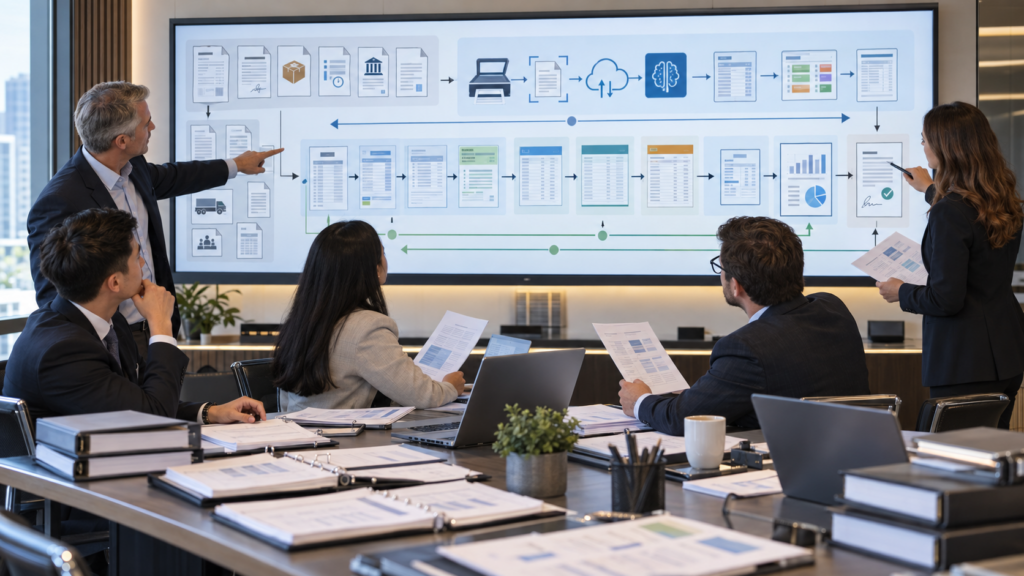
The Complete Accounting Transaction Flow
Not every transaction follows this exact visible sequence. Modern accounting systems compress several stages together. A credit-card feed can import a transaction, apply a machine-learning category, route it through approval, and post it automatically. A payroll provider can calculate payroll, transmit cash, create liabilities, generate reports, and push a summarized entry into the GL. An integrated sales system can invoice, post revenue, update receivables, relieve inventory, record cost of sales, collect cash, and post deposits without a staff accountant entering one traditional journal entry.
But the economics still travel through the same conceptual chain. Someone reviewing the result must be able to reconstruct it.
F — Source Documents: Start With Evidence, Not the Entry
The first competency is recognizing the evidence that proves a transaction occurred and what that evidence does—and does not—prove.
PCAOB AS 1105 offers a useful training principle even outside audit engagements: evidence reliability depends on its nature, source, and circumstances. Evidence from an independent, knowledgeable external source is generally more reliable than evidence created only inside the company, and original documents generally provide stronger evidence than copies when authenticity and controls matter.
That does not mean every accounting entry needs third-party evidence. It means staff should stop treating every PDF, spreadsheet, email, and system report as equally persuasive.
Common source documents
| Transaction | Possible Evidence | What Staff Should Ask |
|---|---|---|
| Purchase | Purchase order, receiving record, vendor invoice, approval, payment record | Was it received? Was it authorized? Asset or expense? Which period? |
| Sale | Contract, order, shipping/delivery evidence, invoice, customer acceptance, cash receipt | What was promised? When was it earned? Is the amount complete? |
| Payroll | Approved time, payroll register, tax reports, benefit reports, bank debit | Who worked? What period? Which liabilities remain unpaid? |
| Fixed asset | Invoice, contract, placed-in-service evidence, serial number, project support | Capitalize or expense? Useful life? Component? Disposal? |
| Loan | Executed note, closing statement, amortization schedule, bank receipt | Principal vs fees? Current vs long term? Covenant/disclosure impact? |
| Inventory | PO, receiving, vendor bill, inventory movement, count, sales/production record | Quantity? Ownership? Cost? Obsolescence? Cutoff? |
Staff should learn to label the source inside the workpaper. “Per client” is not a source. “Per September 30 Wells Fargo statement, page 4” is.
Use the Workpaper Review Checklist to reinforce purpose, source, procedure, result, conclusion, and open-item documentation.
L — Analyze the Transaction Before Touching the Chart of Accounts
A weak training habit is to begin with the software’s category list.
A stronger sequence is:
- What economically happened?
- Which entity is involved?
- When did the event occur?
- What did the entity receive?
- What did the entity give up or become obligated to pay?
- Which assets, liabilities, equity, revenue, or expenses changed?
- What accounting guidance or policy applies?
- What evidence supports the amount?
- What assertion is most likely to fail?
- What entry follows from that analysis?
This forces staff to reason from the transaction to the accounting rather than from a software menu to an answer.
The five-question transaction analysis
For routine work, those five questions can replace pages of theory while still building the right mental model.
Example: a $24,000 annual insurance payment
If the staff member sees a $24,000 bank withdrawal and records insurance expense for $24,000 because “that’s what the bank feed says,” the bank balance may reconcile while the financial statements are wrong.
The transaction analysis should identify:
- cash left the company now,
- the insurance protection covers a future 12-month period,
- the payment initially creates a prepaid asset to the extent future benefit remains,
- expense should be recognized over the coverage period,
- the close requires a recurring amortization adjustment.
The correct thinking produces both the initial entry and the month-end process.
O — Journal Entries: Teach the Story Behind the Debit and Credit
Journal-entry training often stops once debits equal credits.
That is only arithmetic integrity.
A review-ready entry should answer:
- What event is being recorded?
- Why is the entry required?
- Which accounts change?
- Why are they debited or credited?
- Which period does the entry belong in?
- What calculation supports the amount?
- What source supports the calculation?
- Is the entry recurring, automated, system-generated, manual, adjusting, reclassifying, or correcting?
- Who prepared and approved it?
- Can it reverse next period, or should it remain?
Entry quality ladder
| Level | What the Staff Member Can Do |
|---|---|
| 1 — Mechanical | Copies an entry from last month. |
| 2 — Technical | Explains why each account is debited or credited. |
| 3 — Evidence-based | Rebuilds the amount from source support and documents it. |
| 4 — Judgment-ready | Identifies cutoff, classification, estimate, reversal, and control risks. |
| 5 — Reviewer-ready | Can defend the entry and explain its financial-statement effect to another professional. |
W — Walk the Subledger to the General Ledger
Many transaction flows are summarized before they reach the general ledger.
Examples:
- hundreds of customer invoices roll into an accounts receivable control account,
- thousands of inventory movements roll into inventory and cost-of-sales balances,
- a payroll register becomes a summarized GL entry,
- credit-card transactions are imported individually but settle as one bank withdrawal,
- an ecommerce platform can post gross sales, discounts, sales tax, platform fees, refunds, and net cash in a batch.
Staff should be able to identify the detail system, the control account, the interface or posting process, and the reconciliation.
What can go wrong between the subledger and GL?
- a batch does not post,
- a batch posts twice,
- manual entries bypass the subledger,
- transactions map to the wrong GL account,
- the interface uses the wrong date,
- deleted or voided transactions are handled differently between systems,
- foreign-currency translation differs,
- the GL contains a top-side adjustment that does not update detail.
Reconciliation is therefore not merely “the two numbers equal.” Staff should understand why the systems should agree and what legitimate reconciling items can exist.
R — From General Ledger to Trial Balance
The trial balance is the compressed accounting story of the period.
It contains the cumulative result of routine transaction posting plus manual and automated entries. It can be mathematically balanced and still be materially wrong.
Staff should be trained to ask:
- Does the account belong on the trial balance under the expected account code?
- Is the normal debit/credit direction reasonable?
- Does the balance agree to the supporting subledger or reconciliation?
- Does the activity make sense relative to the business?
- Are new accounts or dormant accounts explained?
- Did mapping change from the prior period?
- Are suspense, clearing, uncategorized, or “ask my accountant” accounts unresolved?
- Do unusual credit balances in assets—or debit balances in liabilities—need investigation?
The trial balance is where isolated transaction errors become account-level patterns.
Use Financial Statement Analysis Training to teach staff to connect those account patterns to business drivers and client explanations.
E — Period-End Adjustments: Where Transaction Flow Becomes Accounting Judgment
Routine systems record what has been entered.
Period-end accounting asks what is missing, misstated, incomplete, estimated, or in the wrong period.
Six adjustment families staff should recognize
| Adjustment | Question | Example |
|---|---|---|
| Accrual | Has the economic event occurred even though it is not recorded? | Unbilled legal fees |
| Deferral | Has cash moved before recognition? | Prepaid insurance |
| Estimate | Is measurement uncertain at period end? | Allowance, bonus, useful life |
| Reclassification | Is the amount correct but presented in the wrong account/category? | Current portion of debt |
| Elimination | Does consolidation require removing internal activity? | Intercompany receivable/payable |
| Correction | Was the original accounting wrong? | Equipment coded to repairs |
That is why Month-End Close Training should be tightly linked to transaction-flow training. The close is where staff learn to recognize the economic events the daily transaction system did not fully capture.
A — How Transactions Reach the Financial Statements
The adjusted trial balance is not the final financial statement.
Account balances still need to be mapped, classified, aggregated, and disclosed appropriately.
Income statement
Transaction flow determines revenue, cost of revenue, operating expenses, other income/expense, tax, and ultimately net income. Staff should understand that a wrong period, classification, or gross-versus-net treatment can distort trends even if the bottom line happens to be unchanged.
Balance sheet
Staff should connect ending account balances to resources, obligations, and equity at the reporting date. The key question is not “does it equal last month’s roll-forward?” It is “what does this balance represent at this date, and what evidence supports it?”
Statement of cash flows
Cash flow training exposes whether staff understand transaction mechanics. A fixed-asset purchase affects cash immediately, PP&E on the balance sheet, depreciation over future periods, and investing cash flow. Borrowing affects cash and debt, not revenue. Noncash entries may affect income and the balance sheet without appearing as cash receipts or payments.
Disclosures
Some transactions create disclosure requirements that are invisible if the staff member only looks at account balances. Debt terms, leases, concentrations, contingencies, related parties, commitments, subsequent events, and accounting policies often require facts outside the GL.
FASB’s Conceptual Framework describes financial reporting concepts for selecting transactions, events, and circumstances to account for, how they should be recognized and measured, and how they should be summarized and reported. The transaction-flow framework gives staff a practical bridge from that concept to daily work.
D — Connect Transaction Flow to Financial Statement Assertions
PCAOB AS 1105 identifies financial-statement assertions around occurrence/existence, completeness, valuation/allocation, rights and obligations, and presentation/disclosure.
Those assertions are powerful teaching tools even for accountants who are not performing an audit.
| Assertion | Transaction-Flow Question | Common Failure |
|---|---|---|
| Occurrence / existence | Did the recorded event actually happen? | Duplicate/fictitious invoice or unsupported asset |
| Completeness | What happened that has not been recorded? | Unrecorded accrual or liability |
| Valuation / allocation | Is the amount correct? | Wrong estimate, FX rate, useful life, allowance |
| Rights / obligations | Does the entity own the asset or owe the liability? | Consigned inventory recorded as owned |
| Presentation / disclosure | Is it classified and disclosed correctly? | Long-term debt shown as entirely noncurrent |
Transaction-flow training becomes much stronger when every walkthrough includes at least one “what could go wrong?” question tied to an assertion.
Y — Teach Staff to Perform a Two-Direction Transaction Walkthrough
Forward walkthrough
Choose one real or simulated transaction and require the learner to trace it forward without skipping system steps.
Backward walkthrough
Choose a financial-statement balance or line item and require the learner to trace it backward to the underlying population and source.
Why both directions matter
The forward walkthrough tests whether staff understand processing.
The backward walkthrough tests whether they understand support, completeness, and review.
A staff member who can do both is much less likely to accept a report simply because it was generated by trusted software.
This is also an ideal application of Scenario-Based Training: use controlled files, incomplete evidence, exceptions, and deliberate errors before live client work.
Five Worked Accounting Transaction Flows
Example 1 — Vendor invoice for equipment
Business event: The company receives and places into service a $36,000 production machine on September 18. The vendor allows 30-day payment terms.
Evidence: purchase approval, vendor invoice, receiving/installation evidence, placed-in-service support.
Analysis: The machine provides future economic benefit. Assuming capitalization is appropriate under the company’s accounting policy, recording the invoice entirely to repairs expense would distort both current-period expense and assets.
Initial entry:
- Dr Equipment $36,000
- Cr Accounts Payable $36,000
System path: AP bill → vendor subledger → AP control account and fixed-asset clearing/equipment account → GL → trial balance.
Period-end step: establish useful life, method, placed-in-service date, and depreciation. Verify the asset is in the fixed-asset register and the AP liability is still outstanding or properly cleared when paid.
Financial statement effect: equipment on the balance sheet, depreciation expense over future periods, AP until payment, investing cash outflow when cash is paid for the asset.
Reviewer question: What evidence shows the asset existed and was placed in service before period end?
Example 2 — Customer invoice near period end
Business event: A client invoice for $48,000 is created on September 29, but the underlying service is not completed until October 4.
Risk: the system invoice date can create September revenue even though the economics may support October recognition.
Transaction-flow lesson: invoicing is not the same as earning revenue. Staff must connect the source contract and service evidence to the recognition conclusion.
Possible correction: defer or reverse September revenue if the applicable revenue-recognition model does not support recognition at September 30.
Financial statement effect: revenue and receivables/deferred amounts can be misstated even though the invoice exists and the customer balance is real.
See Revenue Recognition Training for Staff Accountants for the deeper ASC 606 framework.
Example 3 — Payroll spanning two periods
Business event: Employees work September 27–30, but payroll is processed and paid in October.
Daily system: no September cash payment exists yet.
Period-end accounting: September has incurred labor cost and related payroll obligations.
Adjustment:
- Dr Wages Expense
- Dr Payroll Tax / Benefit Expense as applicable
- Cr Accrued Payroll / Payroll Liabilities
October: the accrual is reversed or cleared against the actual payroll posting under the firm’s/client’s close design.
Training point: a bank-feed-centered accountant can miss this entire transaction because cash has not moved. Transaction-flow training teaches accrual accounting as a response to economic timing, not software timing.
Example 4 — Ecommerce sale with fees and sales tax
Business event: Customer pays $1,080: $1,000 selling price plus $80 sales tax. Platform withholds a $30 processing fee and deposits $1,050.
Weak entry: Dr Cash $1,050 / Cr Revenue $1,050.
Better analysis: separate gross revenue, sales tax liability, platform fee, and settlement cash.
- Dr Cash $1,050
- Dr Processing Fee Expense $30
- Cr Revenue $1,000
- Cr Sales Tax Payable $80
Training point: cash settlement is not the transaction. The settlement is the net result of several transaction components.
Example 5 — Customer deposit before performance
Business event: A customer pays $20,000 in advance for work to be performed next quarter.
Cash receipt: proves cash was received—not that revenue was earned.
Initial entry:
- Dr Cash $20,000
- Cr Contract Liability / Deferred Revenue $20,000
Later flow: as performance occurs, the liability is reduced and revenue is recognized under the applicable accounting model.
Reviewer question: What transaction or performance event causes the liability to become revenue?
Automation and AI: Teach Staff to Review the Invisible Middle
Automation does not remove transaction flow.
It hides more of it.
AICPA’s Profession Ready work and its 2026 technology guidance reinforce a “human in the lead” expectation: professionals still need judgment, skepticism, and appropriate review of technology outputs.
When software creates or proposes the accounting, staff should learn five checkpoints:
- Input: What source data entered the system?
- Rule: What logic classified, matched, calculated, or posted it?
- Transformation: Did the software net, aggregate, translate, estimate, or enrich the data?
- Output: What journal entry, report, or balance did it produce?
- Validation: What independent or reconciliatory evidence proves the output is reasonable?
Examples staff should be able to challenge
- AI categorizes every payment to Home Depot as repairs, including capital assets.
- A bank rule codes all Stripe deposits to revenue without separating sales tax, fees, or refunds.
- OCR reads the wrong invoice date and pushes costs into the wrong period.
- A recurring journal entry continues after the underlying obligation ends.
- An automated reconciliation “matches” items because amounts agree even though the payees differ.
- An AI assistant proposes an accounting conclusion without authoritative support.
Use Accountants Are Shifting From Preparers to Reviewers and AI Accounting Training to extend this skill into AI-assisted workflows.
Chart: Manual vs. Automated Transaction Flow
| Stage | Manual Workflow | Automated Workflow | Human Skill Still Required |
|---|---|---|---|
| Capture | Staff enters invoice | OCR/API imports invoice | Source validation and completeness |
| Classification | Staff selects account | Rule/AI predicts account | Economic classification |
| Approval | Email/signature | Workflow routing | Authorization/control judgment |
| Posting | Manual JE | Automatic posting | Posting logic understanding |
| Review | Transaction-by-transaction | Exception/data analysis | Skepticism and pattern recognition |
Accounting Transaction Flow Self-Review Checklist
Before a staff member submits a transaction-flow workpaper, the person should be able to answer yes to the following.
Business event and evidence
- I can explain what actually happened in the business.
- I identified the entity and counterparty.
- I located the original or most reliable available support.
- I verified the transaction date and relevant accounting period.
- I understand what the source document proves and what it does not prove.
- I checked authorization where relevant.
Accounting analysis
- I identified every asset, liability, equity, revenue, or expense affected.
- I can explain the debit and credit without referring only to last month’s entry.
- I identified the applicable accounting policy or guidance when judgment is required.
- I evaluated cutoff.
- I evaluated classification.
- I evaluated whether an estimate is involved.
- I considered whether the transaction creates future-period accounting.
System flow
- I know whether the entry is manual, recurring, automated, or system-generated.
- I know which subledger or source system generated the detail.
- I understand the interface into the GL.
- I checked for duplicate, failed, or bypassed postings where relevant.
- I reconciled the subledger/control account when applicable.
Trial balance and close
- I traced the balance to the GL and trial balance.
- I investigated unusual signs, trends, or reconciling items.
- I considered accruals, deferrals, reclasses, estimates, eliminations, and corrections.
- I documented unresolved items and who owns them.
Financial statements and review
- I know where the balance appears in the financial statements.
- I considered cash-flow classification when relevant.
- I considered disclosure consequences.
- I can identify the primary assertions/risk points.
- I can walk the transaction forward.
- I can walk the resulting balance backward.
- Another reviewer can reproduce my work without asking where the support came from.
100-Point Accounting Transaction Flow Readiness Scorecard
| Capability | Points | What Strong Performance Looks Like |
|---|---|---|
| Business event & source evidence | 15 | Finds reliable support and explains the economics |
| Account / period analysis | 15 | Identifies affected elements, cutoff, classification, policy |
| Journal entry construction | 12 | Builds and explains supported entries independently |
| Subledger / GL flow | 12 | Understands control accounts, interfaces, batches, exceptions |
| Trial balance / reconciliation | 12 | Reconciles and investigates account-level patterns |
| Period-end adjustments | 12 | Recognizes accruals, deferrals, estimates, reclasses, corrections |
| Financial statement mapping | 8 | Explains presentation, cash flow, and disclosure effects |
| Assertions / risk detection | 8 | Identifies what could be wrong and why |
| Automation / AI review | 3 | Challenges inputs, logic, transformation, output |
| Review-ready explanation | 3 | Leaves a reproducible evidence trail and conclusion |
| Total | 100 | End-to-end transaction-flow competence |
Suggested readiness bands
- 90–100: ready for broader routine transaction-flow ownership with normal review.
- 82–89: ready for controlled client work with targeted coaching.
- 72–81: needs structured practice before broader independence.
- Below 72: foundational transaction-flow development required.
30/60/90-Day Transaction Flow Development Plan
Days 1–30 — Build the chain
- Teach the accounting equation and normal balances through real transaction examples.
- Use five high-frequency transaction families: cash receipt, vendor purchase, payroll, fixed asset, customer sale.
- Require forward walkthroughs from evidence to statement.
- Require backward walkthroughs from statement balance to support.
- Have staff build entries manually before showing the automated posting.
- Introduce source labeling and workpaper documentation standards.
- Score accuracy, explanation quality, and evidence quality separately.
Days 31–60 — Add exceptions and period-end accounting
- Introduce accruals, deferrals, estimates, cutoff, reclasses, and corrections.
- Add subledger-to-GL reconciliation exercises.
- Give staff deliberately incomplete support and require intelligent questions.
- Introduce automated bank feeds, OCR, rule-based posting, and interface failures.
- Require staff to identify the primary assertion and “what could go wrong?” for each scenario.
- Move from one transaction to account-level populations.
Days 61–90 — Build reviewer readiness
- Assign multi-step scenarios with conflicting evidence.
- Require staff to explain financial statement and cash-flow effects.
- Have staff review an AI- or system-generated entry and either approve, correct, or escalate it.
- Use real but sanitized review notes to create repeat-practice exercises.
- Measure repeated-error rate and manager intervention load.
- Gate broader client responsibility on demonstrated competence rather than elapsed time.
That same philosophy appears in the Staff Accountant Competency Checklist: readiness should be demonstrated through realistic work, not assumed from tenure or course completion.
Firm Metrics That Show Transaction-Flow Training Is Working
Do not measure success only by module completion.
Track operational outcomes:
| Metric | Why It Matters |
|---|---|
| First-pass review quality | Shows whether staff catch basic flow errors before review |
| Repeated review-note rate | Shows whether corrections are becoming retained knowledge |
| Unsupported-entry rate | Measures evidence discipline |
| Reconciliation aging | Shows whether staff can resolve rather than carry differences |
| Manager rescue time | Measures how much work must be rebuilt or re-explained |
| Escalation quality | Shows whether staff know what they know and what they do not |
| Time to controlled client work | Measures ramp-up without lowering quality |
15 Accounting Transaction Flow Scenarios for Staff Training
- Duplicate vendor bill: The same invoice enters through email capture and a vendor portal. Both post. What evidence, account, and control would identify the duplicate?
- December utility bill received in January: No December AP entry exists. Does December have an expense and liability?
- Equipment coded to repairs: A $14,000 machine is paid by credit card and auto-coded to repairs. What should happen?
- Customer prepays: Cash arrives before performance. Why is the bank deposit not automatically revenue?
- Unapplied customer cash: Cash is posted but not linked to invoices. How can both cash and AR reporting become misleading?
- Payroll interface fails: Payroll cash clears the bank but the GL batch never posts. Which statements are wrong?
- Inventory received without invoice: Goods are on hand at month end; vendor invoice arrives next month. What does completeness require?
- Credit-card settlement: Processor deposits a net amount after fees and refunds. How do you reconstruct gross sales and related components?
- Recurring accrual continues: A legal accrual posts for three months after the matter was settled. What control should catch it?
- Loan proceeds coded to revenue: Cash feed categorizes a $250,000 bank deposit as income. Walk the correction through the statements.
- Owner purchase in company card feed: Is it an expense, receivable, distribution, compensation, or something else? What facts are missing?
- Negative accounts receivable: Several customers have credit balances. Is AR wrong, or does presentation need reclassification?
- AI-generated accrual: An AI tool estimates a bonus accrual using last year’s percentage. What evidence and assumptions must staff validate?
- Late shipping: A sales invoice is dated December 30; shipping occurred January 3. What cutoff evidence controls the conclusion?
- Balanced but unexplained cash reconciliation: The reconciliation reaches zero only because a $19,800 plug is labeled “timing.” Is it review-ready?
How Managers Should Coach Transaction Flow
Managers should resist the fastest short-term solution: fixing the entry themselves.
Instead, ask questions in sequence:
- What happened?
- What is your best evidence?
- What accounting principle or firm policy controls the treatment?
- What accounts should change?
- What period?
- How did the transaction enter the system?
- Where does it land in the trial balance?
- What adjustment might still be necessary?
- Where does it show in the statements?
- What could be wrong?
- What would you show me to prove your conclusion?
That coaching pattern converts review comments into reasoning practice. It is also consistent with the approach in Feedback Training for Accounting Managers: correct the current work while increasing the employee’s ability to recognize and prevent the same issue next time.
Frequently Asked Questions About Accounting Transaction Flow Training
What is an accounting transaction flow?
An accounting transaction flow is the path an economic event follows from source evidence through analysis, recording, subledger or general-ledger processing, trial balance, period-end adjustment, financial statement presentation, and review.
Is transaction flow the same as the accounting cycle?
They overlap, but transaction-flow training is more granular. The accounting cycle describes the recurring period-end process. Transaction flow asks how one real event enters and moves through that cycle and how the resulting financial statement amount can be traced back to evidence.
Why should CPA firms teach transaction flow?
Because staff who understand the flow can detect cutoff errors, classification problems, missing accruals, broken interfaces, unsupported entries, and automated-posting errors that software operation alone may not reveal.
What is the first step in analyzing a transaction?
Identify the economic event before selecting an account. Determine what happened, when it happened, what evidence supports it, what the entity received or gave up, and which accounting elements changed.
What is a source document in accounting?
A source document is evidence supporting the occurrence, amount, timing, terms, authorization, or other facts of a transaction. Examples include invoices, contracts, receiving reports, bank statements, payroll registers, purchase orders, shipping records, and loan agreements.
Does a bank transaction prove an expense?
No. A bank transaction proves that cash moved. It does not, by itself, prove whether the payment is an expense, asset, liability settlement, distribution, loan, prepaid item, or another accounting category.
What is the difference between a subledger and the general ledger?
A subledger contains detailed records for a transaction class—such as customer receivables or vendor payables. The general ledger contains the control-account balances used in the trial balance and financial statements. The two should reconcile under the designed accounting process.
Can the general ledger be correct when the subledger is wrong?
Yes. Manual entries to a control account can make the GL look correct while detail remains wrong. The reverse can also happen if subledger detail is correct but an interface batch fails to post.
What is the purpose of a trial balance?
The trial balance summarizes ledger account balances and provides the account-level foundation for period-end analysis, adjusting entries, financial-statement mapping, and review.
Why can a balanced trial balance still be wrong?
Debits can equal credits even when transactions are omitted, duplicated, recorded in the wrong period, classified incorrectly, valued incorrectly, or posted to the wrong accounts.
What are adjusting entries?
Adjusting entries update the accounting records for accruals, deferrals, estimates, reclassifications, eliminations, corrections, and other period-end matters not fully captured by routine transaction processing.
What does cutoff mean?
Cutoff means recording transactions in the correct accounting period based on when the relevant economic event occurred—not merely the invoice date, payment date, or system-entry date.
How should staff learn journal entries?
Start with the business event, not memorized debit/credit patterns. Require staff to explain the source, accounting logic, period, calculation, financial-statement effect, and reversal or future-period implications.
How do transaction flows connect to financial statement assertions?
Each stage can create risks related to occurrence/existence, completeness, valuation/allocation, rights and obligations, and presentation/disclosure. Mapping those risks helps staff understand why reconciliations and controls exist.
What is a forward walkthrough?
A forward walkthrough traces one event from source evidence through recording and reporting to the financial statements.
What is a backward walkthrough?
A backward walkthrough starts with a financial statement line or trial-balance account and traces it back through the ledger, detail records, entries, and source evidence.
How does automation change transaction flow?
Automation compresses or hides transaction-processing steps, but the underlying accounting logic still exists. Staff must understand inputs, rules, transformations, outputs, controls, and validation rather than simply trusting the automated result.
Can AI create journal entries?
AI can assist with classification, calculation, and draft entries, but professional staff remain responsible for validating source data, accounting treatment, period, amount, authorization, confidentiality, and the reasonableness of the resulting financial statements.
What transactions should new staff practice first?
Start with sales and collections, purchases and payments, payroll, fixed assets, prepaid expenses, customer deposits, debt, and inventory because they expose staff to both routine processing and period-end adjustments.
How do you know when staff are transaction-flow ready?
Staff are ready for controlled client work when they can independently trace common transactions in both directions, support entries, reconcile subledgers and GL balances, identify period-end adjustments and risks, and leave review-ready documentation.
Should transaction-flow training use live client files?
Not initially. Simulated or sanitized files allow firms to create mistakes, missing evidence, and exceptions without risking client work. Live files should validate readiness after structured practice.
How does transaction-flow training improve manager capacity?
It reduces basic review notes such as “where did this come from?”, “why is this expense?”, “did you accrue this?”, “why doesn’t AR tie?”, and “what does this balance represent?” Managers can spend more time on judgment and less time rebuilding the accounting story.
Does transaction-flow training help advisory development?
Yes. Accountants cannot reliably explain what financial results mean unless they first understand how transactions created those results. Transaction flow is a foundational bridge from bookkeeping execution to analysis and advisory work.
How does transaction flow relate to internal controls?
Controls are embedded throughout the flow: authorization, access, segregation of duties, completeness checks, interface controls, reconciliations, approvals, exception reporting, and period-end review. Understanding the flow helps staff understand why those controls matter.
What is the most important transaction-flow habit?
Never accept a number solely because the software produced it. Be able to explain where it came from, why it is accounted for that way, and what evidence would show that it is wrong.
How This Guide Was Developed
This guide combines more than three decades of public-accounting experience with current profession-readiness and financial-reporting references. The framework is SkillAbility’s practical training synthesis—not a replacement for GAAP or auditing standards.
Key external references include:
- AICPA & CIMA — Building a Profession-Ready CPA Workforce (September 2026)
- AICPA & CIMA — Profession Ready Initiative
- PCAOB AS 2110 — Identifying and Assessing Risks of Material Misstatement
- PCAOB AS 1105 — Audit Evidence
- FASB — Conceptual Framework
- Google Search Central — Optimizing for Generative AI Features
- Google Search Console — Generative AI Performance Report
Google’s 2026 guidance is also why this article emphasizes original expert synthesis, visible practical examples, structured tables, internal linking, and useful diagrams rather than special “AEO/GEO” tricks. Google states that foundational SEO remains relevant to generative AI features and that unique, valuable, non-commodity content is the better path.
About Vincent Howard, CPA
Vincent Howard, CPA, has worked in public accounting since 1990. He earned a bachelor’s degree in accounting and a master’s degree in taxation from the University of Central Florida, founded his accounting firm in 1993, and later merged into Howard, Howard and Hodges. He helped grow the practice from three employees to approximately 50 staff serving clients across Florida and multiple states. He has been a member of PASBA since 1997, and his firm was recognized as PASBA Firm of the Year in 2015.
Since 2020, Vincent has focused on building SkillAbility to help accounting firms transfer institutional knowledge, develop early-career accountants, reduce manager re-teaching, and create a visible path from new hire to future partner.
Stop teaching software steps without teaching the accounting story.
SkillAbility helps CPA and accounting firms replace shadowing, repeated explanations, and manager-dependent learning with structured practice that builds technical execution, documentation, judgment, communication, and review readiness.
Protect Knowledge. Develop People. Scale the Firm.
Book Your Free 10-Minute Structural Alignment Review →
Includes our 45-Day Out-of-Pocket Performance Guarantee for qualifying onboarding engagements.
The Bottom Line
Accounting transaction flow training should not produce staff who can memorize a debit and credit.
It should produce accountants who can explain the entire accounting story.
Start with the economic event.
Demand evidence.
Analyze before coding.
Understand the automated system path.
Reconcile detail to the ledger.
Use period-end adjustments to capture what routine processing missed.
Map the adjusted accounts to the statements.
Ask what could be wrong.
Walk forward and backward.
When staff can do that, they are no longer just entering accounting data.
They are learning to think like accountants.