
By Vincent Howard, CPA | Managing Partner, Howard, Howard and Hodges | Skillability for Accounting Firms
Last updated: 2026 | 15-minute read
The Short Answer (TL;DR)
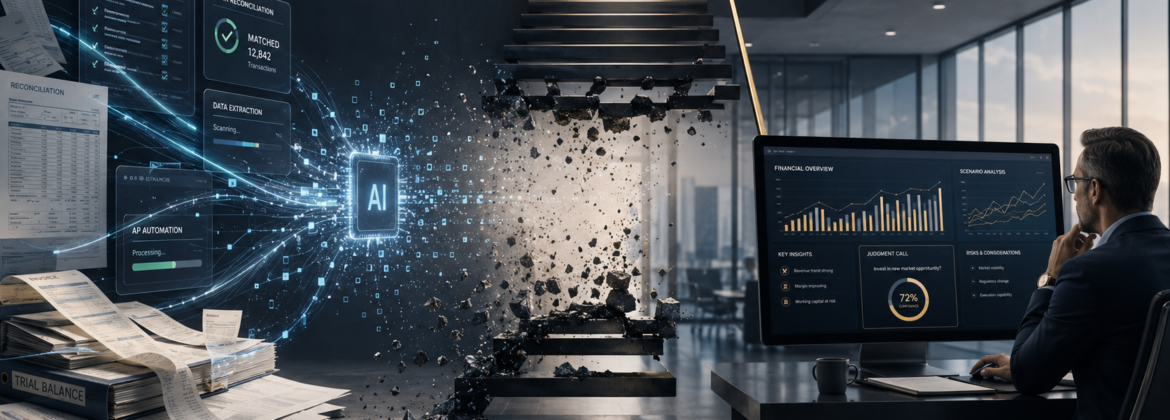
For a century, accountants learned the profession by doing the grunt work — reconciliations, transaction coding, trial balances — and developing judgment through thousands of hours of hands-on repetition. AI is now performing that grunt work faster and cheaper, which means the entry-level jobs that trained every senior accountant alive are disappearing. This creates the apprenticeship crisis: a profession that can automate execution but can no longer manufacture judgment, because the training ground that produced it is gone. The data is already here — a 2026 BambooHR analysis found accounting hiring running at a 3-to-1 senior-to-entry-level ratio with a third of new hires quitting within their first year, and peer-reviewed research in Accounting Horizons warns of “de-skilling” as automation removes the hands-on learning that built professional judgment. Stanford and MIT researchers found junior accountants accept AI output without scrutiny while experienced professionals challenge it — proof that judgment can’t be downloaded. The firms that survive will replace the lost apprenticeship with a deliberate, structured one: simulated experience that compresses years of hands-on judgment-building into weeks. The firms that don’t will end up with abundant AI at the bottom, aging expertise at the top, and no one in the middle.
This is the most important structural problem facing the profession, and almost no one is solving it operationally. Here’s the full anatomy — and the fix.
Who I Am and Why You Should Listen
I’ve been in public accounting since 1990. I founded my own firm in 1993, merged it in 2001 to form Howard, Howard and Hodges, and grew it from three people to 50 staff across four locations and multiple states. Our firm was named PASBA Firm of the Year.
I am, myself, a product of the apprenticeship model this article is about. I learned accounting the old way — by doing the grunt work, making mistakes a senior caught, and slowly accumulating the pattern recognition that eventually became judgment. I can still remember the reconciliation that finally made the whole logic of double-entry click for me, years into the work. That click is the thing the profession is about to stop manufacturing.
Since 2020 I’ve built and run a structured training platform that more than a thousand accounting professionals across dozens of PASBA member firms have moved through — which means I’ve spent five years studying, in measured data, exactly how judgment gets built and how fast it can be built deliberately rather than accidentally. That makes this crisis not an abstraction to me. It’s the precise problem my last five years have been spent solving. I’ll show you the research, then show you what actually works.
What Is the Apprenticeship Crisis in Accounting?
The apprenticeship crisis is the collapse of the profession’s traditional training mechanism. For generations, the career path was identical and reliable: a new graduate entered at the bottom, spent two or three years doing routine execution — processing invoices, reconciling accounts, preparing trial balances and basic returns — and through the sheer volume of that hands-on work developed something no classroom teaches: professional judgment, pattern recognition, and the instinct for when a number is wrong.
That entry-level work was never really about the work. It was the tuition. The grunt work was the apprenticeship.
AI has now made that grunt work obsolete. As one industry analysis put it plainly, the traditional apprenticeship model for public accounting will not work long-term, because the tasks traditionally used to train interns and entry-level professionals are handled far faster by AI — and it won’t make sense to hire people for that work. The American Accounting Association’s own journal frames the danger precisely: automation improves efficiency but eliminates the hands-on learning that helped young professionals understand core processes, raising the risk of “de-skilling” — newcomers who never develop the judgment to interpret complex transactions because they never had to build the numbers themselves.
Here is the trap in one sentence: you can automate the execution, but you cannot automate the experience that execution used to provide — and judgment was always a byproduct of the execution, not the curriculum.
The Evidence: This Is Already Happening
This is not a forecast. The data from 2025 and 2026 shows the crisis in progress.
The hiring ratio has already inverted
A 2026 BambooHR analysis — drawing on six years of workforce data spanning over 480,000 employee records — found accounting and finance hiring running at a 3-to-1 senior-to-entry-level hiring ratio, with a third of new accounting and finance hires quitting within their first year. BambooHR’s CFO attributed much of the early-quit problem to mismatched expectations between new hires and senior management amid the rise of AI. Firms are hiring three seniors for every junior — pulling up the ladder they themselves climbed.
The broader white-collar pattern confirms the direction
Accounting isn’t alone, which tells you the mechanism is structural, not sector-specific. Big tech entry-level hiring fell to just 7% of new hires in 2024, more than 50% below pre-pandemic levels, and Brookings Institution research found AI could automate over 50% of tasks in entry-level positions — five times the risk faced by senior roles. Law firms using AI for contract review already report 40% fewer document-analysis opportunities for first-year associates. The entry rung is being automated across every knowledge profession at once.
The judgment gap is measurable
The most important research finding is also the most alarming. Stanford University and MIT researchers found that junior accountants often accept AI-generated outputs without significant scrutiny, even when the systems flag their own uncertainty — while experienced professionals treat AI conclusions as something to be challenged and evaluated. That contrast is the entire crisis in miniature: the experienced professionals can supervise AI because they earned their judgment doing the work AI now does. The juniors can’t supervise what they never learned to do. And critical thinking and professional skepticism, the research notes, are developed through hands-on work experience rather than shortcuts.
The profession has officially noticed
This is no longer fringe concern. The AICPA launched its Profession Ready Initiative in February 2026 to define the skills early-career CPAs need in an AI-driven marketplace. Robert Half’s 2026 research found just 6% of finance and accounting managers have the talent they need for priority projects, with 62% reporting skills gaps more pronounced than a year earlier. And the American Accounting Association is now explicitly urging firms to co-design structured learning environments — “sandboxes, residencies, or apprenticeships” — where new hires develop judgment even as AI handles routine execution.
When the standard-setters start using the word “apprenticeship,” the crisis has arrived.
The Mechanism: A Chart of the Broken Ladder
Here is the structure of the problem, laid out as the profession’s career ladder — then and now:
The traditional ladder (1990–2020):
| Career stage | What they did | What they were actually building |
|---|---|---|
| Years 0–2 (Entry) | Reconciliations, transaction coding, data entry, trial balances | Pattern recognition, error instinct, process understanding |
| Years 3–5 (Staff/Senior) | Preparing returns, reviewing juniors’ work, client interaction | Applied judgment, exception handling, review skill |
| Years 6+ (Manager/Partner) | Advisory, complex judgment, client strategy, supervision | Wisdom — the synthesis of a decade of accumulated reps |
Each rung was load-bearing. The judgment at the top was manufactured by the grunt work at the bottom. Remove the bottom rung and the whole ladder loses its structural logic.
The AI-disrupted ladder (2026 forward):
| Career stage | What happens now | The consequence |
|---|---|---|
| Years 0–2 (Entry) | AI does the reconciliations, coding, trial balances. The jobs shrink. | The judgment-building reps never happen |
| Years 3–5 (Staff/Senior) | Pushed into advisory work earlier — but without the foundational reps | The “experience gap”: advising without the depth to advise well |
| Years 6+ (Manager/Partner) | Aging out, retiring (40% of CPAs near retirement) | Expertise leaving with no fully-formed replacements beneath |
The result, in the words of the research, is a profession with abundant AI capability at the entry level and experienced leadership at the top, but insufficient mid-career professionals to bridge the gap. One accounting commentator named it the “experience gap” — professionals skilled at using AI but less familiar with how financial data is actually built and understood, pushed into advisory conversations earlier in their careers but lacking the depth to interpret business context and ask the right questions.
You cannot have a profession of supervisors when no one was ever a worker.
Why “Just Hire Experienced People” Doesn’t Solve It
The instinctive firm-owner response to a junior-talent problem is to skip juniors entirely — hire experienced, hire seniors, let the BambooHR 3-to-1 ratio be the strategy. This fails on three fronts, and understanding why points directly at the real solution.
First, the experienced people are running out. The pipeline shed 300,000+ professionals between 2019 and 2021, roughly 40% of CPAs are near retirement, and Robert Half found only 6% of firms have the talent they need. You cannot build a long-term staffing model on a shrinking pool — you’re bidding against every other firm for the same vanishing inventory, and the recruiter’s fee just keeps climbing.
Second, it’s a deferral, not a solution. Today’s seniors were yesterday’s juniors. If the profession stops minting juniors now, the senior shortage of 2026 becomes the catastrophic senior shortage of 2035. Every firm pulling up the ladder is collectively guaranteeing there’s no one to promote in a decade.
Third — and this is the insight most firm owners miss — the judgment gap is now solvable deliberately, which means the accidental apprenticeship was never the only way to build it. The old model built judgment as an unplanned byproduct of years of grunt work. That was always inefficient — it just happened to be the only mechanism available. The grunt work is gone, but the judgment-building experience it provided can now be manufactured intentionally, and far faster, through structured simulation.
That last point is the whole answer. Let me show you what it means in practice.
The Solution: Replace the Accidental Apprenticeship With a Deliberate One
The profession’s own bodies have named the fix without operationalizing it: the AAA called for “sandboxes, residencies, or apprenticeships” where new hires build judgment while AI handles execution. That’s directionally right and operationally vague. Here’s the concrete version.
If judgment was historically built by processing a year’s worth of real client work and learning from the patterns and mistakes, then you rebuild it by having new hires process a full simulated year of client work in a structured environment — compressing the judgment-building reps that used to take years of accidental exposure into weeks of deliberate practice.
This is exactly what a well-built structured pathway does, and it maps directly onto the lost apprenticeship:
It restores the reps AI took away. Inside a structured pathway, a new hire still processes twelve months of transactions, twelve reconciliations, twelve sales tax returns, quarterly payroll filings, and a full year-end close — on realistic sample client data, in the actual software. AI may do this work in production, but the trainee does it in training, because the doing is where the judgment forms. We don’t automate the apprenticeship; we automate the delivery of the apprenticeship.
It builds the AI-skepticism the Stanford/MIT research found juniors lack. When a trainee has personally built a reconciliation and seen what a correct one looks like, they can recognize when an AI-generated one is wrong. The hands-on reps are precisely what create the instinct to challenge AI output rather than rubber-stamp it. You cannot supervise what you’ve never done — so the training has them do it, deliberately, before they’re asked to supervise the machine doing it.
It gates on judgment, not completion. Assessments built on the trainee’s own work product — at an 80% threshold before progression — verify that the judgment actually formed, rather than assuming it accreted through exposure. The old apprenticeship had no quality gate; you became competent whenever you happened to. The deliberate version confirms it.
It compresses the timeline brutally. What the accidental apprenticeship delivered in two to three years of uneven, opportunity-dependent exposure, a structured pathway delivers in two to three weeks of full-time, every-scenario-guaranteed practice — because nothing is left to chance. The trainee hits the personal-use-of-company-car calculation and the 2% S-corp health insurance addback in week three whether or not a real client would have presented those that month.
Then it carries them up the ladder that AI flattened. The same infrastructure that rebuilds the entry-level reps continues into the advisory development the experience gap demands — financial statement analysis, the advanced tax scenarios, the proactive client communication that turns a processor into an advisor. The broken ladder gets rebuilt rung by rung, deliberately, inside a system instead of left to the vanishing grunt work.
The profession spent a century building judgment by accident. The firms that win the next decade will build it on purpose — and faster.
What Firm Owners Should Do Now
Five concrete moves, in order:
1. Stop equating “entry-level” with “disposable.” The BambooHR 3-to-1 ratio is the profession optimizing for this quarter and mortgaging 2035. If you stop developing juniors, you are choosing to have no seniors later. Hire for aptitude — the capacity to develop judgment — rather than for experience you can no longer find anyway.
2. Build the deliberate apprenticeship before AI finishes eating the accidental one. Install structured, simulation-based training that has new hires process a complete client year and develop the reps the shrinking entry-level workload no longer provides. This is the AAA’s “sandbox/residency/apprenticeship,” made real.
3. Train AI supervision explicitly. Your juniors will accept bad AI output unless you deliberately build the skepticism. That means having them do the work by hand in training so they can recognize when the machine is wrong in production — the single most valuable skill in an AI-augmented firm, and the one the research says juniors most lack.
4. Move the experience-gap fix upstream. Because structured training compresses the foundational reps into weeks, your people can move into genuine advisory capability sooner — but with the depth the accidental apprenticeship used to require years to build. Pair the simulated foundation with a deliberate advisory development track so “advising earlier” doesn’t mean “advising shallowly.”
5. Make the development path visible — it’s also your retention answer. A third of new accounting hires quit in year one, largely from mismatched AI-era expectations. A new hire who can see a structured pathway from foundational reps through AI-supervision skill to advisory capability has a reason to stay that “we’ll figure it out” never provides.
Frequently Asked Questions
What is the apprenticeship crisis in accounting?
The apprenticeship crisis is the collapse of accounting’s traditional training mechanism. For generations, junior accountants developed professional judgment by doing entry-level grunt work — reconciliations, transaction coding, trial balances — over two to three years. AI now performs that work faster and cheaper, eliminating the jobs that built judgment as a byproduct. The result is a profession that can automate execution but can no longer manufacture the judgment that execution used to teach, creating an “experience gap”: abundant AI at the entry level, aging expertise at the top, and too few mid-career professionals to bridge them. Peer-reviewed research in Accounting Horizons warns of “de-skilling” as a direct consequence.
Is AI eliminating entry-level accounting jobs?
Yes, and the data already shows it. A 2026 BambooHR analysis found accounting and finance hiring running at a 3-to-1 senior-to-entry-level ratio. Across white-collar work the pattern is consistent — big tech entry-level hiring fell to 7% of new hires in 2024, over 50% below pre-pandemic levels, and Brookings research found AI could automate over 50% of entry-level tasks, five times the risk to senior roles. AI primarily absorbs routine data entry, invoice processing, transaction matching, and basic reconciliation — precisely the tasks that historically trained new accountants. The work that remains for humans is judgment, advisory, exception handling, and AI supervision.
How will accountants learn judgment if AI does the entry-level work?
Through a deliberate apprenticeship that replaces the accidental one. Historically, judgment formed as an unplanned byproduct of years of hands-on grunt work; with that work automated, firms must build judgment intentionally through structured, simulation-based training. The mechanism: have new hires process a complete simulated client year — twelve months of transactions, reconciliations, returns, payroll filings, and year-end work — on realistic data in the actual software, gated by assessments on their own work product. This compresses the judgment-building repetitions that once took two to three years into two to three weeks, and crucially builds the ability to recognize when AI output is wrong, which Stanford and MIT research found junior accountants currently lack.
What is the “experience gap” in accounting?
The experience gap is the emerging condition where accountants are skilled at using AI tools but lack familiarity with how financial data is actually built and understood — because automation removed the hands-on work that historically created that understanding. Professionals may enter advisory conversations earlier in their careers but without the depth to interpret business context, recognize anomalies, or ask the right questions. It compounds the better-known “AI skills gap”: firms need staff with both AI fluency and the foundational judgment that only comes from having done the underlying work. The fix is deliberately rebuilding foundational experience through structured simulation rather than waiting for it to accrue through (now-automated) routine work.
Should accounting firms still hire entry-level staff in the AI era?
Yes — but hire and develop them differently. Skipping juniors to hire only experienced staff fails three ways: experienced talent is running out (300,000+ left the profession 2019–2021, ~40% of CPAs near retirement, only 6% of firms report having needed talent), it merely defers the senior shortage to the next decade, and it forfeits the chance to build judgment deliberately. The better approach: hire for aptitude rather than scarce experience, then use structured simulation-based training to rebuild the judgment-forming reps AI removed from the entry-level workload. Firms that stop developing juniors are choosing to have no seniors to promote in ten years.
How do accounting firms build judgment in junior staff without traditional grunt work?
By manufacturing the experience deliberately instead of waiting for it accidentally. Four components: (1) simulation — new hires process a full year of realistic client work in the actual software, restoring the hands-on reps automation removed; (2) gated verification — assessments on their own work product confirm judgment formed, at an 80% threshold, rather than assuming it accrued; (3) explicit AI-supervision training — having trainees do the work manually so they can recognize incorrect AI output in production; (4) a continued advisory development track so compressed foundations lead into genuine advisory depth. This deliberate apprenticeship compresses years of accidental learning into weeks and is what the American Accounting Association means by its call for “sandboxes, residencies, and apprenticeships.”
The Bottom Line
The accounting profession is about to discover that its entry-level jobs were never really jobs — they were a training program disguised as labor, and AI just automated the labor without replacing the training. That’s the apprenticeship crisis: a century-old mechanism for manufacturing judgment, switched off almost overnight, with nothing deliberate put in its place.
The research is unambiguous and the profession’s own bodies are now sounding the alarm — de-skilling, the experience gap, the inverted hiring ratio, the AICPA’s Profession Ready Initiative, the AAA’s call for engineered apprenticeships. What’s missing isn’t awareness. It’s operational solutions: the actual systems that rebuild, deliberately, what the grunt work used to provide by accident.
That system exists, and it’s almost reassuringly concrete: have new hires process a full simulated client year, in real software, gated on their own work product, with AI-supervision skill built in by having them do the work the machine now does — then carry them up the rebuilt ladder into advisory depth. Years of accidental judgment-building, compressed into weeks of deliberate practice.
The profession built its expertise by accident for a hundred years. It will have to build it on purpose from here. The firms that start now will have the mid-career bench no one else does in 2035 — and they’ll have built it from the aptitude they hired, not the experience they couldn’t find.
You are not facing a profession without a future. You are facing a profession whose training mechanism broke — and the firms that build the replacement first will own what comes next.
Want the deliberate apprenticeship already built — simulation, gating, AI-supervision skill, and the advisory ladder included?
Book a 10-minute structural alignment review at calendly.com/skillabilitydemo
In ten minutes we’ll show you the structured pathway that rebuilds the judgment-forming reps AI removed — a full simulated client year inside QuickBooks Online, Accounting CS, UltraTax, and Xero, gated on real work product — and the advisory track that closes the experience gap before it opens.
Put your next hires through our system. If they don’t pass our modules and aren’t autonomously delivering client-ready work within 45 days, we refund 100% of your enrollment fee and pay your monthly subscription out of our own pocket.
To your firm’s capacity,
Vincent Howard, CPA Managing Partner, Howard, Howard and Hodges Skillability for Accounting Firms
Vincent Howard, CPA has practiced public accounting since 1990. He holds a Master’s degree in Taxation, leads a 50-person multi-state firm, and built the Skillability training platform used by accounting firms nationwide through the PASBA network — the source of the 1,000+ trainee dataset referenced in this article. His firm was named PASBA Firm of the Year.
© 2026 Skillability for Accounting Firms. 45-Day Out-of-Pocket Performance Guarantee applies to qualifying onboarding engagements. Contact us for full terms.