

 By Vincent Howard, CPA | Managing Partner, Howard, Howard and Hodges | SkillAbility for Accounting Firms
Last updated: August 11, 2026 | 51-minute read
- What strategic tax planning training means
- Why forward-looking tax capability matters in 2026
- Return preparation vs. strategic tax planning
- The FORECAST framework
- Build the projected tax baseline
- Start with client decisions and goals
- 2026 planning environment and current law
- Entity, compensation, and owner-level planning
- Income and deduction timing
- Capex, Section 179, and bonus depreciation
- Research and experimental expenditures
- Business-interest limitations and financing
- Qualified business income planning
- Loss limitations, basis, at-risk, and passive rules
- Retirement and owner benefit planning
- State and local tax planning
- Transaction and exit-related tax triggers
- Scenario modeling and marginal analysis
- Tax savings vs. cash-flow economics
- Document and communicate tax advice
- Lead the tax-planning meeting
- Build a year-round planning calendar
- AI in strategic tax planning
- Worked planning example
- Tax-planning dashboard
- 90-day firm implementation plan
- 30-day accountant training curriculum
- 30/60/90 live-work progression
- 100-point readiness scorecard
- 15 realistic training scenarios
- What the firm should measure
- Common mistakes
- Frequently asked questions
A tax preparer sees a client’s $1.4 million of pass-through income after December 31 and asks:
“What deductions do we have?”
A strategic tax adviser sees the same client in May and asks:
- What do we expect taxable income to be?
- What capital purchases are actually needed?
- Is the owner planning a large distribution?
- Will the business hire, borrow, acquire, or sell anything?
- Does the client have domestic research activity?
- Are estimated payments aligned with the projected liability?
- What basis or loss limitations could change the outcome?
- Are there state elections or multistate issues that need action before year-end?
- What decision would the client make differently if we showed the after-tax cash effect now?
The difference is not that the second accountant knows a secret deduction. The difference is timing, modeling, judgment, and client communication.
A tax return records the consequences of decisions already made. Strategic tax planning helps the client understand tax consequences while there is still time to choose differently.
Who I Am and Why This Matters
I have practiced public accounting since 1990. I founded my accounting firm in 1993, merged it in 2001 to form Howard, Howard and Hodges, and helped grow the organization from three people to approximately 50 staff across multiple Florida locations and states. Our firm was named PASBA Firm of the Year in 2015.
One of the biggest development gaps in tax is that staff can become very good at preparing technically correct returns without ever being taught how to use that technical knowledge before the transaction occurs.
Return preparation builds an important foundation: entity taxation, basis, depreciation, credits, loss limitations, state reporting, and owner taxation. Planning requires another layer: forecasting, business understanding, timing, scenario analysis, cash-flow thinking, client discovery, communication, and professional judgment.
Since 2020, I have built and run the SkillAbility accounting workforce development platform, used by more than 1,000 accounting professionals across dozens of PASBA firms.
The development objective is not to turn every staff accountant into the tax partner. It is to create a structured progression where the staff accountant begins to recognize planning opportunities, the senior can model them, the manager can evaluate trade-offs, and the partner or specialist can focus on the highest-risk judgment rather than rebuilding the entire analysis.
Read Accounting Workforce Development for the broader technical-to-advisory pathway and How Accountants Identify Advisory Opportunities Inside Compliance Work for recognizing planning signals already visible inside tax returns and workpapers.
What Is Strategic Tax Planning Training for Accountants?
Strategic tax planning training develops an accountant’s ability to project a client’s tax position before year-end, identify decision-sensitive opportunities and risks, model alternatives, quantify tax and cash consequences, communicate assumptions and trade-offs, coordinate actions before deadlines, and escalate technical conclusions appropriately.
Planning is not a list of tax-saving ideas
A list of 25 deductions can sound sophisticated while adding very little value if none of them applies to the client’s facts.
Strategic planning begins with:
- Current-year facts
- Projected income
- Business changes
- Ownership changes
- Cash needs
- Upcoming transactions
- Client goals
- Known deadlines
Planning is not simply minimizing this year’s tax
The lowest current-year tax is not always the best economic outcome.
Examples:
- Buying unnecessary equipment to generate depreciation can reduce tax and destroy cash.
- Accelerating a deduction into a lower-rate year may be less valuable than preserving it for a higher-rate year.
- Deferring income can be counterproductive if a transaction, rate change, limitation, or expiring attribute makes the future year less favorable.
- Reducing owner compensation too aggressively can create S corporation reasonable-compensation risk.
Planning is a decision system
Why Forward-Looking Tax Capability Matters in 2026
AICPA’s own staff-development pathway now explicitly connects tax knowledge to planning and business advice
AICPA & CIMA’s 2026 Tax Staff Essentials program is updated for H.R. 1 / OBBBA and describes progressive development from tax fundamentals through complex compliance, planning, review, business strategy, and business advice. Level 3 specifically focuses on understanding business strategies and competitive positioning and converting that knowledge into tax planning and business advice.
Source: AICPA & CIMA Tax Staff Essentials.
Current federal law changed the planning landscape
The IRS’s Working Families Tax Cuts resource, last updated July 17, 2026, consolidates current implementation guidance for major provisions enacted in Public Law 119-21. For business clients, the changes include permanent 100% bonus depreciation for qualifying property acquired after January 19, 2025, a current deduction for qualifying domestic research or experimental expenditures for tax years beginning after 2024, changes to business-interest limitations, and other provisions that affect planning timing and modeling.
Source: IRS Working Families Tax Cuts.
Tax planning is becoming a year-round client relationship
AICPA & CIMA’s 2026 Tax and Financial Planner is organized month by month around timely business actions, planning opportunities, and client conversations rather than one filing-season event.
Source: AICPA & CIMA 2026 Tax and Financial Planner.
Tax advice is still governed by professional standards
AICPA’s revised Statements on Standards for Tax Services Nos. 1–4 have been effective since January 1, 2024 and remain the enforceable tax practice standards for AICPA members. Strategic planning must be proactive without becoming casual about authority, evidence, disclosure, documentation, competence, or client facts.
Source: AICPA revised SSTS announcement.
Return Preparation vs. Strategic Tax Planning
| Return Preparation | Strategic Tax Planning |
|---|---|
| Looks backward | Looks forward |
| Records completed transactions | Models decisions before they are completed |
| Uses final books | Uses projections, assumptions, and scenarios |
| Focuses on filing position | Focuses on timing, alternatives, cash, and client goals |
| Deadline is filing date | Deadline is often the date the client must act |
| Primary output is return | Primary output is a decision, action plan, and updated projection |
Compliance data is the starting point
Prior returns reveal:
- Entity structure
- Carryovers
- Basis
- Credits
- Depreciation
- State filings
- Owner-level patterns
- Repeated limitations
But the prior return does not tell you what will happen this year unless staff learn to ask what changed.
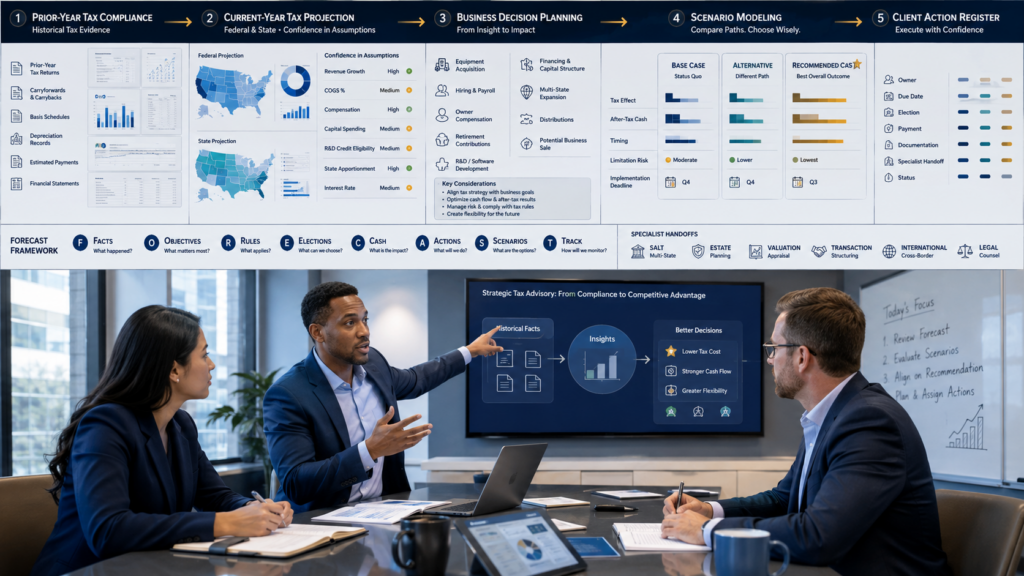
The FORECAST Framework for Strategic Tax Planning
F-O-R-E-C-A-S-T
F — Facts, Forecasts, and Filing Baseline
Reconcile prior filings and current books, then project current-year income, deductions, credits, basis, estimated payments, and state exposure.
O — Objectives and Opportunities
Understand what the client is actually deciding—investment, hiring, retirement, ownership, cash, acquisition, exit, or personal planning.
R — Rules, Rates, Restrictions, and Risks
Map phaseouts, basis, at-risk, passive, interest, loss, compensation, state, documentation, and other technical constraints.
E — Elections, Entity, and Expense Timing
Identify elections and timing choices that require action before filing season.
C — Cash Consequences and Credits
Translate tax effects into after-tax cash, financing, working-capital, retirement, and credit consequences.
A — Actions Before Deadlines
Assign exact actions, responsible parties, evidence, elections, payment dates, and implementation deadlines.
S — Scenarios and Specialist Coordination
Compare alternatives and route estate, SALT, international, valuation, legal, compensation, or transaction issues to qualified specialists.
T — Track Results and Refresh the Plan
Update projections after material changes and compare expected tax, actual tax, cash impact, and execution.
Build the Projected Tax Baseline Before Recommending Anything
Start with prior-year carryforward facts
Bring forward, as applicable:
- Federal and state NOLs
- Capital-loss carryovers
- Charitable carryovers
- Passive losses
- At-risk limitations
- Basis
- Credits
- Depreciation schedules
- Section 163(j) carryforwards
- Estimated tax payments
Build current-year projections
For a business owner, project:
- Business taxable income
- W-2 compensation
- Interest and dividends
- Capital gains
- Rental income
- Retirement contributions
- Charitable giving
- Large deductions
- Credits
- State taxes
- Estimated payments
Use a confidence level
Do not present a June estimate as if it were a December fact.
For each material assumption, identify:
- Known
- Estimated
- Management forecast
- Contingent
- Unknown
The formula is conceptually simple, but the quality of the projection depends on the facts, timing, limitations, elections, and state treatment underneath it.
Start With Client Decisions and Goals
Do not ask only “how can we reduce tax?”
Ask:
- Are you planning to hire?
- Are you buying equipment because the business needs it?
- Are you planning to sell an asset or the company?
- Will ownership change?
- Do you expect large capital gains?
- Do you need more cash personally?
- Are retirement contributions a priority?
- Are you acquiring another business?
- Are you expanding into new states?
- Are you developing new technology or software?
Tax is one variable in a business decision
For every recommendation, teach staff to show:
- Business purpose
- Tax consequence
- Cash consequence
- Timing
- Risk / limitation
- Implementation requirement
Read KPI Advisory Training for Accountants and Cash Flow Advisory Training for Accountants for connecting tax recommendations to the operating and liquidity decisions they affect.
The 2026 Tax-Planning Environment: What Staff Should Know Now
The strategic-planning process should be permanent. The technical opportunities inside it change as law changes.
| Current Federal Planning Area | 2026-Relevant Rule | Why It Creates a Planning Conversation |
|---|---|---|
| Bonus depreciation | Permanent 100% additional first-year depreciation for qualifying property acquired after Jan. 19, 2025, subject to applicable rules. | Purchase timing, placed-in-service date, cash, financing, basis, state conformity, and whether the asset is actually needed. |
| Domestic R&E | For tax years beginning after Dec. 31, 2024, qualifying domestic research or experimental expenditures may generally be deducted currently under new §174A, with alternative capitalization treatment available. | Identification, domestic vs. foreign location, software-development costs, accounting method, documentation, and transition rules. |
| Business interest | For years beginning after 2024, depreciation, amortization, and depletion are added back in computing adjusted taxable income for §163(j); further changes apply after 2025. | Debt structure, projected taxable income, capitalized interest, acquisitions, and interest carryforwards. |
| QBI deduction | The §199A qualified business income deduction is permanent under current law. | Entity and compensation interactions, taxable-income thresholds, SSTB status, W-2 wages, property, aggregation, and owner planning. |
| Excess business losses | The §461(l) limitation for noncorporate taxpayers was made permanent. | Large losses may not produce the current-year benefit clients expect; basis, at-risk, passive, and NOL rules may also apply. |
| 2026 individual framework | Seven individual rates remain 10% through 37%; the 2026 standard deduction is $32,200 MFJ, $16,100 single/MFS, and $24,150 HOH. | Owner-level projections, withholding, estimated payments, deductions, and transaction timing should use current-year—not prior-year—thresholds. |
| Estate planning | The 2026 basic estate-tax exclusion amount is $15 million under current federal law. | Business-owner transition, gifting, estate planning, and valuation conversations may require coordination with estate counsel and valuation specialists. |
Sources: IRS Working Families Tax Cuts, IRS 2026 inflation adjustments, IRS §163(j) update, and IRS QBI deduction guidance.
Do not teach a “2026 strategy list” without teaching the decision process
Specific provisions will change again. Staff who know only a list of current rules become obsolete when the list changes.
Staff who know how to build facts, projections, scenarios, documentation, and implementation can update the technical layer without relearning the advisory process.
Entity, Compensation, and Owner-Level Planning
Entity choice should not be reduced to one tax rate
Compare:
- Income tax
- Employment / self-employment tax
- QBI
- Reasonable compensation
- Distribution needs
- Fringe benefits
- State tax
- Capital needs
- Exit / transaction goals
- Administrative complexity
S corporation planning requires compensation judgment
Do not teach “minimize salary.” Teach staff to:
- Understand the owner’s actual role
- Document compensation facts
- Recognize payroll-tax implications
- Model distributions
- Escalate reasonable-compensation judgments
Partnership planning requires basis and agreement awareness
Potential planning areas include:
- Partner basis
- Debt allocation
- Guaranteed payments
- Distributions
- Special allocations
- Section 754 considerations
- Ownership changes
Staff should not infer economic or legal rights from tax data alone. Partnership agreements and qualified legal / tax review may be necessary.
Entity restructuring is not a year-end shortcut
Conversions, elections, reorganizations, and ownership changes can create legal, payroll, state, basis, and transaction consequences. Build the model before filing an election.
Teach Income and Deduction Timing as a Multi-Year Decision
The planning question is often “which year?”
Consider:
- Projected marginal rates
- Expected business income
- Capital gains
- Loss carryovers
- Charitable contributions
- Retirement contributions
- Phaseouts
- QBI interactions
- State treatment
- Expected sale or transition
Compare at least two years when timing is material
This is a conceptual planning formula, not a statutory computation. The point is to teach that deferral and acceleration have time-value and rate consequences.
Do not accelerate deductions mechanically
A deduction may be less valuable if it:
- Falls into a lower-rate year
- Creates or increases a limited loss
- Reduces QBI or another benefit unexpectedly
- Creates state consequences
- Consumes cash for an unnecessary purchase
Capex, Section 179, and Bonus Depreciation
Permanent 100% bonus depreciation makes capital planning more—not less—important
The IRS states that Public Law 119-21 made the 100% additional first-year depreciation deduction permanent for eligible property acquired after January 19, 2025, subject to the applicable qualification and placed-in-service rules.
Source: IRS Notice 2026-11 guidance announcement.
Ask whether the client needs the asset before asking how fast it can be deducted
Model:
- Purchase price
- Cash down payment
- Financing
- Expected useful business benefit
- Tax basis
- Depreciation method
- Section 179 eligibility
- Bonus eligibility
- State conformity
- Future disposition / recapture issues
Placed-in-service timing matters
Ordering equipment is not necessarily the same as placing it in service for tax purposes. Staff should identify operational timing, installation, use, documentation, and year-end cutoffs early enough for the client to act.
Show after-tax cash—not only the deduction
A $100,000 Deduction Is Not a $100,000 Tax Saving
Illustrative only. Ignores state tax, limitations, time value, financing, basis interactions, recapture, and other taxpayer-specific rules. The lesson is that a deduction reduces taxable income; it does not reimburse the purchase price.
Research and Experimental Expenditures
Domestic research changed materially under current law
The IRS states that for tax years beginning after December 31, 2024, taxpayers may deduct qualifying domestic research or experimental expenditures currently under new Section 174A, or elect qualifying capitalization treatment. Foreign research remains subject to different treatment.
Source: IRS Working Families Tax Cuts — domestic research expenditures.
Planning starts with identifying the activity
Potential factual questions include:
- What development work is being performed?
- Where is it performed?
- Which employees and contractors perform it?
- Is software being developed?
- What costs are direct or allocable?
- How were prior years treated?
- Do transition rules or method changes apply?
Do not confuse Section 174A treatment with the research credit
Expense treatment and credit qualification are related planning areas but are not the same calculation. Staff should learn to identify both questions and escalate specialized credit analysis as needed.
Business-Interest Limitations and Financing
Debt planning requires projected tax capacity
The IRS states that for tax years beginning after December 31, 2024, Section 163(j) adjusted taxable income again adds back depreciation, amortization, and depletion. Additional changes apply for years beginning after December 31, 2025.
Source: IRS business-interest limitation update.
Teach staff to model debt before the acquisition closes
Consider:
- Projected interest expense
- Adjusted taxable income
- Carryforwards
- Entity structure
- Capitalized interest
- Acquisition debt
- Cash interest coverage
- State conformity
This is a good example of why strategic tax planning belongs alongside business advisory. A financing decision can affect both cash flow and deduction timing.
Qualified Business Income Planning
Section 199A is now a long-term planning variable
The IRS’s current guidance reflects that the qualified business income deduction remains available under current law. The deduction can be up to 20% of qualified business income for eligible taxpayers, subject to taxable-income limitations and other rules.
Source: IRS Qualified Business Income Deduction.
Teach the interaction—not just the formula
Potential planning variables include:
- Taxable income
- QBI by business
- SSTB status
- W-2 wages
- Qualified property
- Aggregation
- Reasonable compensation
- Guaranteed payments
- Retirement contributions
- Capital gains
Do not let QBI dominate the business decision
An entity or compensation decision should make economic, legal, operational, and tax sense as a whole.
Loss Limitations, Basis, At-Risk, and Passive Rules
A projected loss is not automatically a current tax deduction
Before telling a client that a loss will offset other income, test the limitation sequence that applies.
Depending on the taxpayer, that can include:
- Entity or shareholder / partner basis
- At-risk rules
- Passive-activity rules
- Excess-business-loss limitation
- Net operating loss rules
Excess business loss limitations are permanent under current federal law
The 2025 Form 461 instructions state that Public Law 119-21 permanently extended Section 461(l). Disallowed excess business losses are generally treated as NOL carryovers under the applicable rules.
Source: IRS Instructions for Form 461.
Teach staff to build a loss-availability schedule
Planning value comes from knowing before the client commits cash
A client may contribute money, buy an asset, invest in a project, or restructure ownership expecting an immediate tax benefit. If the benefit is limited, the accountant should identify that before the economic decision is finalized.
Retirement, Compensation, and Owner Benefit Planning
Retirement planning should connect employer cost and owner goals
Potential conversations include:
- Plan type
- Owner and employee demographics
- Contribution limits
- Cash requirements
- Deductibility
- Employee retention
- Timing
- Administrative burden
Do not recommend the contribution in isolation
A larger deductible contribution may be attractive from a tax perspective while creating cash pressure or employee-cost consequences.
Coordinate with qualified plan advisers
Plan design, ERISA, nondiscrimination, actuarial calculations, investment decisions, and fiduciary matters may require specialized advisers.
State and Local Tax Planning
Federal planning is incomplete without state review
Ask:
- Where does the client operate?
- Where are employees located?
- Where are customers located?
- What states receive sales?
- What states conform to federal depreciation or research treatment?
- Are pass-through entity elections available?
- Do sales, payroll, property, or income create nexus?
- Are estimated payments or extensions needed?
Do not assume federal conformity
A federal deduction may be added back or modified at the state level. Staff should maintain a state-conformity question list rather than copying federal projections blindly.
Multistate growth is a planning trigger
Remote employees, online sales, new locations, acquisitions, and service expansion can change filing and indirect-tax obligations before management realizes it.
Use specialists when the footprint becomes complex
Strategic tax planning includes recognizing when a client’s facts require SALT expertise rather than pretending every generalist should independently resolve every jurisdiction.
Transaction and Exit-Related Tax Triggers
Tax planning should begin before a letter of intent
Potential planning triggers include:
- Sale of business
- Sale of real estate
- Partner buyout
- Stock redemption
- Family transfer
- Management succession
- Acquisition
- Debt refinancing
- Large capital gain
Entity and basis history matter
Transaction analysis may require:
- Stock / outside basis
- Asset basis
- Depreciation recapture
- Installment-sale rules
- Purchase-price allocation
- State tax
- QSBS questions
- Estate and gifting coordination
Do not let a generalist improvise deal structure
Asset-versus-equity structure, Section 338 elections, purchase-price allocation, reorganizations, QSBS, estate strategies, and multistate transaction issues may require specialized tax and legal advisers.
Read Exit Planning Training for Accountants for the years-before-sale planning process and M&A Advisory Training for Accountants for transaction-readiness and diligence support once a sale becomes active.
Scenario Modeling and Marginal Analysis
Every material planning recommendation should have a comparison
At minimum:
- Base case
- Recommended case
- Relevant alternative
Show the marginal effect
Then add:
- Cash required
- Cash retained
- Timing difference
- Future-year tax
- Business impact
- Risk / uncertainty
Do not hide assumptions in the spreadsheet
Document:
- Projected income
- Transaction date
- Tax rate
- Deduction eligibility
- State treatment
- Basis
- Carryovers
- Expected future year
Use sensitivity when the answer changes materially
If a strategy is attractive only if projected income is above $1 million, show what happens at $750,000, $1 million, and $1.25 million.
Tax Savings vs. Cash-Flow Economics
Tax savings are not the same as wealth creation
Teach staff to ask:
- How much cash leaves the business?
- How much tax is deferred versus permanently reduced?
- What operating return does the expenditure produce?
- Does the strategy increase debt?
- Does the owner need liquidity?
- What is the state impact?
This is a conceptual decision formula. A complete analysis can require present-value, financing, state, basis, recapture, and other taxpayer-specific adjustments.
Teach the phrase “tax-efficient business decision”
Not “tax decision.”
The best planning often changes the timing or structure of something the client already wants to do.
Document and Communicate Tax Advice
Good planning is not complete when the spreadsheet works
The client needs to understand:
- Recommendation
- Facts assumed
- Alternatives considered
- Expected tax effect
- Cash effect
- Risks / limitations
- Action required
- Deadline
- Who owns the action
AICPA tax standards matter to planning engagements
AICPA’s SSTS framework applies to tax services, and current professional guidance should be used when communicating tax advice. Federal written advice may also implicate Circular 230 and other requirements.
Source: AICPA tax professional standards resources.
Use a tax-planning recommendation memo
| Field | What to Document |
|---|---|
| Client decision | What the client is deciding or trying to accomplish |
| Facts | Material facts and source of information |
| Projection | Current-year and relevant future-year assumptions |
| Alternatives | Base case and modeled options |
| Recommendation | What action is recommended and why |
| Limitations | Technical uncertainty, state issues, missing facts, specialist reliance |
| Implementation | Owner, due date, election, payment, documentation, follow-up |
Lead the Strategic Tax-Planning Meeting
Do not read the tax projection line by line
Lead with decisions.
Use a five-question agenda
- What changed in the business or owner’s life?
- What does the current projection show?
- Which decisions create a meaningful tax difference?
- What are the cash and business trade-offs?
- What must happen next, by whom, and by when?
Separate the tax result from the recommendation
Example:
Tax result: “Placing the qualifying equipment in service this year could accelerate depreciation under current federal rules.”
Advisory recommendation: “Because operations already require the equipment and the 2026 projected income is substantially higher than our current 2027 forecast, the timing appears worth evaluating now, subject to state treatment and final eligibility.”
End with an action register
Every planning meeting should produce owners and deadlines, not just ideas.
Read Project Management Training for Accountants for converting advisory recommendations into controlled deadlines, dependencies, owners, and follow-through.
Build a Year-Round Tax-Planning Calendar
January–March: close the loop
- Finalize prior-year facts
- Capture carryovers and basis
- Identify planning misses
- Flag clients needing spring planning
- Update estimated-tax assumptions
April–June: establish the forward baseline
- Build current-year projections
- Update entity and payroll facts
- Identify capital plans
- Identify research activity
- Review multistate footprint
- Ask about ownership, acquisition, and exit plans
July–September: model decisions while time remains
- Update year-to-date results
- Compare income and deduction timing
- Review retirement and benefit planning
- Model large transactions
- Review estimated payments
- Coordinate specialists
October–December: execute and verify
- Refresh final projection
- Confirm capex and placed-in-service timing
- Confirm elections and contribution deadlines
- Confirm state actions
- Document advice
- Verify implementation before year-end
Do not wait until November to discover a June decision
Staff should learn to trigger planning from client events, not only calendar dates.
AI in Strategic Tax Planning
AI can accelerate the analytical workflow
Potential uses include:
- Summarizing prior-year return data
- Generating discovery questions
- Comparing scenario narratives
- Identifying missing planning facts
- Drafting client meeting agendas
- Drafting action summaries
- Flagging internal consistency issues
AI should not become an unsupervised tax authority
Tax law changes rapidly and taxpayer facts are highly specific. Staff and reviewers must verify:
- Current law
- Effective dates
- Jurisdiction
- Primary authority
- Client facts
- Calculations
- Professional standards
- Documentation
Use AI to challenge the model
Useful prompts include:
- What facts could make this recommendation ineligible?
- Which assumptions create the largest change in tax?
- What state or owner-level issues are not modeled?
- What implementation deadlines could make this strategy fail?
- Which conclusion requires a specialist or primary-source verification?
Do not upload confidential tax data into unapproved systems
Tax returns contain Social Security numbers, EINs, bank information, addresses, income, ownership, and other sensitive data. Firm security and privacy controls apply.
Worked Example: From Return Preparer to Strategic Tax Adviser
Illustrative example only: This case is designed to demonstrate the planning process. It is not a recommendation for any specific taxpayer and intentionally omits many federal, state, basis, limitation, payroll, retirement, and entity-specific calculations.
An S corporation owner expects a strong year.
- Prior-year pass-through income: $720,000
- Current-year projected pass-through income: $1.1 million
- Owner W-2 compensation: under annual review
- Management is considering $180,000 of equipment
- The company spent approximately $140,000 on domestic software development
- The owner is considering a large retirement-plan contribution
- A second state now represents a meaningful share of sales
- The owner may sell a small investment property before year-end
Weak planning approach
In December, the preparer says:
- Buy equipment before year-end.
- Max retirement.
- Pay another estimate.
FORECAST approach
F — Facts, Forecasts, and Filing Baseline
The senior builds a current projection and verifies prior carryovers, shareholder basis, estimated payments, depreciation schedules, and the new-state filing footprint.
O — Objectives and Opportunities
The owner says the equipment is operationally needed regardless of tax. Cash is adequate, but the owner also wants personal liquidity for a property purchase.
R — Rules, Rates, Restrictions, and Risks
The team identifies several technical questions:
- Is the equipment eligible for bonus or Section 179?
- When will it actually be placed in service?
- Does the new state conform?
- Does the software activity meet the applicable domestic R&E rules?
- How does owner compensation affect payroll tax and QBI?
- Does the retirement contribution create the intended owner-level result?
- What state filing or estimated-payment changes are required?
E — Elections, Entity, and Expense Timing
The team documents which elections and year-end actions require decisions before the return is prepared.
C — Cash Consequences and Credits
The model shows the equipment’s expected tax reduction separately from the $180,000 cash / financing decision. The client sees that “deductible” does not mean “free.”
A — Actions Before Deadlines
The manager assigns:
- Equipment eligibility and state conformity review
- Research-cost fact gathering
- Owner-compensation analysis
- Retirement-plan specialist coordination
- New-state nexus and payment review
- Updated Q4 projection
S — Scenarios and Specialist Coordination
The property sale is modeled separately. Because it introduces basis, depreciation-recapture, capital-gain, state, and broader investment considerations, it receives its own analysis rather than being buried in the business projection.
T — Track and Refresh
In October, projected business income falls from $1.1 million to $920,000. The team reruns the scenarios rather than assuming the June recommendations remain optimal.
The Value Moves Earlier in the Year
Conceptual SkillAbility chart, not empirical percentages. The point is that planning flexibility generally declines as transactions, elections, payroll, purchases, and year-end deadlines become fixed.
The advisory gain
The staff did not independently make every final technical call. They did something just as important for the firm:
- Recognized the issues early
- Built the baseline
- Collected the right facts
- Modeled alternatives
- Connected tax to cash
- Identified implementation deadlines
- Escalated the right questions
The Strategic Tax-Planning Dashboard
Projection status
- Current projected federal liability
- Projected state liability
- Estimated payments / withholding
- Expected balance due or overpayment
- Projection confidence
Planning opportunities
- Opportunity
- Estimated tax effect
- Cash effect
- Eligibility confidence
- Action deadline
- Owner
Risk / limitation status
- Basis
- At-risk
- Passive activity
- Excess business loss
- Business interest
- QBI
- State conformity
- Reasonable compensation
Execution status
- Decision made
- Election prepared
- Payment made
- Asset placed in service
- Specialist review complete
- Documentation retained
Track planning quality, not only savings
A large “tax savings” number can be misleading if it reflects deferral, an unnecessary expenditure, or a benefit that will reverse. Track the economic and implementation quality of the recommendation.
A 90-Day Strategic Tax Planning Implementation Plan
Days 1–30: Build the firm’s planning method
- Define target planning clients
- Create a projection template
- Create carryover and basis schedules
- Create a client-change questionnaire
- Create a planning-opportunity register
- Create scenario-model standards
- Create recommendation memo templates
- Create action and deadline registers
- Define manager / partner review thresholds
- Map specialist handoffs
- Review SSTS, Circular 230, privacy, and firm documentation requirements
Deliverable: A repeatable planning operating model rather than an annual list of partner ideas.
Days 31–60: Train through realistic cases
- Build projections from incomplete midyear data
- Identify planning triggers
- Model depreciation timing
- Identify R&E questions
- Model entity and compensation interactions
- Test loss limitations
- Review state conformity
- Model retirement and cash trade-offs
- Draft client recommendations
- Practice client conversations
Deliverable: Staff who can move from “I see a tax issue” to “I can prepare the facts and scenarios a manager needs to advise the client.”
Days 61–90: Pilot on selected clients
- Select business-owner clients with meaningful planning needs
- Build midyear projections
- Hold planning meetings
- Track opportunities identified
- Track actions completed
- Track manager review time
- Compare forecast to year-end actual
- Update templates based on recurring errors
Deliverable: Evidence that strategic tax planning can be delivered consistently beyond the partner level.
Do not launch with every possible tax strategy
Start with a controlled planning core:
Then deepen specialized areas as competence grows.
The Complete 30-Day Strategic Tax Planning Training Curriculum
Days 1–5: Projection foundations
- Reconcile prior return and current books
- Identify carryovers
- Build business and owner projections
- Identify estimated payments and withholding
- Assign confidence levels to assumptions
- Recognize state filing questions
Evidence: Complete projected tax baseline with documented assumptions.
Days 6–10: Planning triggers and technical interactions
- Identify changes in income, ownership, operations, and transactions
- Review depreciation and capex
- Review QBI interactions
- Review basis and loss limitations
- Review compensation
- Identify domestic research activity
- Identify business-interest issues
Evidence: Planning-opportunity register with technical questions and escalation level.
Days 11–15: Scenario modeling
- Build base, recommended, and alternative scenarios
- Separate permanent savings from deferral
- Compare current and future years
- Show marginal tax effects
- Show cash effects
- Perform sensitivity analysis
- Test state treatment
Evidence: Scenario workbook with assumptions and manager-readable conclusion.
Days 16–20: Business and owner advisory
- Connect tax to hiring, capex, financing, distributions, and cash
- Model owner compensation
- Coordinate retirement planning
- Identify exit / transaction triggers
- Recognize multistate changes
- Identify when legal, estate, valuation, or other specialists are needed
Evidence: Tax-plus-business recommendation memo.
Days 21–25: Communication and implementation
- Lead the five-question planning meeting
- Explain tax without jargon
- Present uncertainty
- Document advice
- Build action registers
- Assign deadlines
- Follow up on implementation
Evidence: Recorded client-planning simulation and completed action register.
Days 26–30: Independent capstone
- Receive an unfamiliar business-owner case
- Build the tax baseline
- Identify planning opportunities and risks
- Model at least three scenarios
- Quantify tax and cash effects
- Identify state and specialist issues
- Present recommendations
- Defend assumptions under manager questioning
- Prepare the implementation calendar
Evidence: Complete FORECAST planning package and 100-point readiness scorecard.
Use Scenario-Based Training for Accountants so staff practice uncertain facts, changing projections, client trade-offs, and escalation before real planning deadlines depend on their judgment.
The 30/60/90-Day Live-Work Progression
Days 31–60: Controlled planning support
The learner may:
- Build projections
- Prepare carryover schedules
- Identify planning triggers
- Prepare capex scenarios
- Prepare QBI / basis support
- Research current primary authority
- Draft recommendation memos
- Prepare client questions
Managers retain final responsibility for material tax conclusions, high-risk positions, complex elections, entity restructuring, transaction planning, multistate conclusions, and client recommendations.
Days 61–90: Scoped client-facing responsibility
Expand responsibility when the learner consistently:
- Builds accurate projections
- Identifies material missing facts
- Models alternatives without hiding assumptions
- Connects tax to cash
- Recognizes limitation interactions
- Uses current authority
- Documents advice clearly
- Escalates appropriately
After day 90: Authority remains defined
Firm leadership or specialists may retain authority for:
- Complex reorganizations
- M&A tax structuring
- International tax
- Complex SALT
- Estate and gift strategies
- Valuation-dependent planning
- Controversial or uncertain positions
- High-dollar written opinions
Read Tax Manager Development Program for the broader progression from technical review to manager judgment and client leadership.
100-Point Strategic Tax Planning Readiness Scorecard
| Capability | Points | Observable Evidence |
|---|---|---|
| Tax baseline and projection | 14 | Builds a reconciled current-year federal / state projection with carryovers and payments |
| Client discovery and business context | 10 | Identifies decisions, cash needs, ownership, transactions, and material changes |
| Planning-opportunity recognition | 12 | Recognizes timing, capex, R&E, QBI, loss, retirement, state, and transaction triggers |
| Technical limitations and risk | 12 | Tests basis, at-risk, passive, §461(l), §163(j), compensation, phaseout, and state issues |
| Scenario modeling | 12 | Compares base and alternatives, documents assumptions, and uses sensitivity analysis when appropriate |
| Tax-to-cash translation | 10 | Separates deduction from tax effect, deferral from permanent savings, and tax from economic cost |
| Research and current authority | 8 | Uses current primary / authoritative sources and verifies effective dates |
| Client communication | 8 | Explains recommendation, alternatives, assumptions, uncertainty, and action in business language |
| Implementation and deadlines | 8 | Turns recommendations into owners, evidence, elections, payments, and deadlines |
| Professional judgment and escalation | 6 | Recognizes when partner / specialist review is required and avoids unauthorized conclusions |
Suggested readiness rule: Require at least 86 points overall, no zero category, no material recommendation without a current projection, no strategy presented as tax savings without a cash analysis, and partner / specialist review for material high-risk or specialized conclusions.
15 Realistic Strategic Tax Planning Training Scenarios
Scenario 1: The equipment purchase
The owner wants a $200,000 machine primarily because “we can write it off.” The learner must separate operating need, depreciation eligibility, cash, financing, and tax benefit.
Scenario 2: The domestic software team
A service company has internal developers but historically treated all costs the same. The learner must identify Section 174A questions and research-credit handoff.
Scenario 3: The S corporation salary
The owner asks to cut W-2 wages by 60% to “save payroll tax.”
Scenario 4: The surprise passive loss
A client expects a new investment loss to offset active business income, but material participation and at-risk facts are unclear.
Scenario 5: The QBI interaction
A retirement contribution, owner compensation, and capital gain all change the owner’s taxable-income projection and possible QBI result.
Scenario 6: The new state
Twenty percent of sales and several remote employees move into a state the client has never filed in.
Scenario 7: The acquisition debt
The client will finance a competitor acquisition and assumes every dollar of interest is immediately deductible.
Scenario 8: The year-end charitable gift
The owner wants a large contribution but the learner must consider income, appreciated property, limitations, substantiation, and broader estate / wealth goals.
Scenario 9: The business sale rumor
The owner says, “Someone might buy us next year.” The learner must identify basis, entity, transaction, estate, and valuation planning before any structure is chosen.
Scenario 10: The 37% deduction pitch
A staff member tells the client a $100,000 expense “saves $37,000,” ignoring state, limitations, future years, and whether the client actually sits in the 37% marginal bracket.
Scenario 11: The disappearing projection
Projected income falls 25% in October, but the June strategy memo is never updated.
Scenario 12: The AI answer
AI recommends an election using an outdated effective date and ignores state nonconformity.
Scenario 13: The excess business loss
The owner expects a large business loss to offset investment income dollar for dollar in the current year.
Scenario 14: The retirement plan
The owner wants the biggest possible deduction but does not understand the employee contribution and cash requirements of the proposed plan design.
Scenario 15: The planning meeting with no action
The firm identifies five valid strategies but assigns no owner, date, documentation, or follow-up.
Each scenario should require the learner to build facts, identify the client decision, locate current authority, model alternatives, quantify tax and cash, communicate uncertainty, and decide whether to act or escalate.
What the Firm Should Measure About Strategic Tax Planning
| Metric | What It Reveals |
|---|---|
| Eligible clients with current-year projections | Whether the firm is planning proactively |
| Planning opportunities identified before Q4 | How early staff recognize decision-sensitive issues |
| Planning recommendations implemented | Whether advice becomes action |
| Recommendations requiring rework | Quality of staff modeling and technical judgment |
| Projection-to-actual variance | Quality of assumptions and update cadence |
| Manager / partner review hours per plan | Whether staff capability is reducing senior reconstruction |
| Client actions completed by deadline | Strength of implementation control |
| Specialist escalations before client advice | Whether professional boundaries operate in practice |
| Estimated-payment surprises | Quality of projection and client communication |
| Planning realization / contribution | Whether the service is commercially sustainable |
| Planning-client retention / expansion | Whether clients perceive recurring forward-looking value |
Read Client Profitability Analysis for Accounting Firms for evaluating the economics of advisory delivery and Accounting Firm Realization Rate for diagnosing pricing and delivery leakage after the engagement begins.
Common Strategic Tax Planning Training Mistakes
Mistake 1: Starting with a tax strategy list
The firm recommends ideas before understanding the client’s facts or decisions.
Mistake 2: Planning only in November and December
Important transactions, payroll decisions, purchases, elections, and state changes have already occurred.
Mistake 3: Treating last year’s return as this year’s projection
Income, ownership, law, rates, and client goals have changed.
Mistake 4: Calling every deduction a saving
Deferral, timing, limitations, and cash cost are ignored.
Mistake 5: Buying assets only for the write-off
The tax tail wags the economic dog.
Mistake 6: Ignoring basis and loss limitations
The client expects a deduction that may be suspended or deferred.
Mistake 7: Modeling federal tax only
State nonconformity or nexus changes the result.
Mistake 8: Treating QBI in isolation
Compensation, retirement, taxable income, gains, and entity facts are not integrated.
Mistake 9: Using stale law
Staff rely on last year’s planning checklist without verifying current effective dates and guidance.
Mistake 10: Hiding assumptions
The client sees a precise tax number built on uncertain revenue, compensation, or transaction facts.
Mistake 11: Giving complex advice without documentation
The firm cannot show what facts, authorities, assumptions, alternatives, or limitations supported the recommendation.
Mistake 12: Giving away planning inside return preparation
The firm performs projections, modeling, meetings, and implementation without a defined advisory scope or fee.
Mistake 13: Letting AI substitute for current authority
A fluent answer is mistaken for a verified tax conclusion.
Mistake 14: Managers redo every plan
Staff never learn planning judgment because the reviewer rebuilds the analysis instead of coaching it.
Mistake 15: No implementation follow-through
The strategy is technically sound but misses the deadline.
Read Feedback Training for Accounting Managers for correcting analytical work without recreating it and Reviewer Calibration for CPA Firms for standardizing judgment and review expectations.
Frequently Asked Questions About Strategic Tax Planning Training for Accountants
What is strategic tax planning?
Strategic tax planning is the forward-looking process of projecting tax consequences, identifying decision-sensitive opportunities and risks, comparing alternatives, quantifying tax and cash effects, and taking action before relevant transactions or deadlines become fixed.
What is the difference between tax preparation and tax planning?
Tax preparation reports completed transactions on a return. Tax planning models future or current-year decisions before the taxpayer acts or before planning deadlines pass.
When should tax planning start?
For many business-owner clients, planning should begin early enough in the year to establish a projection and should be refreshed after material changes. It should also be triggered by events such as acquisitions, large purchases, hiring, ownership changes, financing, large gains, new states, and potential business sales.
Can staff accountants do strategic tax planning?
Yes, within defined levels of responsibility. Staff can build projections, identify planning triggers, gather facts, research authority, prepare scenarios, and draft recommendations. Managers, partners, and specialists should retain responsibility for material or specialized tax conclusions until the learner demonstrates appropriate competence.
What should be included in a tax projection?
Include projected business and owner income, deductions, credits, carryovers, basis and loss limitations, capital gains, retirement contributions, estimated payments, withholding, state tax, and material planning assumptions.
What tax law changes matter for business planning in 2026?
Current federal planning areas include permanent 100% bonus depreciation for qualifying property acquired after January 19, 2025, current deduction of qualifying domestic research expenditures for years beginning after 2024, revised Section 163(j) rules, a permanent QBI deduction, permanent excess-business-loss limitations, and updated 2026 individual thresholds. Client-specific eligibility and state conformity must be verified.
Is 100% bonus depreciation always a good tax strategy?
No. It can accelerate a deduction for qualifying property, but the client should still evaluate business need, cash, financing, state treatment, loss limitations, future tax rates, basis, and potential disposition consequences.
What changed for domestic research expenses?
For tax years beginning after December 31, 2024, current federal law generally permits taxpayers to deduct qualifying domestic research or experimental expenditures under Section 174A, subject to the applicable rules and elections. Foreign research remains subject to different treatment.
Is the qualified business income deduction permanent?
Yes under current federal law. Eligibility and amount remain dependent on taxpayer facts, including taxable income, qualified business income, SSTB status, wages, property, and other limitations.
What is tax scenario modeling?
It compares the projected tax and cash result under different client choices, such as buying an asset this year versus next year, changing compensation, making a retirement contribution, selling an asset, or deferring a transaction.
Why should tax planning include cash flow?
A deduction reduces taxable income; it does not necessarily increase wealth. Clients need to see the cash required, current tax effect, future tax consequences, financing, and operating economics before deciding.
How often should a tax projection be updated?
Update it whenever a material fact changes and at planned intervals appropriate to the client. Many business-owner clients benefit from midyear, third-quarter, and year-end refreshes, but the cadence should fit volatility and complexity.
Should strategic tax planning be a separate engagement?
Often yes when the firm is providing recurring projections, scenario modeling, meetings, recommendation memos, specialist coordination, and implementation follow-up beyond ordinary return preparation. Scope and fees should reflect the actual work.
How should tax advice be documented?
Document the client decision, material facts, current authority, assumptions, alternatives, projected tax and cash effects, recommendation, uncertainty or limitations, actions, deadlines, and specialist involvement as appropriate under professional standards.
Can AI perform strategic tax planning?
AI can assist with organizing data, drafting questions, comparing scenarios, and preparing summaries, but accountants must verify current law, client facts, calculations, jurisdiction, primary authority, confidentiality, and professional standards.
How do CPA firms train accountants to become tax advisers?
Use a progression from return comprehension to projections, planning-trigger recognition, technical research, scenario modeling, tax-to-cash analysis, client communication, implementation, and controlled live-work responsibility under manager review.
What makes a good strategic tax-planning recommendation?
It is fact specific, timely, supported by current authority, economically sensible, modeled against alternatives, clear about uncertainty, translated into cash consequences, and paired with an executable action and deadline.
What is the biggest mistake firms make with tax planning?
Waiting until filing season or late year-end, when many of the decisions that could have changed the result are already complete.
Can Your Staff See the Tax-Planning Decision Before It Becomes a Tax-Return Fact?
SkillAbility helps accounting firms develop technical execution, advisory judgment, client communication, manager capability, and leadership readiness through structured practice, scenarios, feedback, and measurable development pathways.
Book Your Free 10-Minute Structural Alignment Review →
Includes our 45-Day Out-of-Pocket Performance Guarantee.
To helping clients make tax-informed decisions before the deadline passes,
Vincent Howard, CPA
Managing Partner, Howard, Howard and Hodges
SkillAbility for Accounting Firms
About the Author
Vincent Howard, CPA has practiced public accounting since 1990. He earned a Bachelor of Science in Accounting and a Master’s in Taxation from the University of Central Florida, founded his accounting firm in 1993, and serves as Managing Partner of Howard, Howard and Hodges. He helped grow the organization from three people to approximately 50 staff across multiple Florida locations and states. He has participated in PASBA since 1997, and the firm was named PASBA Firm of the Year in 2015. Since 2020, he has built and run the SkillAbility accounting workforce development platform, used by more than 1,000 accounting professionals across dozens of PASBA firms.
© 2026 SkillAbility for Accounting Firms. This article provides general educational information and does not replace federal, state, local, or international tax advice; legal, estate, investment, valuation, compensation, retirement-plan, or other qualified advice. Tax strategies should be based on the taxpayer’s actual facts, applicable law, current guidance, professional standards, engagement scope, and implementation requirements.