

 By Vincent Howard, CPA | Managing Partner, Howard, Howard and Hodges | SkillAbility for Accounting Firms
Last updated: August 11, 2026 | 52-minute read
- What scenario planning training means
- Why scenario capability matters now
- Scenario vs. forecast vs. sensitivity vs. stress test
- The SCENARIO framework
- Define the decision and decision window
- Build the base case
- Identify critical uncertainties
- Build coherent scenarios
- Model first- and second-order financial effects
- Define thresholds, triggers, and actions
- Use sensitivity analysis correctly
- Use stress testing correctly
- Turn scenarios into contingency playbooks
- Run a scenario-planning client meeting
- Create an assumption register
- Refresh scenarios as actuals arrive
- Seven CPA advisory applications
- AI and scenario planning
- How managers should review scenario work
- Worked scenario-planning example
- Scenario-planning dashboard
- 90-day implementation plan
- 30-day training curriculum
- 30/60/90 live-work progression
- 100-point readiness scorecard
- 15 realistic training scenarios
- What the firm should measure
- Common scenario-planning mistakes
- Frequently asked questions
A client asks:
“Should we hire six people now so we can handle the growth we expect next year?”
The historical numbers show strong demand.
The forecast says revenue will grow 18 percent.
A planning adviser asks a harder question:
What happens if demand grows 18 percent, 8 percent, or not at all—and what should management do before each outcome becomes obvious?
That opens questions the single forecast may hide:
- How much cash does six months of payroll consume?
- What if collections slow while revenue grows?
- What if demand arrives faster than hiring?
- What if the largest customer leaves?
- What if management delays hiring by 90 days?
- Which threshold would tell us to accelerate, delay, freeze, or reverse the decision?
A forecast asks what management expects. Scenario planning asks what management will do if the expectation is wrong.
Who I Am and Why This Matters
I have practiced public accounting since 1990. I founded my accounting firm in 1993, merged it in 2001 to form Howard, Howard and Hodges, and helped grow the organization from three people to approximately 50 staff across multiple Florida locations and states. Our firm was named PASBA Firm of the Year in 2015.
Accountants are trained to reconcile facts. Advisory work increasingly requires us to help clients make decisions before all the facts are known.
That does not mean abandoning accounting discipline.
It means using the same discipline to make uncertainty visible:
- What do we know?
- What are we assuming?
- What could change?
- What would that change financially?
- What would management do?
Since 2020, I have built and run the SkillAbility accounting workforce development platform, used by more than 1,000 accounting professionals across dozens of PASBA firms.
The development objective is not to make staff “predict the future.” It is to help them create a disciplined bridge from historical evidence to alternative futures, decision thresholds, and client action.
Read Financial Modeling Training for Accountants for building the underlying model architecture and Scenario-Based Training for Accountants for the learning method we use to practice judgment. Scenario planning is the advisory capability; scenario-based training is a way to develop that capability.
What Is Scenario Planning Training for Accountants?
Scenario planning training develops an accountant’s ability to identify the uncertainties that matter to a client decision, construct multiple plausible futures, quantify their financial effects, define decision thresholds and contingency actions, and update the analysis as reality changes.
AFP distinguishes scenario analysis from sensitivity analysis in a useful way: sensitivity analysis changes one variable while holding others constant; scenario analysis changes multiple variables together to represent a coherent alternative future.
Source: AFP Enterprise Risk Management.
Scenario planning is not “guess three revenue numbers”
A coherent scenario may change:
- Revenue volume
- Price
- Customer mix
- Gross margin
- Hiring
- Capacity
- Collections
- Inventory
- Financing
- Capital expenditures
- Taxes
- Management action
Scenario planning should change what management does
If the scenarios produce different numbers but no different decision, threshold, or action, the exercise may be interesting but not useful.
Scenario planning is not prediction
The objective is not to assign false certainty to the future.
It is to make the client more prepared for more than one future.
Why Scenario Planning Capability Matters Now
Finance leaders are being asked to guide organizations through volatility
A May 2026 Journal of Accountancy article on succeeding in uncertainty argues that finance must combine strategic clarity, risk frameworks, flexible budgeting, disciplined planning cycles, and effective storytelling rather than assume a perfectly predictable operating environment.
Source: What finance must do to succeed in uncertainty.
AICPA & CIMA is explicitly teaching scenario planning to finance leaders
Its August 2026 controller and finance-manager program includes integrating nonfinancial data into reporting and using scenario planning to evaluate alternative business outcomes.
Source: Annual Update for Controllers and Finance Managers: Driving Business Value.
The profession’s future agenda emphasizes judgment and alternative futures
AICPA & CIMA’s Rise2040 initiative was developed through dialogue across more than 25 countries and 6,000 accounting and finance professionals. Its stated premise is not to predict one future but to equip the profession to help shape it amid AI, expanding data, and increasing complexity.
Source: AICPA & CIMA Rise2040.
Planning assumptions can change quickly
AICPA & CIMA’s Economic Outlook surveys illustrate why a single annual planning case can age rapidly. Between the first and second quarters of 2026, optimism about the U.S. economy among surveyed finance leaders fell from 39 percent to roughly one-third, while concern about inflation over the next six months increased from 56 percent to 81 percent.
Sources: Q1 2026 Economic Outlook and Q2 2026 Economic Outlook.
Planning Context Can Move in One Quarter
Sources: AICPA & CIMA Economic Outlook Survey coverage, Q1 and Q2 2026. The Q2 optimism bar uses approximately 32% solely to visualize the source’s phrase “almost one-third”; it is not presented as a reported exact percentage.
Scenario capability is a natural extension of finance business partnering
AFP’s finance-business-partnering guidance explicitly includes what-if analysis, sensitivity analysis, simulation, scenario planning, stress testing, contingency planning, and operational playbooks as part of integrated planning and decision support.
Source: AFP Finance Business Partnering.
Scenario Planning vs. Forecasting vs. Sensitivity vs. Stress Testing
| Tool | Primary Question | What Changes? | Best Use |
|---|---|---|---|
| Forecast | What do we currently expect? | One expected assumption set | Current outlook and operating plan |
| Scenario analysis | What if a different future occurs? | Multiple linked assumptions | Alternative futures and decisions |
| Sensitivity analysis | Which assumption matters most? | Usually one or a small number of variables | Decision sensitivity and breakpoints |
| Stress test | What could break the plan? | Severe adverse assumptions | Resilience and downside exposure |
| Contingency plan | What will we do if it happens? | Management actions | Prepared response |
Forecasting and scenario planning work together
CFA Institute’s 2026 company-forecasting curriculum treats scenario analysis as a method for considering multiple outcomes around financial forecasts, alongside forecasting revenue, expenses, working capital, capital investment, and capital structure.
Source: CFA Institute — Company Analysis: Forecasting.
Do not call every +/- adjustment a scenario
Changing revenue from 10 percent growth to 5 percent growth while every other assumption stays fixed is usually closer to a sensitivity.
A real downside scenario might also include:
- Lower price realization
- Reduced hiring
- Slower collections
- Higher bad debt
- Delayed capex
- Different financing
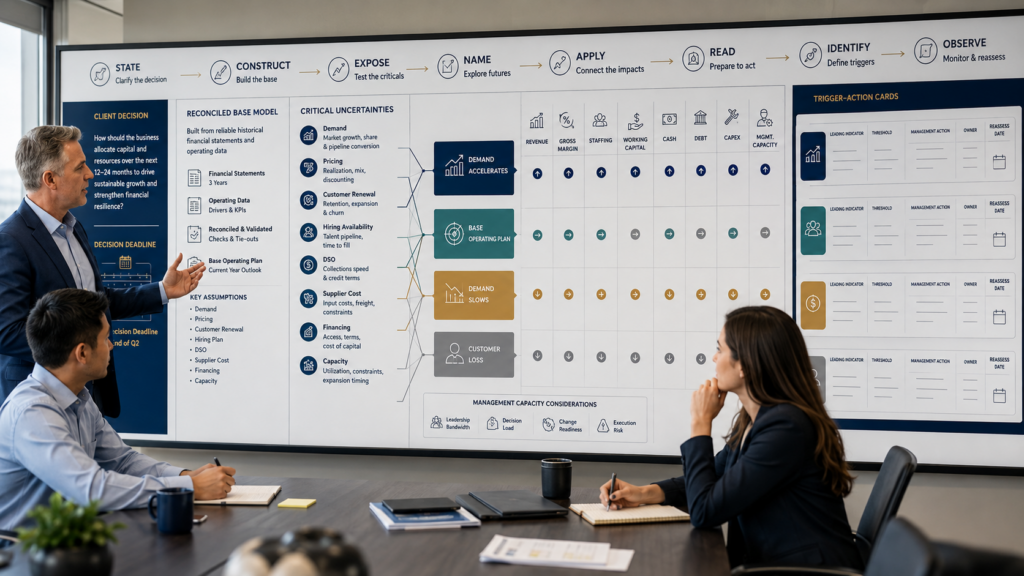
The SCENARIO Framework
S-C-E-N-A-R-I-O
S — State the Decision and Decision Window
Define what management is deciding, who owns the decision, what deadline matters, and which constraints cannot be ignored.
C — Construct the Reconciled Base Case
Start with a reliable model and the current expected path before changing assumptions.
E — Expose Critical Drivers and Uncertainties
Identify the small number of assumptions capable of changing the economics or the decision.
N — Name Plausible Alternative Futures
Build coherent stories rather than arbitrary percentage changes.
A — Apply Integrated Financial Effects
Flow scenario assumptions through profit, working capital, cash, debt, tax, capacity, and other relevant outputs.
R — Read Thresholds, Triggers, and Second-Order Effects
Find the point where the decision changes, a constraint breaks, or management must respond.
I — Identify Actions and Contingency Moves
Define what management will accelerate, delay, freeze, finance, cut, or escalate under each scenario.
O — Observe Actuals and Update
Track which leading indicators are moving, refresh assumptions, and retire scenarios that are no longer decision-relevant.
Define the Decision and Decision Window
Scenario planning without a decision becomes storytelling
Start by writing:
- What decision is management considering?
- Who makes it?
- When must it be made?
- What conditions would make one option unacceptable?
- What information could arrive before the deadline?
Examples
Hiring: Should the company add three client-service professionals in October?
Pricing: Should management raise price 6 percent across the customer base or target selected segments?
Expansion: Should the company sign a five-year lease for a second location?
Financing: Should management use cash, debt, or staged capex for a new production line?
Customer concentration: How should the company prepare if its largest customer renews at lower volume, renews unchanged, or does not renew?
Define the no-go conditions
Examples:
- Minimum cash below $500,000
- Debt covenant headroom below management’s buffer
- Manager span above eight direct reports
- Break-even later than month 18
- Contribution margin below 30 percent
Construct the Reconciled Base Case
A scenario model built on weak history produces sophisticated noise
Before creating alternative futures:
- Reconcile historical financial statements
- Identify unusual periods
- Separate one-time events
- Understand seasonality
- Define operational drivers
- Document the current forecast assumptions
Use one base case—not three different spreadsheets
The scenario architecture should generally use one model with controlled assumption changes.
This reduces:
- Formula drift
- Version problems
- Inconsistent logic
- Review time
The base case is an expectation, not “truth”
Label it clearly:
Base case = management’s current expected operating path based on the information available today.
Read Financial Modeling Training for Accountants for building the driver-based and three-statement architecture underneath scenario planning.
Expose Critical Drivers and Uncertainties
Not every assumption deserves a scenario
Focus on variables with both:
- Material financial effect
- Meaningful uncertainty
Common uncertainty categories
- Demand
- Price realization
- Customer retention
- Labor availability
- Wage inflation
- Collections
- Supplier pricing
- Interest rates
- Financing availability
- Tax law
- Regulation
- Technology adoption
- Capacity
- Transaction timing
Separate controllable and uncontrollable uncertainty
Controllable:
- Hiring timing
- Pricing decisions
- Capex timing
- Distribution policy
- Marketing spend
Less controllable:
- Customer loss
- Economic demand
- Input price shock
- Interest-rate movement
- Regulatory change
Use leading indicators
Each critical uncertainty should have an observable signal where possible.
Examples:
- Pipeline conversion
- Backlog weeks
- Proposal volume
- Customer renewal status
- DSO
- Staff turnover
- Utilization
- Commodity price
- Interest-rate index
Build Coherent Scenarios
Name scenarios by business condition—not emotional label
Instead of:
- Best
- Base
- Worst
consider:
- Demand Accelerates
- Base Operating Plan
- Large Customer Reprices
- Hiring Constraint
- Collection Slowdown
- Demand Contraction
Write the scenario narrative first
Example:
Large Customer Reprices: The largest customer renews at 15 percent lower volume and requests a 3 percent price concession. The company reduces contractor use, freezes two planned hires, maintains core management headcount, and increases sales spend to diversify the customer base. DSO remains unchanged.
Now model it.
Use internally consistent assumptions
If volume falls sharply:
- Does variable labor fall?
- Does gross margin change?
- Does working capital release cash?
- Does management reduce capex?
- Does sales expense increase?
A scenario should contain management response
There are two useful versions:
Unmitigated scenario: What happens if the event occurs and management does nothing?
Mitigated scenario: What happens after the planned response?
The difference quantifies the value and limitations of the contingency plan.
Apply First- and Second-Order Financial Effects
First-order effect
Customer loss reduces revenue.
Second-order effects
- Gross margin changes
- Variable labor changes
- AR falls
- Cash changes
- Capacity opens
- Marketing spend increases
- Hiring changes
- Debt need changes
Upside scenarios also have second-order costs
Faster demand can create:
- Overtime
- Contract labor
- Recruiting cost
- Receivables growth
- Inventory investment
- New equipment
- Management bottlenecks
Connect the scenario through the statements
When material, model:
- Income statement
- Balance sheet
- Cash flow
- Debt
- Capex
- Tax
- Owner distributions
Do not stop at EBITDA
A scenario that improves EBITDA but produces a working-capital or financing crisis can still be a bad operating path.
Read Cash Flow Advisory Training for Accountants for connecting scenarios to liquidity and KPI Advisory Training for Accountants for choosing leading indicators and thresholds.
Read Thresholds, Triggers, and Decision Breakpoints
The most useful output may be a threshold—not a forecast number
Examples:
- If backlog remains above 10 weeks for six consecutive weeks, accelerate hiring.
- If DSO exceeds 52 days, pause owner distributions.
- If pipeline conversion falls below 22 percent, delay the second location.
- If gross margin falls below 34 percent, activate the pricing and vendor-cost review.
Use trigger-action pairs
| Indicator | Trigger | Action | Owner |
|---|---|---|---|
| Backlog | >10 weeks | Open two approved positions | COO |
| DSO | >52 days | Weekly collections review | Controller |
| Minimum cash | Projected <$500K | Delay discretionary capex | CEO / CFO |
Distinguish warning trigger from action trigger
A leading indicator may require closer monitoring before it requires a major operating decision.
Use Sensitivity Analysis Correctly
Sensitivity analysis answers: “Which variable matters most?”
AFP describes sensitivity analysis as changing one variable while holding others constant to observe its effect on an outcome.
Useful variables include:
- Price
- Volume
- Gross margin
- DSO
- Headcount
- Interest rate
Use two-way sensitivity tables for paired assumptions
Example:
Price change across columns and volume change down rows.
Find the break-even threshold
Instead of asking:
“What happens if revenue falls 10 percent?”
ask:
“How far can revenue fall before minimum cash is breached?”
Use sensitivity to design scenarios
If the model is highly sensitive to DSO but barely sensitive to office rent, build a collection scenario before spending hours on rent assumptions.
Use Stress Testing Correctly
Stress tests are intentionally adverse
Examples:
- Largest customer leaves
- Revenue drops 25 percent
- DSO increases 25 days
- Interest rate rises 300 basis points
- Hiring fails for six months
- Key supplier cost increases 20 percent
Stress testing should reveal failure modes
Ask:
- When does cash become negative?
- When is the covenant breached?
- When does capacity fail?
- When must management act?
Do not confuse stress with “most likely downside”
The purpose is resilience, not probability forecasting.
Turn Scenarios Into Contingency Playbooks
A scenario without a response is incomplete
For each material scenario, define:
- Leading indicator
- Trigger
- Immediate action
- Decision owner
- Cash impact
- Communication plan
- Reassessment date
Build actions before the crisis
Examples:
- Approved hiring sequence
- Capex deferral list
- Available credit capacity
- Customer diversification campaign
- Pricing response
- Contractor pool
- Expense reduction tiers
Contingency plans should preserve options
Do not create only “cut everything” plans.
Some scenarios require:
- Accelerating investment
- Securing financing
- Adding capacity
- Locking supplier terms
How to Run a Scenario-Planning Client Meeting
1. Start with the decision
Do not open with a 40-page model.
Open with:
“The decision we are trying to make today is whether to commit to the second location before the lease deadline.”
2. Confirm what management currently expects
Summarize the base case in plain language:
- Demand
- Price
- Hiring
- Collections
- Capex
- Financing
3. Identify the assumptions management is least certain about
Ask:
- Which assumption would you be least comfortable guaranteeing?
- Which external event would change your plan fastest?
- What constraint worries you most?
- What would make you reverse the decision?
4. Compare scenarios by decision outputs
Do not compare every line item.
Focus on:
- Revenue
- Operating profit
- Minimum cash
- Financing need
- Break-even timing
- Capacity
- Decision threshold
5. Ask what management would do
“If this scenario begins to emerge, what action are we willing to take?”
6. Assign triggers and owners
Every important contingency should have an owner.
7. Schedule the refresh
Scenario planning becomes useful when it enters the management cadence.
Create an Assumption Register
Do not bury assumptions inside formulas
| Assumption | Base | Alternative | Source | Owner | Confidence |
|---|---|---|---|---|---|
| Revenue growth | 12% | 5% / 20% | Pipeline + contracts | VP Sales | Medium |
| DSO | 43 days | 55 days | Historical aging | Controller | High |
| Hiring ramp | 90 days | 150 days | Recent hires | COO | Medium |
Include confidence
A model assumption can be precise numerically and weak evidentially.
Assign assumption ownership to the business
Finance should challenge assumptions, but operating leaders should own the assumptions they control.
Observe Actuals and Refresh the Scenarios
Scenario planning is not an annual workshop
Refresh when:
- Actual results differ materially from the base case
- A leading indicator crosses a warning threshold
- A major customer changes behavior
- Financing terms change
- A material tax or regulatory event occurs
- Management changes the decision
Retire scenarios that no longer matter
If a customer signs a three-year renewal, the “customer exits next quarter” scenario may become less decision-relevant.
Create new scenarios when new uncertainty appears
Do not keep last quarter’s scenarios because the slides are already built.
Compare scenario assumptions with actual results
This is a training opportunity.
Ask:
- Which assumptions were directionally wrong?
- Which leading indicators gave early warning?
- Which second-order effect did we miss?
- Which planned action worked?
Seven High-Value CPA Advisory Applications
1. Hiring and capacity
Model:
- Demand growth
- Hiring timing
- Ramp period
- Productivity
- Manager capacity
- Cash
2. Pricing
Model:
- Price increase
- Volume response
- Customer churn
- Gross margin
- Mix
3. Cash and working capital
Model:
- Collections slowdown
- Inventory growth
- Supplier terms
- Capex
- Financing availability
4. Strategic tax planning
Model alternative business decisions before deadlines, including the tax and cash consequences of timing, investment, compensation, retirement, transactions, or other planning choices.
Read Strategic Tax Planning Training for Accountants.
5. Exit planning
Model business outcomes under:
- Continued ownership
- Management transition
- Customer concentration reduction
- Owner-dependence reduction
- Different growth paths
Read Exit Planning Training for Accountants.
6. M&A and acquisition analysis
Model:
- Base business
- Synergy realization
- Integration delay
- Customer loss
- Debt service
- Working capital
Read M&A Advisory Training for Accountants.
7. Business valuation support
Scenario analysis can help test:
- Growth assumptions
- Margin assumptions
- Owner dependence
- Customer concentration
- Capital requirements
Formal valuation conclusions remain specialist work where applicable.
Read Business Valuation Training for Accountants.
AI and Scenario Planning
AI can expand the scenario set quickly
Useful applications include:
- Generating alternative scenario narratives
- Identifying overlooked second-order effects
- Summarizing scenario differences
- Drafting trigger-action matrices
- Testing model logic
- Preparing management questions
AI can also create false plausibility
A generated scenario can sound sophisticated while relying on:
- Unsupported market assumptions
- Invented probabilities
- Incorrect tax or regulatory claims
- Business relationships that do not exist
- Data the client never provided
Use AI to widen questions, not to outsource judgment
Journal of Accountancy reported in May 2026 that 75 percent of senior finance leaders in a cited KPMG survey were actively using AI in finance, compared with 30 percent two years earlier. As AI expands, accountants need stronger model governance and interpretation skills—not less.
Source: AI for CPAs: From efficiency tool to decision engine.
How Managers Should Review Scenario Work
Review the decision
Can the manager state the decision in one sentence?
Review the base model
Does history reconcile? Does cash link? Do working-capital assumptions behave correctly?
Review scenario coherence
Ask:
- Why do these assumptions change together?
- What management response is included?
- What second-order effects are missing?
Review the range
Are the scenarios meaningfully different without becoming fantasy?
Review the triggers
Can management observe the trigger before it is too late to act?
Review the recommendation
The output should explain:
- What management can do now
- What management should monitor
- What would change the recommendation
Read Reviewer Calibration for CPA Firms for creating consistent review standards and Feedback Training for Accounting Managers for coaching judgment without recreating the model.
Worked Example: Should the Client Hire Ahead of Demand?
Illustrative example only: The figures below demonstrate scenario-planning logic. They are not staffing, industry, financing, or business-performance benchmarks.
A professional-services client is considering hiring six employees in October to support expected growth next year.
Base operating facts
- Current annual revenue: $9.2 million
- Current EBITDA margin: 17 percent
- Current cash: $1.1 million
- Management minimum cash: $650,000
- Current DSO: 44 days
- New-hire annualized payroll and burden: $510,000
- Expected productive ramp: four months
Scenario 1: Demand Accelerates
Assumptions:
- Revenue growth: 20 percent
- Backlog remains above 10 weeks
- DSO remains 44 days
- All six hires start in October
- Productivity ramp occurs as expected
Outcome:
- Capacity becomes the primary constraint.
- Hiring early protects service levels.
- Cash remains above management’s minimum.
Scenario 2: Base Operating Plan
- Revenue growth: 12 percent
- DSO: 46 days
- Six hires start in October
- Ramp is one month slower than expected
Outcome:
- Hiring remains supportable.
- Cash headroom narrows.
- Management should monitor backlog and collections monthly.
Scenario 3: Demand Slows
- Revenue growth: 4 percent
- DSO: 52 days
- Six hires begin as planned
- Ramp is two months slower
Outcome:
- Cash falls below the management minimum.
- Utilization declines.
- The staffing commitment is too early under this scenario.
Scenario 4: Large Customer Loss
- One major customer exits in January
- Revenue falls 9 percent versus current year
- Management freezes the last three hires
- Contract labor is reduced
- Sales investment rises
Outcome:
- Mitigation reduces the cash impact but does not fully offset the revenue loss.
- The action plan matters almost as much as the scenario itself.
One Hiring Decision Produces Four Different Liquidity Outcomes
Illustrative training figures only. Bar lengths are scaled to the example and are not empirical benchmarks.
The decision changes from “hire or do not hire” to a staged decision
The adviser recommends:
- Approve all six roles conceptually.
- Open the first three positions now.
- Open the next three when backlog remains above 9 weeks for six consecutive weeks.
- Pause expansion if projected minimum cash falls below $650,000.
- Escalate collections action if DSO exceeds 50 days.
The value of scenario planning is not choosing the “correct” scenario.
It is giving management an action structure that works across several plausible outcomes.
The Scenario-Planning Capability Dashboard
Decision quality
- Decision stated clearly
- Decision owner identified
- Decision window identified
- No-go thresholds documented
Scenario quality
- Base case reconciled
- Critical uncertainties identified
- Scenarios internally coherent
- Second-order effects included
- Management responses modeled
Assumption quality
- Source documented
- Business owner identified
- Confidence assessed
- Leading indicator identified
- Refresh date assigned
Action quality
- Trigger defined
- Action defined
- Owner assigned
- Cash impact understood
- Contingency ready
Development quality
- Models completed independently
- Scenario errors caught in review
- Manager rebuild time
- Client presentation readiness
- Actual-to-scenario learning captured
A 90-Day Scenario Planning Implementation Plan
Days 1–30: Build the firm’s scenario-planning standard
- Define scenario, sensitivity, stress-test, and contingency terminology
- Create a base-case model standard
- Create an assumption register
- Create a scenario narrative template
- Create trigger-action matrices
- Define model-review checks
- Define client-meeting outputs
- Create version-control rules
- Choose three initial client use cases
Deliverable: One repeatable scenario-planning method across managers and teams.
Days 31–60: Train through realistic cases
- Hiring ahead of demand
- Customer concentration
- Pricing
- Working-capital slowdown
- Expansion
- Financing
- Tax-planning decision
Deliverable: Independent models and client conversations scored against shared standards.
Days 61–90: Pilot on live advisory decisions
- Select clients with reliable data and a real decision window
- Build base case
- Identify two to four material scenarios
- Run the client meeting
- Agree on triggers and actions
- Refresh the model when actuals arrive
- Measure whether the decision or timing changed
Deliverable: Evidence that scenario planning changes client decision quality—not just spreadsheet complexity.
Read Accounting Advisory Proposal Template for scoping scenario-planning work, meeting cadence, client responsibilities, assumptions, and change control.
The Complete 30-Day Scenario Planning Training Curriculum
Days 1–5: Planning foundations
- Forecast vs. scenario
- Sensitivity vs. scenario
- Stress testing
- Contingency planning
- Decision windows
- Thresholds
Evidence: Concept test and scenario classification exercise.
Days 6–10: Base-case integrity
- Historical tie-outs
- Driver-based modeling
- Three-statement logic
- Working capital
- Cash
- Assumption documentation
Evidence: Reconciled base model.
Days 11–15: Scenario construction
- Critical uncertainties
- Scenario narratives
- Linked assumptions
- First-order effects
- Second-order effects
- Management responses
Evidence: Four coherent scenario cases built from one model.
Days 16–20: Sensitivities, thresholds, and stress
- One-way sensitivity
- Two-way sensitivity
- Break-even analysis
- Minimum cash
- Covenant headroom
- Stress cases
Evidence: Decision-threshold matrix.
Days 21–25: Action and communication
- Trigger-action pairs
- Contingency playbooks
- Scenario meeting facilitation
- Executive outputs
- Assumption challenge
- Client recommendation
Evidence: Recorded client scenario meeting.
Days 26–30: Independent capstone
- Receive an unfamiliar client decision
- Define the decision
- Build the base case
- Select critical uncertainties
- Create scenarios
- Run sensitivities
- Define triggers
- Present recommendation
- Respond to manager challenge
Evidence: Complete SCENARIO package and 100-point scorecard.
The 30/60/90-Day Live-Work Progression
Days 31–60: Controlled analytical responsibility
The learner may:
- Update historical and base models
- Maintain assumption registers
- Build approved scenario cases
- Run sensitivities
- Prepare trigger dashboards
- Draft meeting materials
Managers retain high-impact scenario design, technical assumptions, client recommendations, specialist conclusions, and significant financing, tax, valuation, or transaction judgments.
Days 61–90: Scoped client-facing responsibility
Expand responsibility when the learner can:
- Distinguish scenario from sensitivity
- Identify the critical uncertainty
- Build coherent linked assumptions
- Explain cash and second-order effects
- Identify decision thresholds
- Communicate a trigger-action recommendation
- State assumptions and limitations clearly
After day 90: Increase complexity—not ambiguity of authority
More advanced learners can support acquisition, valuation, tax, financing, and strategic scenarios under appropriate manager and specialist oversight.
100-Point Scenario Planning Readiness Scorecard
| Capability | Points | Observable Evidence |
|---|---|---|
| Decision definition | 10 | States the decision, owner, window, constraints, and thresholds before modeling |
| Base-case integrity | 12 | Uses reconciled financials and a model that behaves consistently |
| Critical uncertainty identification | 12 | Focuses on assumptions with material decision impact and meaningful uncertainty |
| Scenario coherence | 14 | Builds plausible linked assumptions rather than arbitrary percentage changes |
| Integrated financial effects | 12 | Captures profit, working capital, cash, debt, capacity, and second-order consequences |
| Sensitivity and stress testing | 10 | Uses the correct tool for breakpoints, uncertainty, and resilience |
| Triggers and contingency actions | 12 | Defines observable triggers, actions, owners, and timing |
| Assumption governance | 8 | Documents source, owner, confidence, leading indicator, and refresh date |
| Client communication | 6 | Explains alternative futures and recommendations without implying certainty |
| Refresh discipline | 4 | Updates scenarios as actuals and new information change the decision landscape |
Suggested readiness rule: Require at least 86 points overall, no zero category, a reconciled base model, no scenario built from unexplained hard-coded assumptions, and manager review before high-impact client decisions rely on the analysis.
15 Realistic Scenario Planning Training Scenarios
Scenario 1: Hire Ahead of Demand
Management expects 18 percent growth and wants to add six people now. The learner must build demand, ramp, cash, and delayed-hire alternatives.
Scenario 2: Customer Concentration
A customer representing 27 percent of revenue is entering renewal. Build unchanged, repriced, reduced-volume, and lost-customer cases.
Scenario 3: Price Increase
The owner wants a 7 percent price increase but assumes zero churn. The learner must model price, volume, mix, margin, and customer response.
Scenario 4: Collection Slowdown
Revenue remains on plan while DSO rises by 15 days. The learner must identify the cash and financing effect.
Scenario 5: New Location
The base plan is profitable, but a slower ramp creates a minimum-cash breach.
Scenario 6: Supplier Cost Shock
A key input cost rises 18 percent. Management can raise price, renegotiate, substitute, or absorb margin.
Scenario 7: Interest-Rate Change
The client is considering variable-rate debt and asks what higher rates would do to cash and covenant headroom.
Scenario 8: Tax Planning Decision
A capital purchase has operating, cash, depreciation, and tax implications. The learner must coordinate with the tax team rather than optimize one dimension in isolation.
Scenario 9: Owner Exit Timeline Changes
An owner originally planning a five-year exit now receives an unsolicited offer. The scenario set must change.
Scenario 10: Acquisition Synergies
Management assumes all projected cost savings occur immediately. The learner must model delayed and partial synergy realization.
Scenario 11: AI Investment
The client assumes new AI software reduces headcount by 20 percent immediately. The learner must model adoption, implementation, controls, and transition costs.
Scenario 12: Capacity Constraint
Demand accelerates, but manager capacity is already at the limit. The “upside” scenario creates service-quality and cash risks.
Scenario 13: Forecast Becomes Outdated
Actual Q2 revenue is 12 percent below plan. The learner must decide whether to refresh the scenario set rather than defend the old budget.
Scenario 14: One Variable Disguised as a Scenario
A senior presents revenue at +10%, 0%, and -10% with every other assumption unchanged. The learner must redesign the cases into coherent futures.
Scenario 15: Client Wants a Prediction
The client asks, “Which scenario do you think will happen?” The learner must communicate current evidence, confidence, triggers, and action without false certainty.
Each scenario should require the learner to state the decision, identify critical uncertainty, build coherent assumptions, quantify second-order effects, define triggers, recommend actions, and explain limitations.
What the Firm Should Measure About Scenario Planning
| Metric | What It Reveals |
|---|---|
| Scenario engagements with clearly defined decisions | Whether modeling starts with a real client question |
| Base cases tied to reconciled data | Reliability of the modeling foundation |
| Material assumptions with owners and sources | Assumption governance |
| Scenarios containing second-order effects | Analytical maturity |
| Scenarios with trigger-action pairs | Conversion from analysis to operating readiness |
| Scenario refresh cycle time | Ability to adapt when facts change |
| Repeated review corrections | Where learner judgment remains weak |
| Manager rebuild hours | Whether scenario capability is transferring |
| Client decisions changed or staged | Practical decision impact |
| Contingency actions activated as designed | Whether planning survives contact with reality |
Read Project Management Training for Accountants for managing scenario inputs, action owners, deadlines, and dependencies and Client Profitability Analysis for Accounting Firms for evaluating whether scenario-heavy advisory work is commercially sustainable.
Common Scenario Planning Mistakes
Mistake 1: Starting with best/base/worst labels
The labels encourage arbitrary numbers instead of coherent business conditions.
Mistake 2: Building scenarios before defining the decision
The team generates analysis with no decision relevance.
Mistake 3: Using unreconciled history
The future model inherits historical errors.
Mistake 4: Changing only revenue
Margin, working capital, staffing, capex, and management actions remain unrealistic.
Mistake 5: Treating the upside as automatically good
Growth can create capacity and cash problems.
Mistake 6: Treating the downside as “cut costs”
The model ignores sales investment, financing, pricing, or other strategic responses.
Mistake 7: Confusing sensitivity with scenario analysis
The team changes one input but claims it has modeled an alternative business future.
Mistake 8: Assigning invented probabilities
Precision creates false confidence when the underlying estimate is weak.
Mistake 9: Modeling scenarios with no trigger
Management cannot recognize when to act.
Mistake 10: Building no contingency response
The exercise describes risk but does not improve readiness.
Mistake 11: Ignoring second-order effects
The model captures revenue loss but not working-capital release, staffing, or financing effects.
Mistake 12: Creating too many scenarios
Management cannot focus on the handful that matter to the decision.
Mistake 13: Never refreshing the scenarios
Old uncertainty remains in the deck after new facts have resolved it.
Mistake 14: Letting AI create unverified scenarios
Generated assumptions sound plausible but are not grounded in the client’s business.
Mistake 15: Presenting scenario planning as prediction
The accountant overstates what the model can know.
Frequently Asked Questions About Scenario Planning Training for Accountants
What is scenario planning training for accountants?
It teaches accountants to identify uncertainties around a client decision, build multiple plausible operating futures, quantify their financial consequences, define triggers and contingency actions, and refresh the analysis as actual events unfold.
What is the difference between scenario planning and forecasting?
A forecast represents the current expected path. Scenario planning evaluates multiple plausible paths and the decisions management may need to make under each.
What is the difference between scenario analysis and sensitivity analysis?
Sensitivity analysis typically changes one or a small number of variables while holding others constant. Scenario analysis changes a coherent set of linked assumptions to represent an alternative future.
What is the difference between scenario planning and stress testing?
Scenario planning considers plausible alternative futures. Stress testing deliberately applies severe adverse conditions to find where the plan or financial structure breaks.
What is contingency planning?
Contingency planning defines the actions management will take when a specified scenario, risk, or trigger begins to occur.
How many scenarios should accountants build?
Enough to represent the materially different futures that could change the decision. For many client decisions, three to five well-designed scenarios are more useful than a large collection of minor variations.
Should scenarios have probabilities?
Only when there is a defensible basis for those probabilities. Otherwise, use the scenarios to understand conditions, ranges, thresholds, and actions without implying unsupported precision.
What makes a scenario coherent?
The assumptions fit the same business story. If demand falls, the model should consider related effects on price, margin, staffing, working capital, capex, financing, and management response where relevant.
What is a scenario trigger?
A trigger is an observable threshold or event that causes management to monitor more closely, change the plan, or activate a contingency action.
What are leading indicators in scenario planning?
They are observable measures that can signal which scenario is emerging before the full financial outcome appears, such as backlog, pipeline conversion, customer renewal status, DSO, utilization, or staffing turnover.
Can accountants use scenario planning for tax advice?
Yes, scenario modeling can support strategic tax planning by comparing alternative business actions and timing, but tax conclusions should be reviewed under the appropriate tax engagement and professional standards.
Can scenario planning be used in M&A and valuation?
Yes. It can test assumptions around growth, margins, synergies, customer concentration, working capital, integration, and financing. Formal valuation, transaction, legal, and specialist conclusions remain subject to appropriate professional scope.
Can AI create scenarios for accountants?
AI can help generate alternative narratives, identify second-order effects, summarize differences, and challenge assumptions. Accountants still need to validate client facts, data, business logic, confidentiality, technical conclusions, and scenario plausibility.
How often should scenarios be refreshed?
Refresh frequency should match the decision and volatility. Some cash or operational scenarios may need weekly or monthly updates; strategic scenarios may be refreshed quarterly or when a major assumption changes.
What financial statements should a scenario model include?
Include the statements and schedules needed to answer the decision. High-impact growth, financing, capex, or liquidity decisions often require integrated income statement, balance sheet, cash flow, working capital, debt, and capex schedules.
How should CPA firms train junior accountants in scenario planning?
Begin with forecasting and financial-model integrity, then teach critical uncertainties, linked scenario assumptions, sensitivity analysis, stress testing, trigger-action design, client communication, and controlled live-work application.
What is the biggest scenario-planning mistake?
Treating scenarios as numbers rather than decisions. The useful output is not only what the financial result changes to, but what management should do, when it should act, and what evidence should trigger that action.
How does scenario planning differ from scenario-based training?
Scenario planning is an advisory method used to model alternative client futures. Scenario-based training is a learning method that puts accountants into realistic situations so they can practice judgment and communication.
Can Your Staff Model What Changes the Decision—and Tell the Client What to Do Before the Trigger Arrives?
SkillAbility helps accounting firms develop technical execution, advisory judgment, client communication, manager capability, and leadership readiness through structured practice, scenarios, feedback, and measurable development pathways.
Book Your Free 10-Minute Structural Alignment Review →
Includes our 45-Day Out-of-Pocket Performance Guarantee.
To helping clients decide before uncertainty becomes fact,
Vincent Howard, CPA
Managing Partner, Howard, Howard and Hodges
SkillAbility for Accounting Firms
About the Author
Vincent Howard, CPA has practiced public accounting since 1990. He earned a Bachelor of Science in Accounting and a Master’s in Taxation from the University of Central Florida, founded his accounting firm in 1993, and serves as Managing Partner of Howard, Howard and Hodges. He helped grow the organization from three people to approximately 50 staff across multiple Florida locations and states. He has participated in PASBA since 1997, and the firm was named PASBA Firm of the Year in 2015. Since 2020, he has built and run the SkillAbility accounting workforce development platform, used by more than 1,000 accounting professionals across dozens of PASBA firms.
© 2026 SkillAbility for Accounting Firms. This article provides general educational information and does not replace accounting, audit, tax, valuation, financing, investment, legal, professional-liability, strategic, or other qualified advice. Scenario models depend on assumptions and can differ materially from actual outcomes. Firms should tailor the model, engagement scope, specialist involvement, review, confidentiality, and client communication to the actual decision and applicable professional obligations.