
By Vincent Howard, CPA | Managing Partner, Howard, Howard and Hodges | Skillability for Accounting Firms
Last updated: 2026 | 13-minute read
The Short Answer (TL;DR)
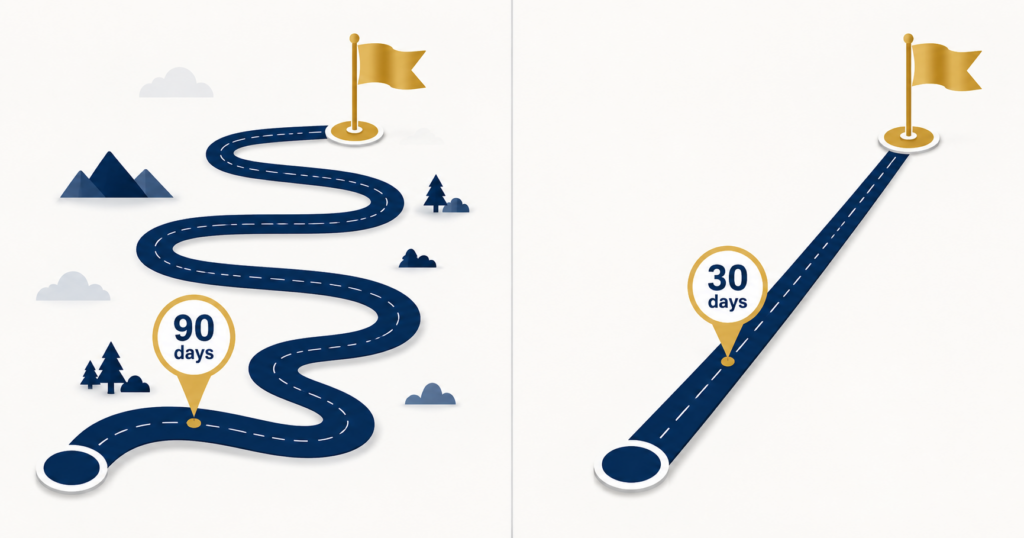
Most new accounting hires take 60–90 days to reach independent productivity — not because they’re slow or under-qualified, but because the firm’s onboarding leaves them to absorb the job through observation, scattered questions, and trial and error. Ramp-up time is a system property, not a personality trait: it’s determined by how the firm transfers knowledge, not by how capable the hire is. Firms that replace observation with structured, execution-based training — where the new hire processes a full simulated client year in the actual software before touching a live file — compress that 60–90 day ramp to under 30 days, and surface a genuine mis-hire in the first week instead of the first quarter. If your new hires take a quarter to become useful, the bottleneck is your onboarding system, not your hiring.
I spent a decade blaming the wrong thing for slow ramp-up. Here’s what’s actually going on — and how to fix it.
Who I Am and Why You Should Listen
I’ve practiced public accounting since 1990. I founded my own firm in 1993, merged it in 2001 to form Howard, Howard and Hodges, and grew it from three people to 50 staff across four locations and multiple states. The firm was named PASBA Firm of the Year.
For years I assumed slow ramp-up was a hiring problem. If a new staff accountant was still asking basic questions in month two, I figured we’d hired the wrong person. Then I started measuring it — and discovered that the same firm, hiring comparable people, produced wildly different ramp times depending entirely on who happened to train them and how busy that person was. The variable wasn’t the hire. It was us.
Since 2020 I’ve built and run a structured training platform that more than a thousand accounting professionals across dozens of PASBA member firms have completed. That dataset shows, in measured time, exactly how fast a new hire can reach productivity when the path is deliberate rather than accidental. Everything below comes from that — my own firm’s mistakes first, then the patterns that repeat across every firm we work with.
What Does “Time to Productivity” Actually Mean in an Accounting Firm?
Time to productivity is the span between a new hire’s start date and the point at which they can perform their core work independently — processing a client’s books, preparing a return, running a payroll cycle — without a senior person checking every step. It’s the moment the hire stops being a net drain on the firm’s capacity and starts adding to it.
At most firms, that moment arrives 60 to 90 days after the start date when onboarding runs on informal shadowing. With structured, execution-based training, it commonly arrives in under 30 days. That gap — two months of a salaried employee not yet contributing, while also consuming a senior’s time — is one of the most expensive and least examined numbers in firm operations.
The Cost of a Slow Ramp
Run the math. A new hire who takes 90 days instead of 30 to reach independence represents two extra months of salary paid against little or no billable output — plus the senior time consumed supervising them through that stretch. If a senior billing $200 an hour spends even 40 hours over those first two months hand-holding, that’s $8,000 of vaporized billable capacity on top of the salary drag, before you count the errors that get written off while the hire is still learning.
And the slow ramp has a second, quieter cost: it hides mis-hires. A candidate who interviewed well but can’t execute will coast inside an observation-based onboarding for weeks, because watching doesn’t expose inability. By the time the gap becomes undeniable, you’ve invested a quarter of salary, supervision, and morale into someone who was never going to work out — a verdict the right system delivers in days.
Why New Hires Ramp Slowly: Five Real Causes
When ramp-up drags, the reason is almost never the hire’s raw ability. It’s one or more of these five structural causes.
1. They’re learning by watching instead of doing
The default onboarding method — sit the new hire next to a senior and have them observe — is the slowest way humans acquire a procedural skill. Watching someone reconcile an account does not build the ability to reconcile an account; only reconciling accounts does. Observation-based onboarding delays the one activity that actually creates competence: hands-on repetition.
2. The learning is unstructured and out of sequence
Under shadowing, a new hire learns whatever the client work in front of their trainer happens to involve that week. They might hit payroll in week one and not see a year-end close for two months — or never, until it’s suddenly live and high-stakes. There’s no logical build from fundamentals to complexity, so knowledge arrives in random fragments that take far longer to cohere into capability.
3. Their trainer is distracted and busy
The person training the new hire is usually your most capable senior — which means they’re also your busiest. They train in fragments, between their own deadlines, often during the exact season when they have the least time to spare. The hire’s questions queue up behind the trainer’s real work, and learning stalls in the gaps. Nobody is being trained well, and a $200-an-hour professional is being consumed doing it badly.
4. There’s no objective measure of where they actually are
Without assessment, neither the hire nor the firm knows what the hire can really do. Progress is a senior’s vague impression formed between deadlines. Gaps go undetected until they surface as errors on live client work — which means the hire is “productive” on paper long before they’re actually reliable, and the firm absorbs the difference.
5. The same foundational gaps never get closed
Because nothing verifies mastery before moving on, foundational weaknesses persist quietly. The hire who never quite understood a particular workflow in week two is still shaky on it in month three, just better at hiding it. Unmeasured onboarding lets gaps compound instead of closing them, which is why some hires seem to plateau short of full independence and never quite get there.
Slow Ramp vs. Fast Ramp: What Changes
| Factor | Slow Ramp (Observation-Based) | Fast Ramp (Structured) |
|---|---|---|
| How they learn | Watching a senior work | Doing the work themselves, gated step by step |
| Sequence | Random — whatever client work comes up | Deliberate — fundamentals to complexity |
| Coverage | Only what they happened to encounter | A full simulated client year, every scenario guaranteed |
| Trainer load | 40+ hours of senior time | Near zero — the system teaches and grades |
| Time to independence | 60–90 days | Under 30 days |
| Mis-hire detection | 60–90 days (subjective) | 3–7 days (objective data) |
| What “ready” means | A senior’s gut feeling | Demonstrated competence on real work product |
How to Compress Ramp-Up Time
Ramp-up time is a system property, so you change it by changing the system — not by hiring “faster learners.” Four moves, in order of impact.
Step 1 — Replace observation with execution
Have new hires do the work from day one — processing real sample client data in your actual software — rather than watching someone else do it. Hands-on repetition is the only thing that builds procedural competence, so the faster you get them executing, the faster they ramp. This single change does more than any other.
Step 2 — Put the learning in a deliberate sequence
Structure the path so the hire builds from fundamentals to complexity in a logical order, and guarantee coverage of every scenario they’ll eventually face — not just the ones that happened to come up. A new hire should hit the year-end close, the quarterly payroll filings, and the unusual adjustments in training, on purpose, rather than discovering them live for the first time on a real client.
Step 3 — Gate progression on demonstrated mastery
Require the hire to demonstrate competence — through assessment on their own work product, at a meaningful threshold — before advancing. Gating does two things at once: it closes foundational gaps instead of letting them compound, and it gives you objective data on exactly where the hire is, so “ready for client work” becomes a fact rather than a hope.
Step 4 — Take it off your seniors’ plates
When the system teaches and grades, your senior staff are freed from the 40-hour hand-holding tax. Their involvement shrinks to a readiness review at the end — which means ramping a new hire no longer means stalling a senior’s billable work. You compress the hire’s ramp and recover the trainer’s capacity at the same time.
The result is a fundamentally different employee arriving at their first real client: one who has already processed a complete client year, been verified at every step, and built genuine competence — in weeks, not the quarter that observation-based onboarding takes to deliver someone merely “less likely to need help.”
“Some Roles Just Take Time to Learn”
True — and structured training doesn’t pretend complex judgment forms overnight. What it compresses is the foundational ramp: the mechanical execution, the software fluency, the standard workflows that make up the bulk of a new hire’s first months and that observation teaches so slowly. Get the foundation built in weeks instead of a quarter, and the genuinely time-intensive part — developing professional judgment — starts sooner and rests on solid ground. You’re not rushing mastery; you’re removing the avoidable delay that sits in front of it.
Frequently Asked Questions
How long should it take a new accountant to become productive?
With informal, observation-based onboarding, most new staff accountants and bookkeepers take 60–90 days to reach independent productivity. With structured, execution-based training inside the firm’s actual software, that compresses to under 30 days — typically two to three weeks to process a full simulated client year before touching a live file. The difference is determined by the onboarding system, not the hire’s ability.
Why is my new hire not productive after two months?
The most common cause is observation-based onboarding: if the hire has spent two months watching a senior rather than doing the work themselves, they haven’t had the hands-on repetition that actually builds competence. Other structural causes include unstructured learning that arrives out of sequence, a busy trainer who can only teach in fragments, and the absence of any objective measure of what the hire can actually do. These are system problems, not hiring mistakes.
How can I speed up new hire ramp-up at my accounting firm?
Replace observation with execution — have new hires do real work in your actual software from day one; put the learning in a deliberate fundamentals-to-complexity sequence that guarantees coverage of every scenario; gate progression on demonstrated mastery so gaps close instead of compounding; and move the teaching into a structured system so your seniors aren’t consumed by it. Firms making these changes routinely cut ramp time from 60–90 days to under 30.
Is slow ramp-up a hiring problem or a training problem?
Almost always a training problem. The same firm hiring comparable people will produce very different ramp times depending on who trains the hire and how busy that person is — which means the variable is the onboarding system, not the candidate. Slow, inconsistent ramp across multiple hires is strong evidence the system, not the people, needs fixing.
How does structured training detect a mis-hire faster?
Because it produces objective data. When a hire works through gated modules assessed on their own work product, a genuine inability to execute surfaces in the first few days — the data makes the gap undeniable to everyone, including the hire. Under observation-based onboarding, the same discovery takes 60–90 days, because watching doesn’t expose inability the way doing does. Faster detection means you stop investing salary and supervision in a hire who won’t work out.
What is a reasonable time to train a new bookkeeper?
With structured, execution-based training, two to three weeks of full-time work produces a bookkeeper who has processed a complete simulated year — twelve months of financials, reconciliations, sales tax returns, quarterly payroll filings, and year-end W-2/1099 work — inside the firm’s actual software, verified at every gate. With informal shadowing, the equivalent baseline independence typically takes 60–90 days, and often longer.
The Bottom Line
If your new hires take a quarter to become productive, the instinct is to question your hiring. The data says question your onboarding. Ramp-up time is set by how a firm transfers knowledge — the sequence, the hands-on repetition, the verification — not by how naturally gifted the hire is. Observation-based onboarding is simply the slowest available method, dressed up as tradition.
Replace it with execution, sequence, gating, and a system that runs without consuming your seniors, and the same hires you have now reach independence in weeks instead of months — while genuine mis-hires surface in days instead of a quarter. The slow ramp isn’t the cost of doing business. It’s the cost of an onboarding system you can change.
Want to know your firm’s real ramp time — and what it’s costing you?
Book Your Free 10-Minute Structural Review →
In ten minutes we’ll calculate what your current ramp-up actually costs per hire, show you where the delay is built into your onboarding, and walk you through a structured pathway that gets new hires productive in under 30 days — inside the software your firm already uses, through the BASE → MAPS → Summit development pathway.
Backed by the Skillability Performance Guarantee: put your next hires through our system — if it doesn’t improve your onboarding, we’ll refund your investment.
To your firm’s capacity,
Vincent Howard, CPA
Managing Partner, Howard, Howard and Hodges
Skillability for Accounting Firms
Vincent Howard, CPA has practiced public accounting since 1990. He holds a Master’s degree in Taxation, leads a 50-person multi-state firm, and built the Skillability training platform used by accounting firms nationwide through the PASBA network — the source of the 1,000+ trainee dataset referenced in this article. Howard, Howard and Hodges was named PASBA Firm of the Year and has offices in Lake Mary, Sarasota, and Winter Springs, Florida.